Lipce village council
The PeasantsLipce village council belongs to a village administration whose formal responsibilities are entangled with personal influence and whose authority is repeatedly tested by collective action. The novel shows it not as a self-contained institution, but as one part of a contested local order: money and official decisions pass through administrative channels, while villagers insist that neither the manor nor public officials can simply override their interests.
Administrative Authority and Public Money
The council appears within a local chain of responsibility that also includes the cashier and Notary. During a dispute over the Voyt’s conduct, one villager points out that the Voyt does not control the funds alone: the cashier, Notary, and council are involved as well. The remark complicates accusations of individual wrongdoing without settling who bears responsibility. In the villagers’ view, however, shared oversight does not remove the burden on them: they fear that they will be made to pay for failures by those entrusted with public administration.
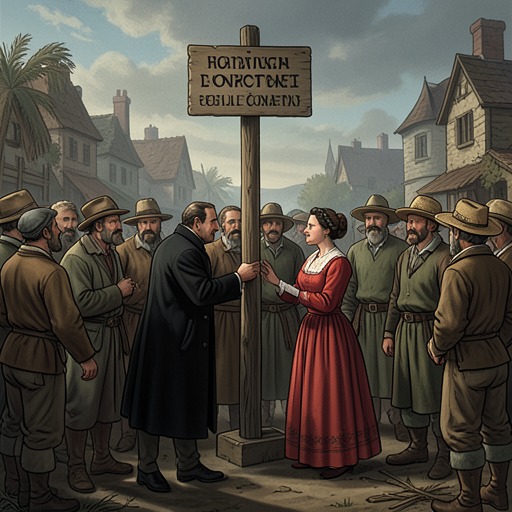
That tension is sharper because the Voyt’s office combines practical influence with public accountability. In a dispute involving the Kozioł family, he uses persuasion, flattery, and vodka to gather witnesses, while many villagers support him because he holds office and can sometimes be useful. The episode suggests that the council’s institutional setting does not make village politics impersonal: office, favors, reputation, and access to help all affect how public disputes unfold.
Customary Rights and Forest Mobilization
The villagers’ claims over pasture and woodland show why formal administration cannot be separated from questions of land and livelihood. One complaint insists that pasturage is clearly entered in the register, yet villagers continue to drive others away and claim the ground as their own. The speaker’s account links the dispute to concrete losses: a cow has died after being driven hard, other animals have been chased off, and a boy has been beaten. Registration, in this telling, has not ended the contest over who may use the land.
The same conflict over rights widens into a confrontation with the manor over timber at Wolf’s Hollow. Boryna counts his own four morgen and Jagna’s one as part of what the village stands to lose, and declares that the villagers will not accept being wronged. At a crowded gathering outside the inn, people wait for the elders to fetch him because they regard him as the village’s leading farmer. The blacksmith and miller try to dissuade the crowd, warning that it may end in imprisonment, but villagers distrust their ties to the manor and ignore them.
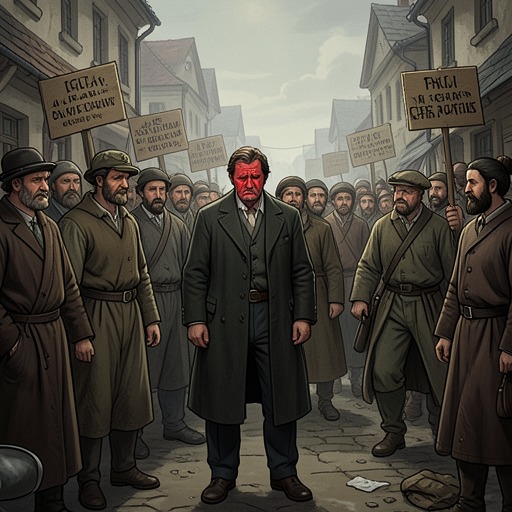
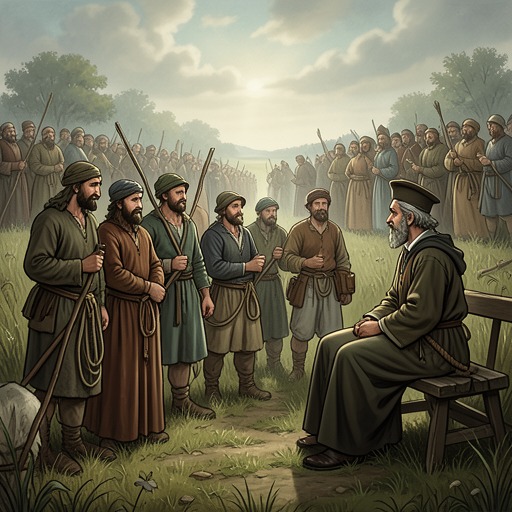
Boryna’s speech turns accumulated grievances into a call for common action: the manor is felling the villagers’ forest, refusing them work, and repeatedly driving them toward ruin. The crowd answers by setting out together, armed with poles, pitchforks, flails, and, in some cases, scythes. At the forest, Boryna leads them toward the woodcutters and demands that workers from Modlica and Rzepki leave. This is not depicted as an operation directed by the council. Rather, it shows villagers claiming a political authority of their own when they believe formal channels have failed to protect their rights.
Livelihood, Representation, and Collective Welfare
The dispute over employment makes the limits of official decision-making a matter of immediate survival. At least twenty hired workers in Lipce are described as desperate for work; winter has brought snow and frost, potatoes have frozen for some, and families are already eating a hot meal only once a day or going to bed hungry. Villagers had expected the manor’s felling to provide wages, but the Squire refuses to hire local men, apparently in response to a complaint lodged against him. Boryna stands by the complaint and refuses to let the trees be cut until the villagers reach an agreement over what they consider theirs.
A wider account of village hardship exposes another weakness in collective governance: proximity does not guarantee mutual aid. Poor households lack potatoes, bedding, credit, and help with work while men are imprisoned and fields stand fallow. The account contrasts this need with better-off farmers’ concern for their own food and lending returns, and observes that the poor are left to divine care while their neighbors turn away. The council is not shown solving this crisis; its significance lies in the institutional and communal gap between shared village life and effective support for those in greatest need.
Schooling and the Limits of Official Consent
The proposed school in Lipce and Modlica provides a further test of who may speak for the village. The governor summons the Voyt to the powiat, where a meeting is to approve the school. Villagers oppose the proposal in part because they expect a new tax for every morgen, as in Doły. At the later meeting, although most present are leaning toward voting against the school, the Notary’s imperious requests receive no response: when he calls for someone to come over, no one moves; when he orders a messenger to the manor for fish, a villager replies that they did not come to run errands.
The scene does not establish a settled council decision. It instead reveals a struggle over the meaning of participation: officials expect compliance, while villagers withhold even routine cooperation and contest the legitimacy of a decision that would impose costs on them. Across disputes about public money, forest rights, employment, and schooling, Lipce village council stands within a fractured system of local authority. Its formal presence matters, but so do the villagers’ willingness to resist, their suspicions of officeholders, and the distance between administrative procedure and the protections they expect.