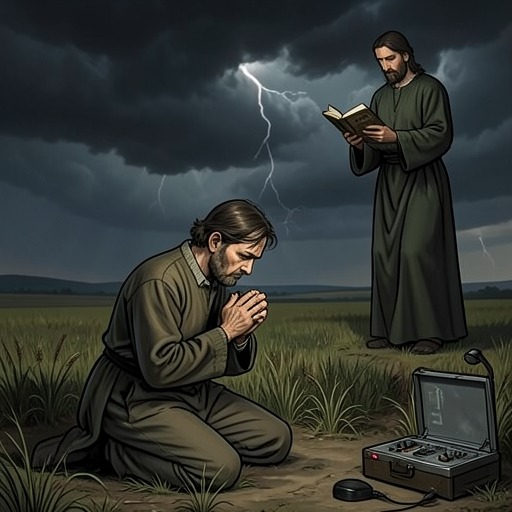
Lipce’s “apparatus” (urządzenie)
The PeasantsLipce’s “apparatus” (urządzenie) names the village’s deeply internalized sense that the world has a fixed order, one that cannot meaningfully be altered. The concept links everyday religious language and beliefs about land to social hierarchy and political passivity: arrangements shaped by history come to feel sacred and inevitable. In this reading, the apparatus does not operate only through explicit rules or force. It works most powerfully when the community experiences its norms as simply the way things are.
Definition and structure
The concept begins with a distinction between the rural community’s apparent autonomy and its limited readiness to understand its historical and economic circumstances. The peasants endure poverty and injustice, while noble patriots remain politically active, but the community’s prevailing conviction is that the world’s ordering is essentially unchanging. The repeated term urządzenie, ordinarily meaning an ordering or arrangement, is interpreted as more than a description: it evokes a system capable of directing conduct, opinions, and discourse. Its influence is therefore cultural and habitual as well as material.
The apparatus becomes most complete when people internalize its worldview as their own. A social norm acquired through historical processes is treated as sacred and timeless, rather than as a human arrangement that might be contested. The transformation of the historically made into something apparently beyond history is described as a kind of sacrifice: the profane becomes sacred. This helps explain why injustice can persist without being defended at every moment by an obvious authority. People themselves may reproduce the beliefs that make the existing order seem unavoidable.
Three pillars support this system in the world of the characters: religion, land, and language. The evidence develops religious belief and land most concretely. They appear together in the opening greeting, “Praised be Jesus Christ!”, which the parish priest addresses to Agata as she leaves to beg. The novel closes with Agata’s farewell, “Go with God, dear people.” The recurring religious formula frames the narrative, but it also carries an implication of helplessness: blessing and commending people to God do not resolve the inequality and violence that shape their lives.
Land and the appearance of inevitability
Land gives the apparatus a material foundation. At the end of the nineteenth century, rural capitalism and competition for land sharpen differences within the peasant stratum. Farmers possess land, while the village proletariat—hired hands and tenants, or komorniki—must lodge with others and go out to earn or serve. Witek states the divide directly: “Only farmers have land, the rest lodge and go out to earn, or take a place as servants.” The difference is not merely a matter of status; it organizes security, work, and access to the village’s resources.
The apparatus makes such disparities appear less like changeable social arrangements than like a permanent law of existence. When Kuba, a farmhand, accepts a zloty reward from the priest for hunting a partridge, he is moved by the kindness and says, “Only the priest respects ’un, only him!” At church he then pushes toward the front, a place occupied by the prominent farmers. Boryna explains that Kuba has disturbed the established order: “That’s how the world is ordered, it is, and your head won’t change it.” The scene makes hierarchy visible as a lived custom, enforced through ordinary conduct as well as formal power.
Boryna’s explanation turns social rank into a claim about the limits of individual agency. The apparatus is not simply an abstract idea imposed from above; it appears in the expectations people use to correct one another. The land-owning farmer’s position at the front of the church and the laborer’s exclusion from it become signs of a broader structure. Kuba’s brief attempt to occupy a different place exposes that structure precisely because the other farmers react as though the boundary were self-evident.
Poverty, piety, and the limits of assistance
Agata’s circumstances show how this ordering bears on old age and property. After signing her property over to her children, she is driven out to beg and earn a living in order to pay her relatives for her care. The priest recognizes her need and diffidently places a zloty in her hand. Yet this personal act of charity does not alter the arrangement that has left her dependent and destitute. It offers momentary relief while leaving the underlying terms intact.
The same tension appears in Kuba’s gratitude for the priest’s reward. The priest’s kindness matters to Kuba, but it does not undo the hierarchy that Boryna defends. In this reading, philanthropy can even reinforce the system when individual generosity substitutes for a challenge to the conditions producing need. Charity answers a particular hardship without changing who owns land, who must work for others, or who is entitled to social precedence.
Boryna’s exchange with Rocho makes the logic of resignation explicit. When Rocho suggests that people could help one another, Boryna rejects responsibility for others’ hunger as impossible for one person and assigns such care to the priest. Rocho answers that one person can do a great deal. Boryna replies with an image of futility: “Just try carrying water in a sieve and you’ll see how much you fetch – that’s how it is with poverty.” He then presents unequal fortunes as divinely settled: “That’s how God has ordered it, seems to me, and how it will stay, that one man has enough, and another catches the wind.” Religious language here converts an economic condition into an apparently ordained fact.
Resignation, resistance, and narrative form
The belief that events could not be otherwise recurs beyond Boryna’s words. When Hanka seeks Rocho’s advice about Jagna, Rocho tells her to leave the matter to the Lord Jesus; when Antek asks the priest whether he should flee to America to avoid imprisonment, the advice is to place himself in Providence’s hands and wait for God’s mercy. These responses differ in circumstance, but both direct people away from decisive intervention and toward endurance or divine care. The novel’s account of the apparatus therefore concerns not only what characters say about society, but also the practical limits placed on action when resignation is accepted as wisdom.
The narrative frame reinforces that sense of a world whose order precedes any one episode. Its opening and closing religious greetings bracket the story, while the first scene already discloses the affair between Antek and Jagna, Jagna’s exceptional beauty and wealth, and Jagustynka’s prediction that a woman like her might be driven from the village. Details central to later events appear amid the everyday movement of the scene, rather than as signs that the established order is about to be overturned. The effect is not that nothing happens, but that conflict repeatedly unfolds inside arrangements the community has learned to regard as settled.
Jagustynka provides a counterpressure. Her blunt social criticism exposes family secrets and the hypocrisy of community leaders, and her judgments challenge the pretence that customary morality is impartial. Her frankness makes visible what the apparatus tends to conceal: the order is sustained by human choices, interests, and unequal burdens, even when its members speak of it as natural. The concept thus holds together the novel’s durable social hierarchy and the moments of speech that reveal its construction, without suggesting that exposure alone is enough to dismantle it.