Lipce’s commune school vote
The PeasantsLipce’s commune school vote turns a local decision about education into a test of who commands the village meeting. With most villagers leaning against the school, the notary’s attempt to redirect them to a manor errand meets collective stillness and a blunt refusal: the assembly has not gathered to serve someone else’s household.
The school proposal and its costs
The vote concerned a commune school, intended to serve several villages rather than Lipce alone. Under the applicable arrangements described in the explanatory note, establishing such a school was paid for by the local population. The decision therefore asked villagers to weigh a shared educational institution against a direct local financial burden; the available evidence does not establish the amount of that burden or the final result of the vote.
The note also places the proposal in a setting where village schools were uncommon: in 1899, only 17 percent of village children attended them. That later figure supplies historical context for the institution’s rarity, not a statistic voiced by the villagers during the meeting. The episode itself shows the choice being argued over as a practical communal obligation.
Debate in the village square
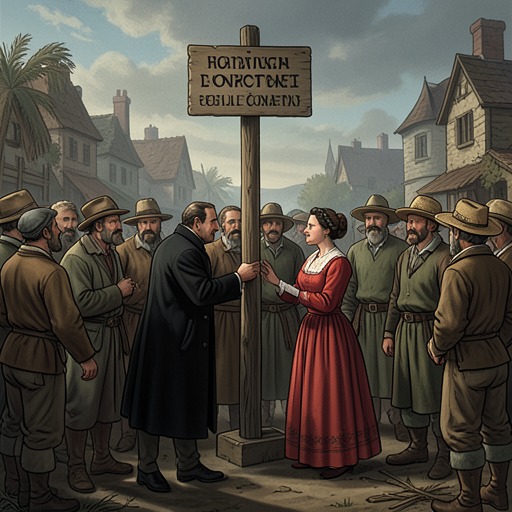
Despite the noonday heat, villagers remained scattered across the square, where their debate grew increasingly loud and fierce. The majority was inclining toward a vote against the school, but the scene records a developing preference rather than a completed ballot. The choice remained under discussion, and the assembly’s conduct matters as much as its apparent leaning.
The notary called from a window for someone to come over. No one moved. He then ordered a villager to hurry to the manor for fish that had supposedly been expected that morning. Again, the crowd did not respond. A bold voice answered that they had not come to run messages. The contrast is pointed: the notary speaks imperiously, as though the gathering and its members are at his disposal, while the villagers hold their place and refuse the diversion.
Civic meaning and limits
The villagers’ silence is not proof that they approved the school, nor does the episode disclose the vote’s outcome. It does show that they could act together, at least momentarily, by withholding the response the notary expected. The refusal converts a routine summons into a dispute over the purpose of the assembly and the villagers’ right to deliberate for themselves.
The episode’s force lies in the collision between a public decision and an attempted private command. The school would entail a cost shared by local people; the notary’s errand, by contrast, would make the meeting answer to the manor’s immediate needs. By declining to move, the villagers keep their attention on the question before them and make their collective presence felt without yet resolving the question by ballot.