Lipce’s land agreement with the squire
The PeasantsLipce’s land agreement with the squire was a proposed settlement to a conflict over woodland, livelihood, and the village’s claim to a secure place in the local landscape. It promised a way to exchange disputed forest resources for fields and building timber, but the villagers’ meeting made clear that the offer itself was not enough: they also had to decide whether the squire’s promises could be trusted and whether a divided community could negotiate on common terms.
Causes and stakes
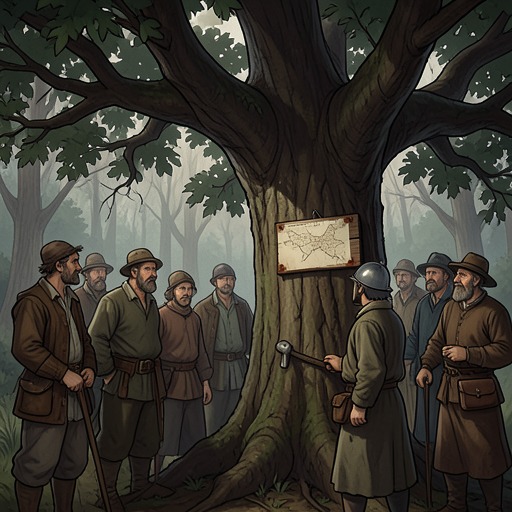
The negotiations followed a period of escalating conflict over the manor’s control of land and forest. Villagers complained that customary pasturage was being denied to them; one account describes a cow dying after it was chased from the grazing ground, and puts the loss at three hundred zlotys. Maciej Boryna, looking across the forest, counted four morgens as his and another morgen as Jagusia’s, and believed that the villagers were being wronged by the manor’s claims. For him, the forest was not an abstract asset: it was connected to landholding, livelihood, and what he regarded as a right belonging to the farmers.
Forest access was also tied to employment. In winter, at least twenty hired hands in Lipce were desperate for work. Some households had already lost potatoes to frost, while others faced empty meals, no income, and the prospect of a lean preharvest season. Villagers had expected that the squire’s felling at Wolf’s Hollow would provide work, but he had reportedly resolved not to hire anyone from Lipce after a complaint was lodged against him with the commissioner. The dispute therefore joined two urgent demands: recognition of the villagers’ claims and the chance to earn wages before spring.
The villagers had already tried formal complaints and legal recourse without success. In the forest mobilization, Maciej Boryna presented the felling as the latest injury in a longer sequence of confiscations and grievances, arguing that the manor’s actions left the community no effective remedy. The proposed arrangement at Podlesie offered a different route: instead of confronting the squire over every disputed tree, the villagers might obtain fields and timber through a negotiated exchange. That prospect mattered especially in a community where land, housing, and seasonal work were all precarious.
The proposal at the inn
The negotiations took shape in a crowded inn, where Lipce’s younger men and several farmers gathered to hear the terms. Grzela, with the blacksmith and other young villagers at the head of the discussion, chalked the proposal onto the table and marked out how the land might be divided. As he presented it, the squire had promised each peasant four fields at Podlesie in return for a morgen of woodland, with the same amount of land to be released again in installments. The squire was also said to be willing to provide wood on credit for cottages.
The chalk marks turned a general promise into a visible scheme of allocation. Grzela was not simply urging the villagers to trust that land would somehow become available; he was showing how much might fall to each person and how the distribution could work. The proposed exchange thus had a practical appeal: fields would answer the need for land, while credit for cottage timber might help families establish or repair homes. Yet the detailed map remained Grzela’s account of what the squire had promised, not proof that the terms had been secured in writing.
Płoszka resisted the growing enthusiasm. He warned the meeting not to trust the squire until the agreement existed in black and white, pointing to a history in which the manor had profited from the villagers’ grievances. His insistence exposed a central risk in the offer: even if its terms sounded advantageous, the community might surrender woodland without receiving the promised land. Kłąb objected that Płoszka should not prevent others from agreeing, and the disagreement widened into a noisy quarrel. The dispute was no longer only between the village and the manor; it was also between villagers who wanted to seize a possible opportunity and those who feared that an unwritten promise would repeat an old injustice.
Persuasion and apparent agreement
The argument gradually shifted toward acceptance. The blacksmith spoke forcefully in favor of the squire’s honesty, and the group drank together as the discussion continued. Jankiel brought vodka to the table; the blacksmith repeatedly supplied the company with vodka, beer, and flavored arak. As the villagers drank and debated, nearly all but Płoszka began to lean toward agreement. The conviviality helped contain the quarrel, but it did not settle the question Płoszka had raised: whether the terms could be relied upon without a written guarantee.
The blacksmith’s advocacy also carried a qualification in the narration: he was apparently making a tidy profit from the arrangement. That detail complicates his role as a persuasive spokesman. He was not necessarily arguing from the same position as every farmer who stood to gain fields or every poor household hoping for timber and work. The meeting’s apparent consensus therefore rested amid unequal interests as well as genuine expectation.
The discussion nevertheless moved from debate toward action. When Hanka asked whether there would be an agreement with the squire, she was told that there would be, and that five men had gone to see him that very day. The priest welcomed the prospect and offered to say Mass for the intention of reaching agreement without charge. Michał the blacksmith proposed that the village contribute together for a votive Mass and Exposition, treating the promised redistribution as a cause worthy of collective religious observance. The exchange joined practical negotiation to communal ritual: the villagers sought both a material settlement and divine favor for its success.
Meaning and limits of the settlement
The proposal’s significance lay in its attempt to convert a forest dispute into a redistribution of usable land. That was a substantial change from the earlier pattern of complaint, failed recourse to the courts, and direct resistance to felling. Yet the deal remained dependent on the squire’s performance and on the villagers’ ability to maintain a united position. Płoszka’s demand for written terms was not a refusal of land; it was a warning that an attractive allocation could still leave the community exposed if promises were not binding.
The agreement also revealed a tension within Lipce’s claims to solidarity. The villagers had invoked collective injury when opposing the manor’s felling and exclusion of local workers, but the Podlesie plan required them to consider how land would be divided and who could speak for the group. In the background stood the hired hands and impoverished families whose need for work and food was most immediate, alongside farmers debating property, woodland, and the terms of exchange. The plan could appear to offer a common benefit while distributing its risks and gains unevenly.
The episode ends with the negotiations apparently advancing: five villagers have gone to meet the squire, and the priest expects an agreement. It does not establish that the promise has been formalized or that the proposed distribution has been carried out. Its decisive movement is from collective grievance toward a concrete but still uncertain bargain, with the chalked fields on the inn table standing between hope for land and the villagers’ memory of promises that might again fail them.