Lipce’s polyphonic language and political community
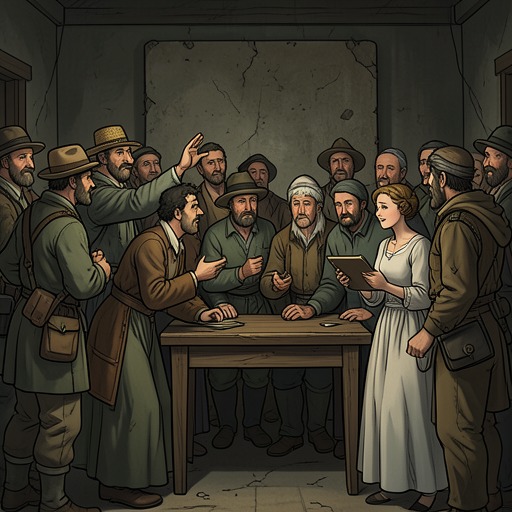
The PeasantsLipce’s polyphonic language and political community name the formal and political force of The Peasants: the novel makes a shared world audible not through one official voice, but through the friction and coexistence of different ways of speaking. Its shifting registers resist the idea that a community must submit to a single language in order to become intelligible. In that formal plurality, the novel imagines a political community of dissimilar people whose experiences can be expressed together without being made the same.
Language without a single authority
The novel’s Polish prose, as Ryszard Koziołek describes it, does not settle into one stable form. It is neither the literary language of its period nor a faithful transcription of the dialect of the Łowicz region. Instead, Reymont combines and reshapes opposing linguistic elements. The result is not a single peasant idiom set against a single literary one, but a syncretic language that changes its character as the narrative proceeds.
This variety has consequences for who appears to possess authority. If the peasants do not speak one language, no single discourse can order the novel’s world for them. The protean narrator has no exclusive idiom of its own; it activates different kinds of jargon and modes of expression. In doing so, the novel loosens the assumed bond between bureaucratic language, correct grammar, and the state that codifies it. Peasant speech is not presented as an imperfect version of a master language, through which the peasants must learn to understand their own lives. The novel instead treats their ways of speaking as expressions of their own ways of thinking.
Registers and voices
The translator’s note identifies three recurring narrative registers: a comparatively detached, omniscient voice that moves between dialect and formal literary style; the intimate, confiding voice of a village raconteur; and a stylized, expressionistic voice associated with the Young Poland sensibility, especially in natural description. Realistic dialogue among the peasants runs through these modes. The voices do not simply decorate a story told in one consistent tone: their alternation is part of how the novel represents village life.
The raconteur’s account of an encounter near Wolf’s Hollow demonstrates how an individual voice can shape an event. The speaker establishes his credibility by presenting himself as a farmer from a farming family, rather than a hired hand or town crook, then recounts hearing grunts while walking past Boryna’s clover after the Angelus. He describes searching the clover for a low, white, creeping creature with shining eyes, crossing himself, and fleeing because the hollow is known in Lipce as a haunted place. His wife confirms the story with an account of Sikora being grabbed and beaten there the year before. The scene combines personal testimony, prayer, fear, and communal lore; its oral cadence makes the tale belong to a speaker and a village, rather than to an impersonal report.
Another register emerges in the practical instruction about sharpening an axe. The speaker compares iron to a human being: one must discover what it likes in order to lead it. The advice is specific to a task, yet its figurative phrasing carries the texture of a mind speaking through work. Nearby, Antek joins Bartek in splitting logs, following the tar marks and working under Mateusz’s direction; the narration records both the bodily task and the sting of taking orders from someone he regards as socially beneath him. Such passages show how speech and circumstance meet: a voice is shaped not only by a speaker’s words but by the labor, status, and relationships in which those words are spoken.
Dialect, translation, and character
The translator cautions against treating Reymont’s language as an ear-witness record of one regional dialect. The original draws on dialect features as needed for effect and emotional response, rather than pursuing strict regional accuracy. It also avoids some conspicuous consonant changes that could turn comedy into mockery or parody. The peasants are therefore not one-dimensional figures of fun, and translation must not make them so by imposing a caricatured dialect.
The English translation seeks to convey the characters’ language through vocabulary and syntax, retaining their tendency toward parataxis where possible while avoiding pastiche. Its cadences, the translator says, are northern, roughly from the Pennines, but the aim is not to reproduce a particular English region as an equivalent of Lipce. The more important principle is that the peasants have a language of their own, rather than merely speaking someone else’s imperfectly. The translation’s choices thus preserve a distinction central to the novel’s social imagination: linguistic difference is not evidence of lesser thought or diminished personhood.
From formal plurality to political possibility
Koziołek distinguishes Jagna’s unwitting challenge to the community’s accepted social arrangements from the more consequential desecration performed by the novel’s language. Jagna cannot formulate a critique of the legal and economic abstractions that govern village life; her dissent emerges through emotion, rebellion, and desire. By contrast, the novel’s formal practice questions the supposedly immutable order of the world by placing different languages and registers beside one another. Its political action lies not in giving a single dissident voice command over the rest, but in disrupting the expectation that one voice must rule.
This matters against the pressure of a nationalistic project that would make political unity depend on linguistic uniformity. The novel’s orchestration of varied registers points instead toward a community of subjects who speak differently and yet undertake the common work of expressing their experiences. Their differences are not dissolved into a master language, nor are they rendered unintelligible by their coexistence. The possibility of community arises in the juxtaposition itself: language becomes a meeting ground where incoherent and dissimilar lives can be heard together, without an authoritative voice claiming to speak for all.