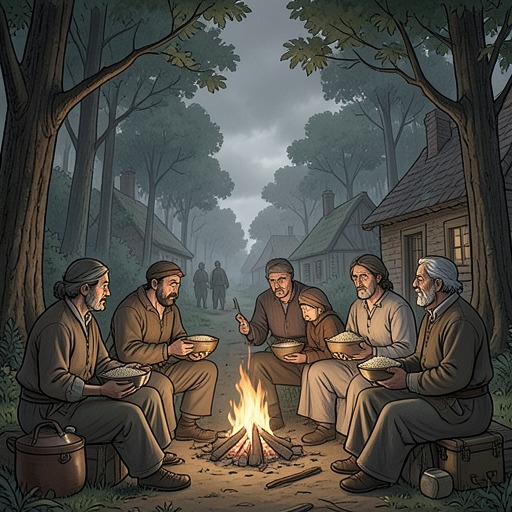
Lipce’s preharvest poverty and scarcity
The PeasantsLipce’s preharvest poverty and scarcity are not a single episode but a recurring pressure on village life, sharpened whenever food, work, or working hands run short before the harvest. Hunger reaches into homes and fields alike: families barter for potatoes, sell animals and household goods, and watch spring work accumulate while imprisoned men are absent. The hardship is endured collectively, but its costs fall most heavily on the poor, whose need is visible to their neighbors without reliably becoming a shared responsibility.
A lean winter and the promise of work
Before spring, the need for wages is already severe. At least twenty hired hands in the village are desperate for work; snow and frost have frozen some households’ potatoes, and money is not coming in. Some people eat a cooked meal only once a day and go to bed hungry. The prospect of the squire felling timber at Wolf’s Hollow woodland had seemed to offer employment to everyone, but the squire refuses to hire men from Lipce after a complaint has been lodged against him with the commissioner. For laborers who have counted on that work, the decision turns an anticipated source of income into another cause for alarm: the lean interval before spring is expected to become still more punishing.
The dispute is also framed as an injustice beyond the loss of wages. At a gathering, the grievance is linked to the manor felling the villagers’ forest while refusing them work and continuing to harry them. They have taken complaints to court and made appeals, but neither has brought relief. The anger in the gathering is collective, yet the material consequences of exclusion are especially stark for the households already without food or cash. The forest conflict and the scarcity crisis therefore meet at the question of who can claim a livelihood from local resources, and who is left to bear the cost when access and employment are denied.
Hunger inside the household
The human scale of deprivation emerges in the account of Filipka’s family. Her cottage is cold, its windows stuffed with straw; there is one bed, and the rest of the household crowds together in bedding. They have run out of potatoes and sold their quilt. To obtain groats, they must ask The Miller, while the people they approach are unwilling to lend or extend credit until harvest. Filipka’s eldest daughter is gravely weakened, not by a fatal illness as first feared, but by hunger. Her husband is in prison with the other men, leaving her with no ready means to provide for the household.
A second birth makes the strain still more concrete. Florka, ill and without savings, gives birth to a healthy boy, but she is thin and has no milk; the family’s cow is only just coming into calf. With Adam also imprisoned, there is no one to cook and the fields lie untilled. Hanka Borynowa hears of these troubles while herself burdened by grief and household conflict. When she speaks of the poor, she does not reduce their suffering to an abstraction: the empty pantry, sold bedding, cold cottage, and hungry children make scarcity a daily condition of survival.
The deprivation is also a question of neighbors’ obligations. Hanka Borynowa observes that well-supplied farmers worry over their meals and lending at interest while poor families may die close by without disturbing anyone’s sleep. Poverty is left to God’s care, even as those with full bowls and warm sheepskins protect themselves from hearing complaints. The account names people who might be able to help, including The Miller, The Parish Priest, and the organist, but the existence of possible assistance is not the same as a dependable system of relief. Against that indifference, Hanka Borynowa’s own assistance to Filipka—potatoes given in exchange for work—shows a limited, practical response to need.
Spring without enough hands
The imprisonment of the men turns scarcity into a labor crisis just as the agricultural year demands work. Spring has arrived; the higher fields are drying, water is subsiding, and the earth is ready for ploughing, manure, and seed. But the working men are in jail. Women are left to manage the farms without enough strength or time for everything, while some are due to give birth and livestock are calving, hatching, and farrowing. Gardens need sowing and planting; potatoes must be sorted from storage, water drained from fields, manure lifted and carted, animals watered and fed, and wood split and carried. Children also require care. By evening, the women are exhausted, and the most consequential work—the fields—still waits.
The contrast between the land’s readiness and the villagers’ capacity to work gives the crisis its particular force. The earth is drying under spring sunshine and rain, winter wheat is growing, and the skylark and storks return to the fields. Yet renewal in nature does not itself feed the people or cultivate the soil. With the men absent, the season’s promise becomes a demand placed on women already carrying domestic, agricultural, and caregiving labor. The fallow ground is not simply a sign of poor harvest prospects; it registers the human cost of imprisonment and the limits of the labor left behind.
Barter, theft, and the approach of harvest
As the shortage persists, exchange is organized around immediate survival rather than spare cash. When Filipka asks for potatoes, Hanka Borynowa is told there is not a grosz in the cottage and that its people are dying of hunger. Hanka Borynowa allows Filipka a bushel to eat at once and makes any additional potatoes conditional on waiting until after planting, when it will be clearer how many remain. The arrangement offers help, but also shows how narrow the margin is: even a household with potatoes must reckon carefully with what can be spared before its own planting needs are met. The harvest is still far away, while scarcity is already pressing at people’s doors.
The theft of Filipka’s sow, which is about to farrow, strikes at the same fragile calculation. The animal is her only possession and the means on which she relies to survive until harvest. Her grief is so acute that she beats her head against the walls and runs to The Parish Priest with her lament. He gives her a rouble and promises a piglet from the litter expected later. This response provides immediate compassion, but the loss also makes clear how little separates a poor household from disaster: the sow is not surplus property but a planned source of subsistence, and its theft threatens the family’s ability to endure the remaining months.
At the fair in Tymów, preharvest need becomes public and visible as a procession of things being sold. Filipka takes six old geese, separated from their barely grown young, because her husband has fallen ill after returning and there is nothing to put in the pot. Other poor villagers lead a recently calved heifer, a milk cow, a sow with piglets, or an old horse to market. One man must sell his chestnut despite his family’s weeping because Balcerkowa is pursuing repayment of fifteen roubles borrowed for a cow. Farmers also bring what they can under pressure from taxes and threatened fines; women carry eggs, butter, poultry, woollen skirts, and linen. The journey to the fair is thus both a communal occasion and a liquidation of the means by which households might otherwise live. Its goods are not merely wares: they are food, breeding animals, clothing, and tools of future security offered up because the harvest has not yet come.
A recurring crisis and an uneven response
The narration presents hunger, illness, quarrels, and death as conditions the villagers recognize from other years, but it distinguishes the current danger by the fields left uncultivated. In the usual cycle, hardship is survived while work continues; now the absence of working hands threatens the production on which recovery depends. Scarcity therefore feeds upon itself: imprisonment removes labor, fallow land imperils the coming harvest, and the long wait drives households to sell livestock and possessions that might have sustained them.
Hanka Borynowa’s return to the farm gives this cycle a personal counterpoint. Looking across the fields in spring, she remembers hunger, troubles, grievances, Antek Boryna’s infidelities, and years of pain, then recognizes that she is back on the land. Her regained place does not erase the village’s poverty, but it marks a change in her own precarious circumstances: the farm is again a source of belonging and security after suffering. Across the wider community, however, relief remains uneven. Neighborly aid can arrive, as in the potatoes Hanka Borynowa shares or the assistance promised by The Parish Priest, but such acts answer particular needs rather than removing the causes of scarcity. The state is defined by that tension between mutual help and abandonment, and by the seasonal distance between present hunger and the harvest on which so many lives depend.