Maciej Boryna
The PeasantsMaciej Boryna stands at the center of the novel’s intertwined stories of marriage, inheritance, and village life. As Lipce’s wealthiest farmer, he commands a prosperous household, but his authority rests on land he refuses to surrender. His choices bind family relations to the farm’s survival and make his private conflicts part of the village’s wider struggle over property and power.
Identity and Household Authority
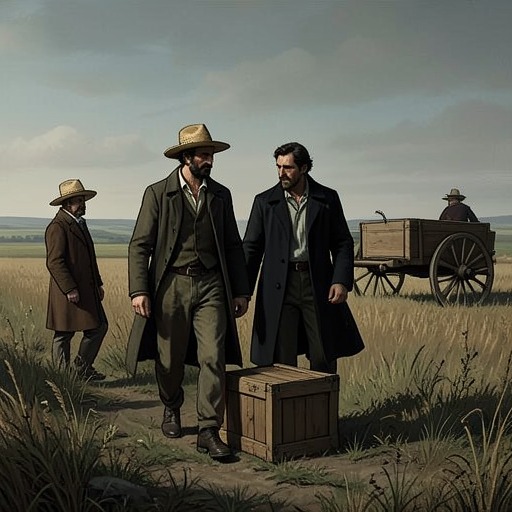
Maciej’s authority is expressed through daily supervision as much as through ownership. After changing into work clothes, he inspects the horses, cows, barn, and pigs, then rebukes Kuba for a misdeed and Witek for letting calves wander among the cows. Returning to the room, he finds his family waiting in silence. The scene presents him as a master of both land and household: farm work, discipline, and inheritance all converge in his presence.
That authority is most sharply tested by Antek’s expectation of inheriting land. Maciej rejects the idea of signing over even a single morgen and being pensioned off by his children. He insists that he will give up nothing while he is alive, and points instead to the possibility that Antek might farm at his father-in-law’s once Grzela returns from the war. The refusal is not merely a dispute about acreage: it leaves Antek’s future uncertain and makes Maciej’s continued command of the farm the immediate cause of their estrangement.
The novel places Maciej’s family story alongside the conflict over the forest, where the manor’s intended sale and felling threaten the peasants’ claims as co-owners. His household’s arguments over land therefore echo a larger question of who may control the resources on which rural life depends. In both settings, ownership is not an abstraction: it determines work, security, and the standing of those who live from the soil.
Marriage and Jagna’s Influence
The marriage to Jagna makes Maciej’s household both more prosperous and less secure. Their betrothal becomes village news, and at the wedding Jagna emerges from the storeroom in white, velvet, feathers, ribbons, silver, and gold. Her bridal appearance is so striking that the guests fall silent, and the narrator compares her to the sacred image carried in procession. The ceremony places her at the center of the household’s public transformation, not merely as a new wife but as a figure whose beauty reshapes the way others see Maciej.
That transformation reaches into everyday governance. Though still hard and unyielding toward other people, Maciej lets Jagna do as she pleases: he obeys her, sees the world through her eyes, and seeks her advice as well as Dominikowa’s. The farm prospers and remains orderly, while Jagna becomes the person to whom he turns for comfort and counsel. His attachment therefore appears to strengthen the household even as it unsettles his customary independence; the man who will not yield land to his children is unusually yielding to his wife.
The marriage is shadowed by Jagna’s connection with Antek Boryna. At Christmas, Maciej drives Jagna through the snow in a fast sleigh; when she catches sight of Antek, their eyes meet for an instant before the sleigh carries her away. Antek remains rooted in place, watching the red of her skirts and listening as the bells fade. The scene sets Maciej’s visible possession of a shared journey against the private recognition passing between his wife and son.
After a reconciliation with Jagna, Maciej changes course again. He takes her back without reproach, but then treats her as a servant rather than as his wife, disregarding her efforts to coax or anger him and making no attempt to guard her. The narration suggests that he knows of her meetings with Antek, though it does not establish what he knows or feels. His earlier devotion gives way to cold withdrawal: the marriage that had seemed to soften his authority becomes another arena in which possession, betrayal, and household power collide.
Forest Conflict, Final Sowing, and Legacy
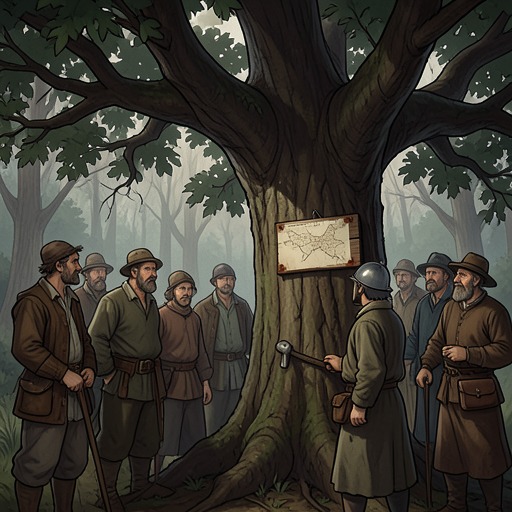
Maciej’s authority eventually moves from the household into the village’s public confrontation with the manor. When the manor’s men prepare to fell the disputed forest, he takes a leading place among the Lipce farmers. Pale and upright, he climbs onto logs by the inn and addresses farmers and hired hands together, naming the manor’s refusal to employ them and its long record of injuries before making the threatened felling the immediate issue. His speech turns private grievance into collective action: the forest is not simply timber for sale but a resource the peasants regard themselves as entitled to share.
The protest becomes a fight. The manor’s men resist with blows, and the peasants’ flails drive them back; when the steward rides into the crowd, Maciej tries to shield him and drag him to safety after the other men knock him from his horse. In the forest, Maciej grapples with the woodsman. The woodsman strikes him on the head with a gun butt, and Maciej falls bleeding. Antek is present; when his injured father opens his eyes and looks at him, a deep, quiet joy appears on Maciej’s face. The moment briefly alters the meaning of their feud: the father who had refused to yield land to his son meets him not across an inheritance dispute but at the point of bodily danger and possible death.
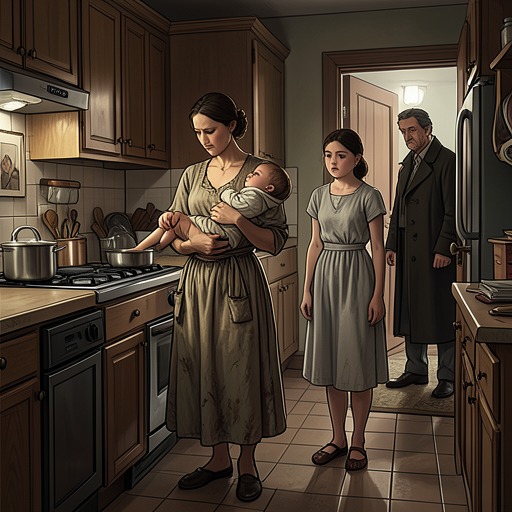
Maciej survives the blow, but his long incapacitation removes him from the work and decisions that once defined his place in the household. His decline is gradual. At times he seems unaware of those around him, calling for Jagna and taking her hands while his gaze remains fixed far away; to Hanka, even the movement of his lips seems to answer only the sound of her voice. During a brief return to awareness, he tells Hanka that money is hidden in the storeroom and urges her to conceal it. He also tells her to defend Antek, even if that means selling half the farm. The instruction joins the two concerns that had dominated his life—protecting property and securing the family’s future—but now places the farm’s defense in Hanka’s hands.
His final delirium returns him to the soil. After fretting and searching beside his bed, Maciej goes out to a patch of earth, kneels, and gathers soil into his shirt as if it were grain taken from a sack for sowing. He crosses himself, swings his arm, and scatters the earth. He falls and dies there. The act makes his last movement a farmer’s gesture: at the end of a life organized around land, labor, and inheritance, he appears to sow the ground itself.
At his funeral, the church fills with weeping as the first farmers lift his coffin and carry it toward a cart bedded with straw. Jagustynka secretly places a loaf wrapped in clean linen in the coffin’s wicker bed, hiding it from the priest. The burial gives Maciej a place in the village’s ritual order, while the question of his hard-won property remains a live family responsibility. The priest warns the heirs to divide the estate justly and in harmony, particularly protecting the orphans and paying anyone owed in full. Maciej’s legacy is thus measured not only in the farm he leaves behind, but in whether those who inherit it can avoid turning his labor into another cause of quarrel.
The Farmer Within Lipce’s Seasonal Economy
Maciej’s authority over a prosperous farm belongs to a village economy governed by the changing demands of the agricultural year. As winter approaches, Lipce households debate whether to sell cattle, grain, or smaller livestock, while needing to buy clothing, tools, and other farm necessities. Ready cash grows harder to find. This wider scarcity throws the meaning of Maciej’s property into relief: land and livestock are not simply signs of rank, but the means by which a household meets recurring needs and maintains its capacity to work.
The seasonal order also makes the farm dependent on available hands. After the men of Lipce are imprisoned, women face a crowded spring workload: tending livestock and children, preparing gardens and potatoes, draining fields, hauling manure and wood, and managing calving, hatching, and farrowing. Maciej’s incapacitation coincides with this broader labor crisis, when the ordinary work of keeping farms productive falls to those left behind. The contrast between his former supervision of animals and buildings and the household’s later dependence on Hanka underscores how much practical authority rests on the ability to act, not merely to own.
When spring work resumes, carts and ploughs move across the fields, and the villages’ renewed activity spreads through the landscape. That return to cultivation gives Maciej’s life its larger rural frame: his standing, family conflict, and legacy are all measured against the continuing cycle of work on the land. At his funeral, he is remembered as a farmer following his father and grandfather, placing his personal story within a lineage of cultivation. His estate passes into the hands of heirs, but the community’s insistence on a just division shows that inheritance is also a test of whether the labor sustaining a farm can survive without becoming another source of discord.