Marriage and property transactions
The PeasantsMarriage and property transactions in The Peasants turn household formation into a negotiation over land, security, labor, and social standing. The proposed marriage between Jagna and Maciej Boryna makes this connection especially visible: Dominikowa sees the match as a route to a protected place for her daughter and a substantial land settlement, while Maciej Boryna weighs that promise against the claims of his grown children and the value of his best fields. The arrangement is neither merely romantic nor simply financial; it places a woman’s future inside the same family economy that determines inheritance and farm survival.
Marriage as household security
The first discussion of a match takes shape through intermediaries and indirect approaches. Ambrozy raises the possibility of a widowed farmer who might send vodka, then describes an older man who could respect Jagna and settle property on her. When the prospective husband is identified as Maciej Boryna, the proposal is defended through his standing as a substantial farmer, his strength, and his local influence. His ability to help with official matters is also mentioned in connection with Jędrzych’s expected military service. Marriage is thus presented as a practical alliance that might provide more than a husband: it could bring Jagna into a prosperous household and connect her family to resources and assistance.
Dominikowa’s argument to Jagna combines material prospects with social pressure. She imagines her daughter as mistress of Maciej Boryna’s household, hopes that a portion will lie beside her own land, and raises the possibility of six morgen. She also insists that Jagna must marry rather than remain the object of village gossip. Jagna, by contrast, shows little interest in calculating portions or choosing among suitors. She says she will marry Maciej Boryna if her mother thinks it best, and her thoughts drift rather than settle on the proposed future. The mismatch matters: the mother treats marriage as a decision about security, standing, and land, while Jagna’s response suggests that those calculations have little hold on her.
Negotiating the settlement
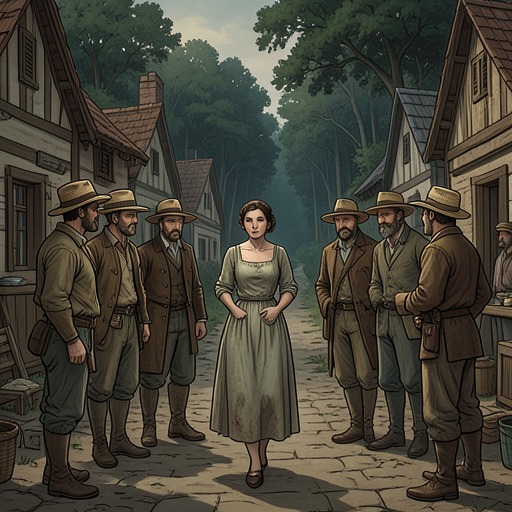
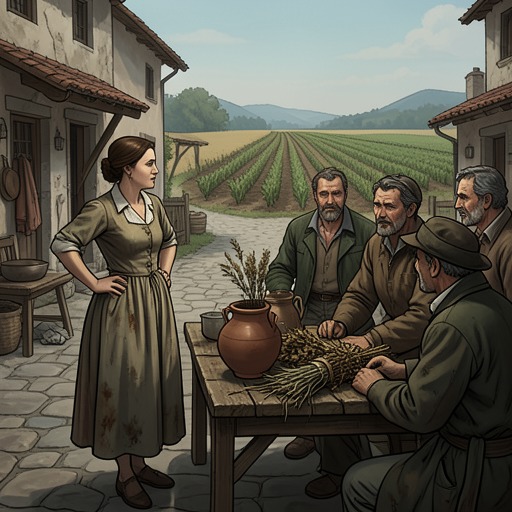
The match is subsequently discussed as a bargain to be settled between the households. The Voyt and another intermediary visit Dominikowa’s home, where the prospect of an agreement is introduced before Maciej Boryna is named. Dominikowa questions the suitability of an older widower, including the possibility that his children might later turn his wife out. The answer is that Maciej Boryna has required a marriage settlement, and Dominikowa immediately asks whether it will be made before the wedding. Her concern is not abstract: a stated provision would give Jagna a claim she could invoke within a household where her husband’s children have their own interests.
Once the betrothal is being celebrated, Dominikowa presses Maciej Boryna directly about the promise of a settlement. He initially answers that what belongs to him belongs to Jagna, but this does not satisfy the practical concern. Dominikowa wants a defined provision so that Jagna can face her stepchildren without being cursed or treated as having no rightful place. The negotiation exposes a tension within the proposed marriage: Maciej Boryna speaks in terms of sharing his property, while Dominikowa seeks an explicit arrangement that will protect her daughter amid competing family claims.
The agreed provision is six morgen, including a woodland portion to come to Jagna after her father, with the specified land by the road where potatoes had been grown in summer. The selection makes the settlement concrete: it is not an unspecified future kindness but a defined parcel, identified by its location and quality. Maciej Boryna reacts to the scale of the grant because the fields are among his best and six morgen represents a substantial portion of a farm. His concern is sharpened by the question of what his children will inherit.
Land, inheritance, and agricultural use
The intermediaries frame the settlement as security for Jagna rather than an immediate loss of Maciej Boryna’s use of the land. They assure him that no one will take the fields from him during his lifetime, propose that a surveyor mark the parcel in spring, and say that he can sow it himself. That explanation makes the arrangement serve two purposes at once: it recognizes Jagna’s future claim while preserving Maciej Boryna’s present ability to cultivate the ground. He agrees, but his hesitation shows that this is not a costless gesture. Land carries both a daughter’s protection and a father’s authority over the farm’s productive inheritance.
The surrounding story gives that bargain a wider economic setting. Before the St Kordula’s Day fair, households calculate what livestock or grain they can sell, what clothing and tools they need, and how to meet taxes, commune contributions, debts, and payments to servants. Even farmers with fifteen morgen struggle to balance the obligations. Some prepare a cow for sale or try to make a worn-out horse appear marketable. In this setting, a land settlement is not a decorative addition to a marriage: it specifies access to a resource whose value is bound to cultivation, household continuity, and the ability to meet future needs.
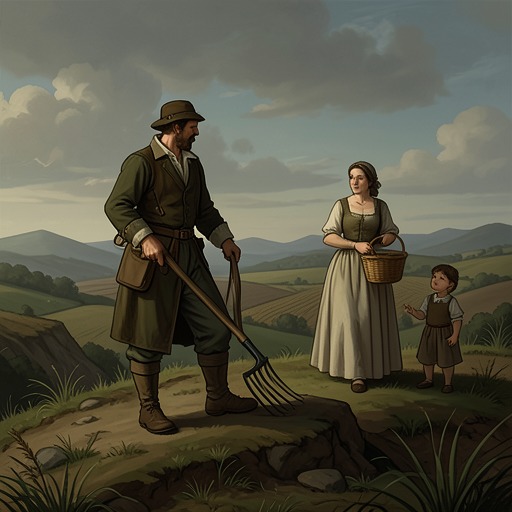
The farm also depends on labor as well as acreage. When Antek Boryna and Hanka Borynowa are living in severe poverty, potatoes and salt are their only food and they have no ready money; the possible sale of their cow becomes a pressing question. Later, when the men are imprisoned, the women must manage livestock, children, gardens, and fieldwork, and the fallow ground becomes a communal crisis. These circumstances show the limits of treating land alone as security. A parcel matters because someone must work it, and household survival depends on the difficult coordination of property, cash, and available hands.
Ceremony and the social meaning of the bargain
The agreement is carried into a public marriage ritual rather than remaining a private calculation. Before leaving for the church, Jagna kneels beside Maciej Boryna as Dominikowa blesses them with a cross and holy water. Jagna then asks forgiveness of her family, and the women embrace her in a shared farewell. At the wedding celebration, women lead her from the storeroom veiled in a white sheet and seat her on a kneading trough, while the assembled guests take part in a staged, playful contest over the bride. These communal gestures mark a change of household and status, but they do not erase the material terms that have helped make the marriage possible.
The novel places the promised settlement beside Jagna’s limited engagement with the negotiations. She is included in a decision made largely by her mother and prospective husband, even as the arrangement is supposed to secure her standing. That contrast gives the transaction its particular weight: property may provide a measure of protection within marriage, but the bargaining power and language of the settlement belong chiefly to the adults who control the land. The six morgen therefore signify both a concrete provision and the unequal terms on which a woman’s future is arranged.
Significance in the village economy
Marriage and property transactions belong to a broader pattern in which private households and collective life are inseparable. Land is measured, inherited, cultivated, and defended, while village reputation influences whether a marriage seems necessary and respectable. The same community that gathers for a wedding also confronts seasonal scarcity and later relies on neighboring villagers to help restore work in the fields. In both settings, survival depends on who can claim resources and who will contribute labor.
The settlement between Maciej Boryna and Jagna condenses these pressures into a single family negotiation. It offers Jagna a specified future claim, forces Maciej Boryna to consider the inheritance expectations of his children, and makes the land usable by agreement before it is marked out by a surveyor. Its promise of security remains inseparable from the vulnerability of farm life: fields must be worked, money is often scarce, and each transfer affects the household’s ability to endure. In The Peasants, marriage does not stand apart from property; it is one of the principal means by which property, labor, status, and family futures are rearranged.