Mateusz
The PeasantsMateusz is one of Lipce’s strongest and most capable farmhands, a bachelor whose open pursuit of Jagna entangles him in village gossip and a bitter rivalry with Antek Boryna. Known as the Dove despite his hawkish face and quick temper, he combines real generosity and extraordinary practical skill with vanity, financial recklessness, and an expectation that women will accept his advances. As the story proceeds, his strength is expressed not only in violence and sexual bravado but also in skilled work and direct assistance to others.
Identity and Character
Already past thirty when he visits Jagna, Mateusz remains unmarried. He has sisters at home and, as village gossip has it, prefers young women and other men’s wives to marriage. Sturdy and self-assured, he is feared for his temper and stubbornness; the nickname the Dove sits oddly beside a face and disposition likened to a hawk. He can make a cart, build a house, construct a stove, and play the pipe with feeling. His skill brings him work and earnings, but money does not stay with him: he drinks, spends, or lends it away.
His reputation is not simply that of a bully or idler. He has a generous heart and a helping hand, and his practical abilities make him valuable wherever work needs doing. Yet he carries himself as if his talents make him superior to others. He boasts of being a catch and of no girl having refused him, and treats romantic pursuit as another arena in which he expects to prevail. The contrast between his generosity and his presumption is central to his characterization: he is capable of giving substantial help, but not always of respecting another person’s refusal.
Pursuit of Jagna
When Mateusz returns to Jagna’s home after an absence of nearly half a year, she is surprised to see him. He takes her hand and gazes at her ardently; she blushes and looks anxiously towards the door. Although he asks her to greet him and attempts to embrace her, she slips away to light a lamp, fearing that her mother or someone else might discover them in the dark. He then seizes her by the waist and kisses her passionately. Jagna struggles and asks him to let her go, invoking her mother; he persists until footsteps in the hallway interrupt them.
The scene makes the imbalance in their encounter plain. Jagna is drawn into a charged moment, but she also tries to get away, fears discovery, and verbally asks Mateusz to stop. His desire overrides those signals. Once Jędrzych enters, the two speak little, exchanging glances instead. When Dominikowa arrives soon after, she glares at Mateusz and refuses to greet him. Jagna quietly urges him to leave before her mother curses him. Mateusz answers openly that he has come to see Jagna, not her mother. Dominikowa warns him to keep away, accusing him of setting village tongues wagging and dragging Jagna’s name through the mud. His bluntness intensifies the very public scrutiny she is trying to prevent.
The village continues to treat Mateusz as a likely claimant on Jagna’s attention. People speculate that once music returns to the inn, she will chase after the young men, and that Mateusz is waiting for the chance. Later gossip imagines him as a reserve suitor who will not give her up, while other voices wonder whether someone will make him do so. These remarks make his pursuit part of a broader economy of reputation: Jagna’s conduct is discussed and predicted by others, while Mateusz’s persistence is taken for granted.
Antek’s Rival and the Mill
Mateusz’s pursuit of Jagna becomes the point of greatest friction between him and Antek. Both had sought her since before spring, perhaps since Shrovetide, and each knew of the other’s interest. Mateusz pursued her almost openly and spoke aloud of his affection; Antek’s meetings had to remain hidden. That difference feeds Antek’s burning envy. The two men had already regarded each other warily, each believing himself the strongest man in the village. Their hostility grows until they pass without greeting, watching one another like enraged wolves.
The rivalry becomes sharper when Antek is taken on at the mill and put under Mateusz’s authority. Mateusz gives him practical instruction, pointing out that the hatchet Antek brought is unsuited to frozen wood and lending him an axe instead. But their work arrangement also gives Mateusz a chance to display his power over Antek. He tells others that Antek works for him and obeys him, while needling him indirectly and seeming to relish the humiliation. Antek restrains himself because he needs the job, but stores up the insults and understands that Mateusz is waiting for a reason to dismiss him. Their conflict is therefore at once erotic, personal, and economic: Mateusz is Antek’s rival for Jagna and the man controlling his livelihood.
The hostility breaks into violence after Mateusz boasts that Jagna had complained about Antek to him. Antek calls him a liar, then seizes him, chokes him, carries him behind the mill, and hurls him through a fence into the fast, deep river. Villagers pull Mateusz from the water unconscious. He repeatedly faints and vomits blood; those around him fear that he may not live until morning, and the priest is summoned. Antek, meanwhile, sits by the fire warming his hands and announces that anyone else who attacks or offends him will meet the same or worse.
Mateusz’s injuries are expected to heal, but the manner of the assault carries a separate injury: public shame. The villagers are awed by Antek’s strength, which they consider exceptional, and imagine that Mateusz may find the humiliation harder to endure than his cracked ribs. The incident reverses the men’s visible hierarchy. At the mill Mateusz had been able to lord his authority over Antek; beside the river, Antek makes him physically helpless in front of the community.
Return, Widowhood, and Renewed Contact
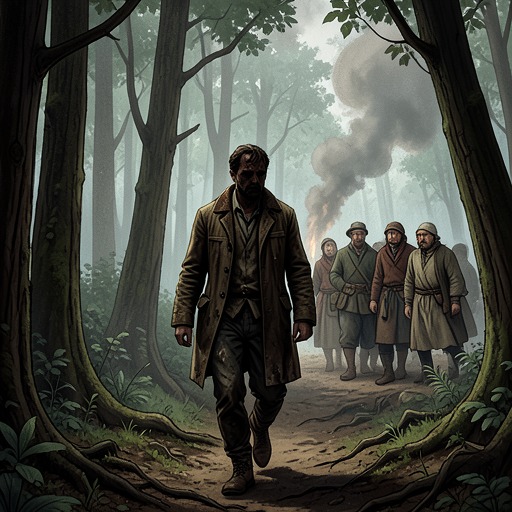
When the imprisoned men return, Jagna is eager to be among them and turns towards Mateusz, whose head she recognizes in the crowd. She pushes forward with a joyful cry, but he seems not to notice her: his mother, Nastusia, younger siblings, and Tereska are already gathered around him. The family reunion leaves Jagna outside the welcome she had hoped to share. She withdraws into the woods, feeling isolated from the crowd’s happiness. The moment registers a change in their connection: Mateusz’s return does not restore the intimacy she had imagined, and his attention is occupied by his own household and the people who greet him.
After Maciej Boryna’s death, Mateusz responds not with a romantic gesture but with skilled labor. He measures the body, says a prayer, and goes out to begin making the coffin, despite it being Sunday. Dry oak planks and joiner’s tools are available in the house; he sets up a workshop in the orchard and works with Pietrek’s help. By the following morning the coffin is finished. When Jagna appears at the barn doors and stares at its black lid, Mateusz speaks to her compassionately of her new widowhood. His craft gives him a practical role in the household’s mourning, while his words acknowledge the changed status that now separates her from the life she had known as Maciej Boryna’s wife.
Mateusz later encounters Jagna in her mother’s garden. By then, he has been living with Tereska through the winter, openly enough for the village to know, and had joked that he would return her when Jasiek came back. He had grown tired of Tereska and was gradually withdrawing from the relationship. When he lunges at Jagna and grabs her, she tears herself away and warns that Tereska may scratch her eyes out. Jagna’s reminder that the past is not the present rebuffs his assumption that their former intimacy still gives him a claim on her. His renewed advance repeats the presumption of the earlier encounter, even as her response makes her refusal unmistakable.
Work, Generosity, and Village Leadership
Mateusz’s life in Lipce cannot be reduced to his pursuit of women or conflict with Antek. He is a conspicuous figure among farmhands: handsome, strong, witty, an accomplished dancer, and capable with tools and music. He has little land and cannot keep money, but his attractiveness and social ease make him a sought-after potential son-in-law. Matchmakers propose girls to him; he drinks with their mothers, courts their daughters, and avoids marriage, saying he will wait because better choices may still appear. His pattern gives his bachelorhood a communal dimension: families see him as a desirable match, while he treats marriage as a commitment he can continually defer.
His practical generosity appears especially clearly in his help to Szymek Pacześ. After Szymek buys a dilapidated house and begins trying to restore it, Mateusz goes with him to inspect the building. Later, when Szymek labors under a heavy load without asking for assistance, Mateusz chooses to help. He admits that he had wanted to do so earlier but had been afraid: Dominikowa was watching him, and Jagusia had warned him against it. He joins Szymek in ploughing for a full day and promises to return the next day, which he does. The episode shows him overcoming hesitation through action; the helping hand previously described as a trait becomes concrete work shared with someone who needs it.
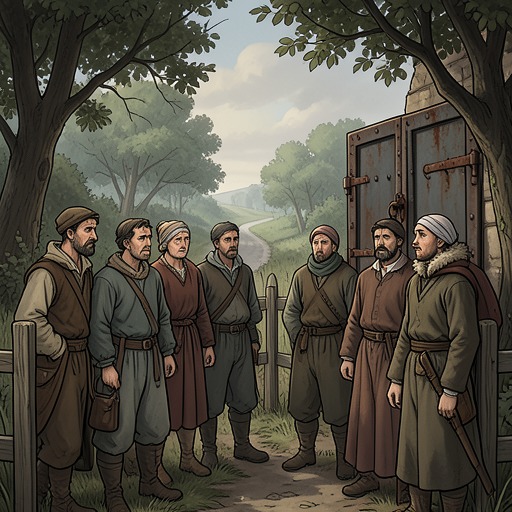
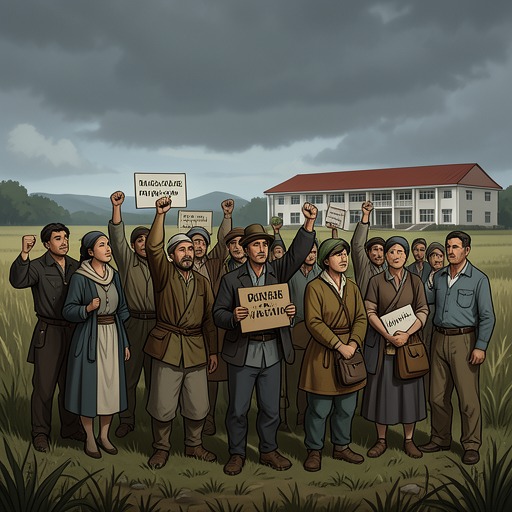
Mateusz also demonstrates judgment about the village’s public affairs. At a quiet meeting of farmers aligned with Antek and Grzela, held before the village’s school meeting, he is among those considering what to do. Later, when the villagers question who can bring them together, Mateusz names Antek and argues that the village will listen to him. The recommendation recognizes Antek’s standing despite their history of jealousy and violence. At the mill, Mateusz is likewise shown directing the whole operation, moving from place to place to organize and supervise the work. In these later roles, his confidence and forcefulness serve collective tasks rather than merely asserting personal dominance.
Narrative Role
Mateusz links several strands of village life that might otherwise appear separate: courtship and gossip, the competition for masculine standing, wage labor, craft, and mutual aid. His pursuit of Jagna helps expose how desire becomes public talk and how a woman’s reputation is scrutinized, while his rivalry with Antek turns that desire into a contest over authority and strength. The mill makes the contest material: Antek needs work, and Mateusz is his supervisor as well as his rival.
Yet Mateusz remains more than a foil for Antek. His energy can injure and intimidate, as when he forces kisses on Jagna or uses his position to taunt Antek; it can also build, organize, and sustain. He lends an axe, directs mill work, helps Szymek plough, and makes Maciej Boryna’s coffin. His later support for Antek’s leadership further complicates their antagonism: personal enmity does not prevent him from recognizing who can serve the village. The evidence leaves Mateusz active in Lipce as a capable worker and participant in communal affairs, without establishing a final outcome for his life.