Nastka
The PeasantsNastka’s brief appearances place her at the meeting point of courtship, land, and the practical ties that bind village life. Her connection with Szymek Pacześ is affectionate but materially constrained: Nastka has only one morgen, and those around them doubt that Dominikowa will consent to the match. When the returning men reach the village, Nastka is among the relatives who welcome Szymek, with her arm around his waist. In a separate exchange, she tries to read a letter for Tereska, who asks her not to tell Mateusz about it. Together, these scenes establish a character whose importance emerges through intimate acts and the limits imposed on them.
Courtship and the Question of Land
Nastka’s relationship with Szymek is discussed through the village’s everyday talk before the returning men arrive. One speaker reports that Nastka is nearly beside herself because Szymek is coming home too. The remark presents the news as emotionally urgent for her, though it reaches the reader through another person’s account rather than through Nastka speaking for herself. Her response to being told that the men are returning is not recorded in this exchange; instead, she becomes visible through what others say about her anticipation.
The discussion quickly turns from feeling to property. A question about whether Dominikowa will give permission points to Nastka’s possession of only one morgen, a small holding that becomes the practical obstacle around which the conversation revolves. Her courtship is therefore not treated as separate from household economics: the prospective marriage is entangled with the family’s control of land and with the resources available to a new couple.
The people discussing the match expect Dominikowa to refuse if Szymek asks for permission. They also speculate that he is old enough to understand the consequences and might marry despite his mother’s opposition, claim his own portion, and farm independently. This is an expectation expressed by others, not a decision that the scene shows Szymek carrying out. It nevertheless frames the relationship as a possible point of conflict between parental authority and a young couple’s prospects. Nastka’s one morgen gives that conflict a concrete measure: affection alone cannot settle where or how the pair might make a household.
The Welcome When Szymek Returns
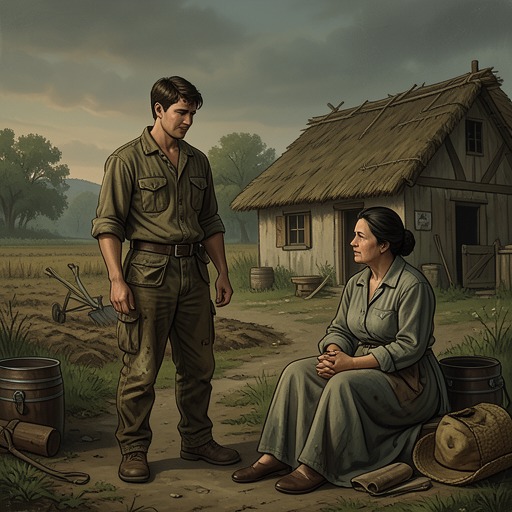
When the imprisoned men come home, the scene of reunion shows Nastka’s relationship with Szymek in action rather than through village speculation. Szymek is surrounded by family and other well-wishers: his mother hangs on his neck, younger children cling to him, and Tereska holds his hand. Nastka’s arm is around his waist. The gesture places her within the intimate circle greeting him and gives visible form to the attachment previously reported in conversation.
The surrounding crowd matters. Szymek’s homecoming is a communal moment of embraces and excited greetings, but those gestures also identify the specific people connected to him. Nastka is not merely mentioned as someone awaiting his return; she is physically beside him when he arrives. The scene thus confirms closeness without supplying a private conversation or explaining what the couple will do next. Its evidence is deliberately simple: among the people reaching for the returning men, Nastka’s place is at Szymek’s side.
The same gathering contrasts her welcome with Jagna’s isolation. Jagna approaches Mateusz, but his family and Tereska have already gathered around him, and he appears not to notice her; she withdraws into the woods feeling excluded. Nastka, by contrast, is shown in a reciprocal and publicly recognized embrace with Szymek. The contrast does not establish that her life is free of constraint—the earlier conversation about land and permission says otherwise—but it distinguishes her reunion from Jagna’s painful failure to join the crowd.
Nastka as a Reader and Confidante
In another episode, Nastka is asked to help Tereska understand a letter from Tereska’s husband. Tereska has kept the grubby paper close to her breast and is afraid to go with it without knowing what it says. Nastka takes it, crouches by a stile, smooths it on her knees, and tries to make sense of the writing. Tereska watches from the crossbar as Nastka works through the marks syllable by syllable, managing to make out only the opening words, “Praised be.”
The exchange gives Nastka a practical role in another woman’s anxiety. She attempts to read the message rather than dismissing Tereska’s fear, but her limited success leaves the letter unresolved: she says Mateusz would be able to manage it. The scene marks a specific boundary in her ability, not a general statement about her character or education. What it does show is that Tereska turns to Nastka first, trusting her with a personal document and with the worry attached to it.
That trust immediately becomes a confidence. Tereska blushes and quietly begs Nastka not to tell Mateusz about the letter. The excerpt does not disclose the letter’s contents or explain why Tereska wants the information kept from him. Nastka’s part is therefore precise but significant: she has been entrusted with a secret whose substance remains unknown, and the scene leaves her response to the request unstated. The letter creates a small pocket of uncertainty within village life, where even a few deciphered words can matter enough to require discretion.
Narrative Role and Limits
Nastka is drawn through a handful of sharply specific social actions: others report her anticipation of Szymek’s return, the prospect of marriage is measured against her one morgen and Dominikowa’s expected refusal, she embraces Szymek when he comes home, and she tries to read Tereska’s letter. These details do not provide an extended account of her past or her private reflections. Instead, they locate her through relationships and exchanges, showing how village life makes affection public and how family decisions can turn on property.
The scenes also give her distinct forms of participation. In the courtship discussion, Nastka is the subject of other people’s predictions; at the reunion, her gesture speaks for itself; in the letter episode, she becomes an active helper and keeper of confidence. Across these brief appearances, she is neither reduced to the land obstacle nor developed into a fully narrated independent plot. Her presence is clearest where public expectations meet private attachment: a small holding shadows the possibility of marriage, while an arm around Szymek and an attempt to help Tereska reveal the bonds that already exist.