Notary
The PeasantsThe Notary is a local official whose influence in Lipce rests on the gap between village needs and administrative power. He records and processes decisions, but he also uses his access to official authority to press farmers for money and guide their choices. During the school dispute, he becomes an intermediary in both language and procedure: after the crowd cannot understand the document being read, he translates it into Polish, then marks each farmer’s vote. His work is not presented as neutral clerical service; it gives him leverage over people already burdened by debt and uncertainty.
Office and village setting
At the chancellery, where people continually come and go, the Notary summons farmers and quietly reminds them of unpaid taxes, dues for the court building, and other obligations. The setting places him at a point of contact between village households and official demands. Farmers listen with resignation, aware that they owe money but often unable to pay during the difficult preharvest period. Some lack even enough for salt; others plead to wait until harvest or the next fair, while one or two hand over a last zloty.
The farmers’ gestures convey how unequal this encounter is. They bow, explain their hardship, and sometimes kiss the Notary’s hand as they give him what little cash they have. The Notary, in turn, is not simply a distant functionary: he deals with them face to face and can make his reminders feel immediate. The scene makes administration part of everyday village life, arriving not as an abstract law but as a demand for money at the moment when household resources are most depleted.
Collection and leverage
The narrative describes the Notary as shrewd and calculating in his dealings. He makes promises, but may also threaten a farmer with the gendarmes, mislead another, or act in concert with someone else to extract a further concession. His requests are not confined to cash. At one point he is short of oats; at another he seeks young goslings for the Prefect, or hints that he needs straw for rope. Farmers promise what he asks, whether willingly or not, because refusal carries risks and they have little room to bargain.
After each person’s business is concluded, the Notary takes acquaintances aside and advises them in an apparently friendly manner. That private counsel extends his influence beyond the formal transaction: he can present pressure as helpful guidance while reminding villagers that their dealings with authority may have consequences. The combination of favors, threats, and advice makes his power informal as well as official. He does not need to issue every demand as a formal order for the farmers to understand the weight behind it.
The school dispute
The Notary’s influence becomes especially visible when Lipce is considering a school measure. The villagers are also seeking an agreement with the Squire over woodland, and the Notary warns them that opposition to the school could anger the Prefect and endanger that agreement. His intervention links two matters the villagers have reason to treat separately: a decision about schooling and a hoped-for settlement over wood. Rather than arguing for the school on its own merits, he invokes the possible cost of displeasing a superior authority.
That warning shows how easily administrative pressure can narrow a community’s choices. The villagers are attempting to negotiate over a matter important to them, yet the Notary presents their success as vulnerable to the Prefect’s displeasure. His advice sounds like practical caution, but its effect is to make a local vote answerable to a wider chain of power. The scene does not establish that he controls the Prefect or the woodland negotiations; it shows that he uses the possibility of official retaliation to influence how the villagers approach the school question.
Language and the recorded vote
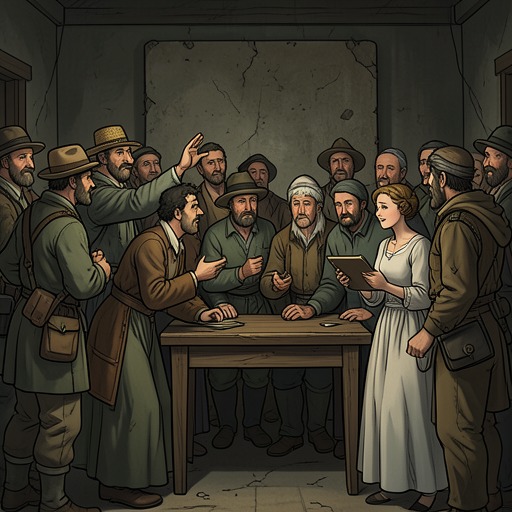
At the meeting, the official text is first read in a language the assembled villagers do not understand. Their demand to hear it in their own tongue interrupts the proceedings. The Notary frowns, then translates the document into Polish, after which the crowd listens closely. His change of language makes the decision accessible to the people who must vote, but it also underscores their dependence on an intermediary to know what is being proposed.
When the Prefect orders a vote by name, the Notary marks each farmer’s choice as the villagers come forward one by one: a mark for the school, a cross against it. The procedure takes time because so many people are present. The recorded result is 200 votes for the school and 80 against. The Notary thus occupies a practical position in the conversion of a public dispute into an official tally. He does not determine the result in the evidence presented, but his translation and recordkeeping shape the process through which the result becomes legible to the authorities.
Narrative role
The Notary’s scenes connect village poverty, local governance, and the reach of the Prefect’s administration. His collection of dues takes place amid preharvest scarcity, while his warning about the school vote places administrative pressure inside the villagers’ attempt to secure an agreement with the Squire. The contrast is telling: farmers appear at the chancellery asking for time to pay, yet the official machinery continues to claim taxes and fees from them; at the meeting, their collective decision is recorded only after an individual roll call.
He is therefore significant less as a fully developed private personality than as a recurring figure of mediation and pressure. The Notary can speak as an adviser, collect as an officer, threaten through the gendarmes, translate an official text, and mark a vote. Those functions give him a small but consequential place between the villagers and the institutions governing them. Through him, the novel shows how power may operate not only through open commands but also through debt, procedural control, and warnings about what the authorities might do.