Peasant customary rights to the forest
The PeasantsPeasant customary rights to the forest are the contested claims through which the villagers of Lipce understand their access to woodland and their authority over it. When the manor sells timber and begins cutting trees, they treat the decision not as an ordinary transaction but as a violation of rights rooted in local use, livelihood, and communal recognition. The story leaves the precise legal boundary unsettled; what it makes unmistakable is the collision between the manor’s power to act and the villagers’ conviction that the forest cannot justly be taken from them.
The Claims Behind the Dispute
The villagers’ sense of entitlement is not confined to the timber at Wolf’s Hollow. Earlier, residents complain that the pasture is theirs according to the register, yet the manor’s people repeatedly drive them and their animals away. One cow dies after being chased, and Walek’s boy is badly beaten. The proposed response is to take the matter to court or the commissioner, but the complaint also registers the difficulty of turning a claim, even one said to be clearly recorded, into effective protection.
Maciej Boryna’s own view of the woodland combines a specific measure with a larger assertion of belonging. Looking over the trees, he counts four morgen as his and another morgen associated with Jagusia, and imagines the manor as demanding too much while the villagers ask too little. His claim is personal as well as communal: the forest appears through the eyes of a landholder who measures its trees and acreage, but who also sees the dispute as an injury to Lipce. The account does not establish that the villagers’ claims are identical, or that every asserted holding has already been formally divided.
That uncertainty becomes central when the news of the felling spreads. The villagers understand that the manor has sold the wood without telling Lipce, and that cutting has begun before the question of who owns which part has been settled. To them, the lack of an agreed division is not a technical detail. It means that the people with local claims have been excluded from a decision that will irreversibly remove the resource in dispute.
Forest Rights and Livelihood
The forest dispute is also a labor dispute. At least twenty hired hands in Lipce are desperate for work, and winter hardship has already left some households without money and with frozen potatoes. The villagers had expected the felling at Wolf’s Hollow to provide employment. Instead, the Squire refuses to hire a single local worker, angered by a complaint made against him. The sale thus threatens both access to woodland and a source of wages at the moment when households are least able to absorb the loss.
This connection between land and subsistence helps explain why the villagers describe a forest claim as a defense of more than trees. In their meeting, Antek Boryna warns that the loss of the forest could be followed by encroachment on their land, cottages, and property. Boryna’s appeal likewise gathers together the felling, the denial of work, and earlier injuries and confiscations. The villagers’ argument is cumulative: one act of dispossession appears to confirm a broader pattern in which their complaints are heard but do not restrain the powerful.
The surrounding landscape gives the conflict material weight without reducing it to a simple contest between people and nature. Lipce’s pond overflows onto the low road by Boryna’s side; winter winds tear at roofs and fences; later, heat wilts vegetables and dries streams while the villagers approach the preharvest season under strain. These conditions do not themselves explain the forest claim, but they place land, water, crops, and work within the same precarious economy. In such a setting, losing access or wages is not an abstract grievance.
From Complaint to Collective Enforcement
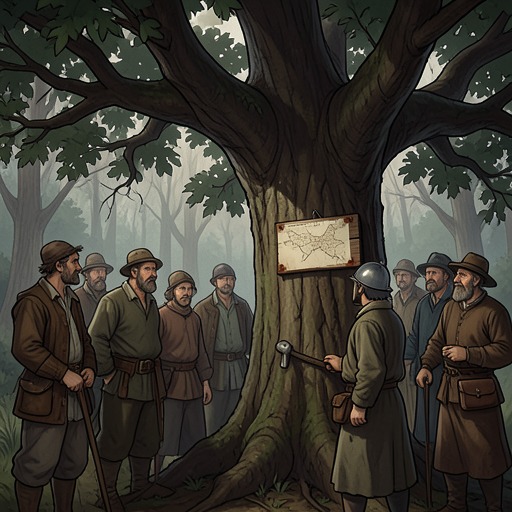
At first the report that the manor is felling the peasants’ forest is met with disbelief. It is mid-March, when thawing ground and rising sap make timber transport seem ill-timed, and the villagers assume the work must concern some other woodland task. As the news travels from cottage to cottage and reaches the inn, alarm turns into a demand for verification. Kłąb sends young men on horseback to inspect the forest; while they are gone, people watch the road, waiting for confirmation.
Once the cutting is confirmed, the inn becomes a place where individual grievances are assembled into a common claim. Antek Boryna speaks forcefully, but the villagers initially hesitate because they remember the priest’s rebukes of his conduct. Their response changes when he frames the felling as a threat not only to the forest but to their homes and property. Anger rises into a shared demand for action. Boryna, regarded as the village’s foremost farmer and the person whose lead other farmers will follow, is summoned before the crowd commits itself to the forest.
The villagers’ own formulation of the grievance is broader still: the manor is felling their forest, withholding employment, and repeatedly driving them toward ruin. They recall having taken complaints to court without being able to touch the manor’s power. Their decision to go together to stop the cutting is therefore both a defense of customary claims and a judgment on the remedies available to them. The group includes peasants, hired hands, women, and older children; some travel by sleigh, horse, or cart, while many go on foot. They carry poles, pitchforks, flails, and scythes, turning a village-wide claim into a visible force.
The Forest Confrontation and Its Limits
At Wolf’s Hollow, the villagers find more than forty men working since dawn. Axes and saws have already brought down trees, and the clearing is strewn with felled trunks and branches. The forest is not a passive backdrop: the sound of the cutting announces that the disputed resource is being transformed before the villagers can secure agreement over it.
The crowd sweeps into the clearing under Boryna’s lead. Faced with the villagers’ numbers and weapons, the woodcutters do not resist. Boryna tells workers from Modlica, Rzepki, and elsewhere to take their tools and leave; the villagers drive them out, extinguish fires, dismantle the stacks of wood, and tear down the huts at the edge of the clearing. The immediate objective succeeds: the cutting is stopped and the workers are expelled. But this is enforcement by collective presence and force, not a final settlement of ownership. The narrative does not present a court judgment resolving the claims.
The victory carries severe consequences. In the later account of the clash, the returning villagers describe Maciej Boryna coming back with his head split after a woodsman attacked him, and Antek Boryna beating that woodsman to death in retaliation. The episode shows how a dispute over rights can pass from public assertion to deadly violence, while also exposing the risks borne by people who act where formal authority has failed to protect their claims.
A Local Right and a Larger Political Problem
The customary claim in the story is powerful precisely because it is shared, but it is not simple or uniform. Boryna speaks as a landholder with a measured stake; the laborers need wages; the whole village responds to the sale as an injury to its common standing. The confrontation draws these interests together without proving that they are interchangeable. Its solidarity is practical and momentary: residents unite to stop the felling, while the question of how the forest should be divided remains unresolved.
The episode also sets competing kinds of authority against one another. The manor acts through sale and employment decisions; the villagers invoke long-standing claims and local justice; courts and commissioners remain possible avenues of appeal but have not, in their experience, prevented injury. In the forest, the crowd supplies its own immediate sanction by ordering the workers away and dismantling the logging camp. The result is neither a secure legal victory nor a mere outburst. It is a collective assertion that the manor’s title and decisions cannot be treated as self-justifying when they override the inhabitants’ claims and livelihood.
That assertion recurs in the villagers’ later discussion of German settlement at Podlesie. They propose approaching the prospective buyers together and warning that they will resist sowing or building if the purchase proceeds. This is not the same dispute as the felling at Wolf’s Hollow, but it echoes the forest episode’s method: a threatened transfer of land is answered with coordinated village action before an outside decision can become an accomplished fact. Across both situations, customary rights mark the boundary Lipce tries to defend between decisions made over the village and decisions made with its people.