Peasant national consciousness and political awakening
The PeasantsPeasant national consciousness and political awakening in The Peasants is not a settled doctrine or a smooth passage from local life into national politics. It takes shape in arguments over forest rights, work, schooling, and language, as the villagers of Lipce begin to describe themselves as Poles while contesting both official authority and the legacy of the gentry. Antek Boryna becomes a prominent voice in these disputes, but the novel leaves the larger political transformation uncertain: solidarity can flare into collective action, yet practical fear, material need, and historical grievance continue to divide the community.
Historical and Political Background
In the Russian partition, peasant emancipation followed the abolition of serfdom in 1864. The change ended the legal system in which peasants owed unpaid labor to landowners, but it did not by itself create an equal or politically unified society. The novel’s historical frame makes the question of national identity especially consequential: a Polish political community could not be rebuilt without engaging the former serfs, even though many landowners had resisted their emancipation and left peasants with reasons to distrust the old social order.
The national ideal associated with Polish Romanticism had often centered on the noble patriot who sacrificed himself in the struggle for independence. The peasants’ place in that tradition was less assured. They had taken part in uprisings, but their experience of relations with landowners could make patriotic appeals from the gentry suspect. The novel therefore places national belonging beside questions of class and land: being called Polish does not erase who owns the forest, who controls employment, or who has historically commanded whose labor.
The wider political stakes exceed the village’s immediate disputes. The novel investigates whether people formerly subordinated to the Polish szlachta and emancipated under Russian rule can become an attached and active Polish citizenry without Polish educational or administrative institutions. Its setting offers no uncomplicated answer. Revolutionary events remain strikingly absent from the characters’ motivations, even though the book was written during a period of political upheaval and peasant strikes. The national question is present, but the village’s political awakening unfolds through local conflicts rather than participation in a clearly organized national movement.
Collective Action and the Forest Dispute
The forest conflict gives the villagers a shared language of grievance. When the manor intends to fell the woodland and refuses to employ Lipce men, the consequences are both political and immediate: hired laborers face a hard winter without wages, some households have already lost potatoes to frost, and poor villagers fear a meager preharvest and hunger. Antek insists that the manor must not cut the trees until it reaches an agreement with the villagers. His stand joins customary claims to the forest with the demand that local people should not be excluded from work on their own terms.
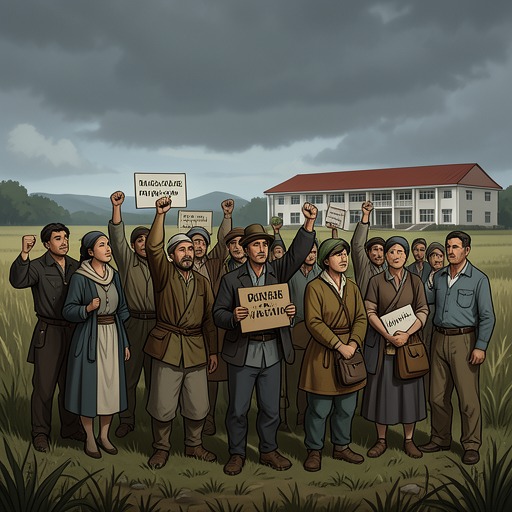
At the inn square, the gathering becomes a public assembly. The villagers wait for Maciej Boryna, regarded as the first farmer and the person expected to lead them. The crowd grows until it fills the square, but its silence and patience are part of the scene: people gather shoulder to shoulder, listening and watching for the elders. The blacksmith and miller try to deter them, warning of imprisonment, yet the crowd distrusts their advice because both men are known to have interests connected with the manor.
The address that sends the villagers toward the forest makes national identity part of a broader appeal. The speaker calls the crowd “Christian folk, honest Poles, farmers and hired hands!” before listing injury, confiscation, failed complaints, denied work, and the felling of the woodland. The address does not ask the crowd to set aside its material claims for an abstract patriotic cause. It presents collective defense of those claims as the villagers’ own right and justice. Their response is practical and communal: they hurry home to prepare, then assemble with poles, pitchforks, flails, and scythes. Farmers, hired hands, women, and older children join the procession. The scene makes political agency visible in the breadth of participation, while its immediate object remains the threatened forest.
Antek as a Voice for the Village
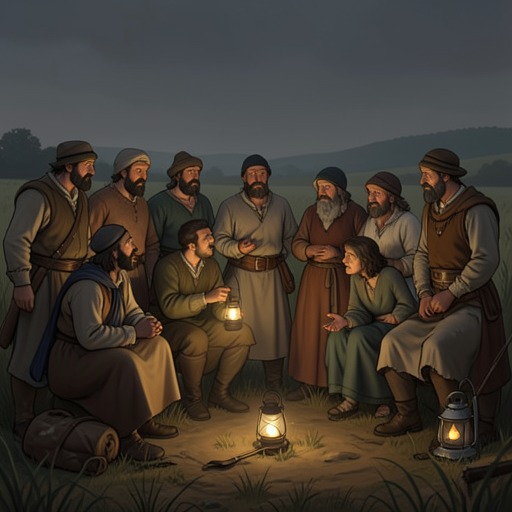
Antek’s later prominence grows from recognition by other villagers rather than from a formal position. When they ask who can take responsibility for bringing the village to its senses, Mateusz names Antek; others agree that people will listen to him and say they will follow. Antek responds uncertainly at first, asking who would heed him, then accepts that he can try. The exchange shows a shift in his standing: he is no longer only a participant in village disputes but is being treated as a possible leader.
His influence is especially visible in the confrontation over the proposed school. With officials, gendarmes, and the prefect present, Antek and other speakers urge the villagers not to accept the school. Their position combines concern about new taxes with resistance to a school that would not teach in the villagers’ own language. The crowd understands the financial burden as a concrete disadvantage, and many lean toward voting against the proposal, though fear of opposing officials makes them hesitate. The assembly is not a unified nationalist demonstration: it is an argument in which the costs of compliance, the authority of the state, and the right to language meet.
Antek makes that right explicit: “Every creature has its own tongue, but only we are ordered to use another’s.” He points to the papers on the table and invokes a decree that he says provides for Polish in schools and courts. The prefect questions his standing, and the notary announces that, because Antek is under criminal investigation, he has no right to participate in the commune meeting. Antek is ordered out, but leaves slowly and urges the men not to approve the school, insisting that the law is on their side. His intervention demonstrates both the reach and the limits of his new political voice: he can frame a local decision as a question of language and law, but officials can still exclude him from the meeting.
National Belonging and Historical Grievance
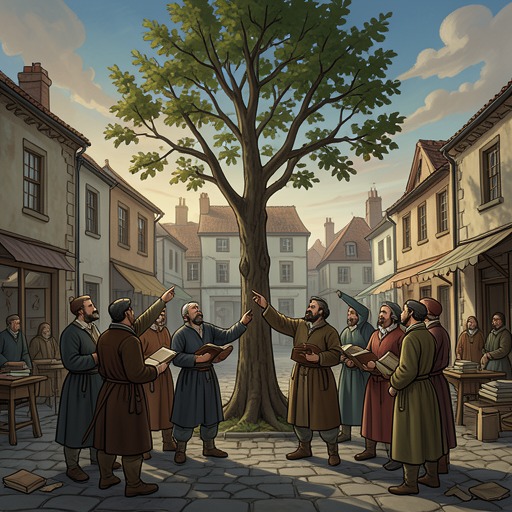
In a conversation with The Squire, Antek explains his assertion of Polish identity simply: “Why, we’re Poles, not Germans or some other sort.” The answer is direct, but the exchange probes how that identity has been learned and who gets to define it. Asked who convinced him, Antek replies evasively that children learn to reason even without a teacher. His claim does not depend on a school or an official instructor; it arises as a judgment made within village life.
Antek’s emerging national consciousness is also inseparable from his criticism of the gentry. He tells The Squire, “I have grown wise because I know the gentry are to blame for all of it.” He then recalls a Polish past in which the people were driven to labor under the whip while the gentry oppressed them and squandered the nation. For Antek, national renewal cannot mean simply restoring the authority of the old Polish elite. The Squire’s angry retort—that a peasant should keep to dung and pitchforks and stay out of gentlemen’s affairs—makes the disagreement concrete: Antek claims the right to speak about the nation, while The Squire tries to confine him to his inherited social role.
Political Possibility and Its Limits
The episodes offer a vivid picture of peasants asserting a political voice, but they do not show that voice becoming a stable national program. Forest resistance draws together villagers around a shared threat, while the school meeting reveals divergent motives, anxiety about taxes, and vulnerability to official pressure. Antek’s leadership is recognized by the crowd, yet his criminal-investigation status is used to bar him from formal participation. At the same time, his indictment of the gentry prevents Polish identity from being treated as an easy reconciliation between classes.
This tension is central to the novel’s treatment of political awakening. The villagers can speak as Poles, demand education in their language, and challenge officials; they can also organize around land and livelihood. But the movement from local solidarity to a durable political class remains incomplete. The forest assembly suggests what collective power might look like, while the school dispute exposes how readily it can fracture or be constrained. National consciousness is therefore neither absent nor fulfilled: it appears as a force emerging from the peasants’ own claims, still burdened by poverty, divided authority, and memories of subordination.