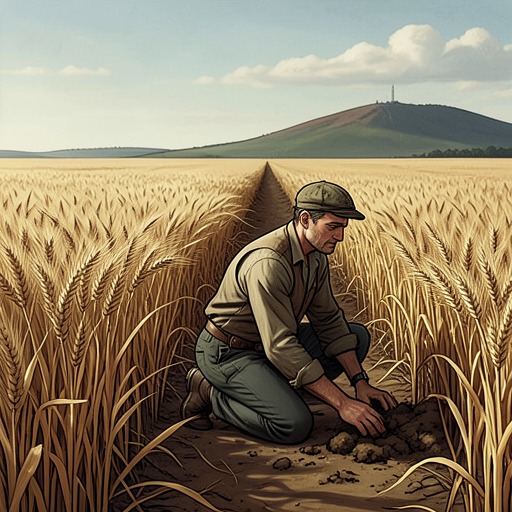
Peasant social hierarchy
The PeasantsPeasant social hierarchy in The Peasants is a practical order of land, work, status, and belonging, reinforced by custom and religious language. The distinction between a landholding farmer and a hired hand governs public respect as well as access to livelihood: it determines who stands near the altar, who is invited into a prominent household’s marriage plans, and who is left exposed when work and credit run short. Yet the same hierarchy that separates villagers can be challenged when their shared claims against the manor bring them together.
Land, household, and rank
Landholding gives farmers standing that hired workers do not possess. Boryna’s position as the village’s foremost farmer is made visible in the way his household gathers prospective brides: the girls are local farmers’ daughters, each with a dowry. The Village Head of Lipce remarks that it would be beneath Boryna’s standing to invite serving girls, hired hands, or other poor people. Marriage prospects thus reproduce the village’s economic divisions, linking a woman’s household rank and dowry to the social position of the man who seeks her.
The hierarchy is also felt in the strain of maintaining a farm. As the St Kordula’s Day fair approaches, families argue over what livestock or grain to sell and what clothing, tools, and farm supplies they need to buy. Taxes, commune contributions, debts, and preharvest loans fall due together. Even households with fifteen morgen must calculate anxiously whether to take a horse or cow to market; poorer villagers have still less room to maneuver. Some try to make a poor cow look saleable by rubbing its flanks with straw and feeding it to swell its appearance, while others prepare an old, nearly worthless horse for the fair. Rank may separate households, but it does not insulate even substantial farmers from seasonal cash pressure.
Kuba and the boundary of belonging
The distinction between farmer and hired worker becomes especially stark through Kuba, a farmer’s son whose disability and poverty have left him treated as an outsider. The village calls him a cripple, a fool, and a sponger; in Kuba’s account, even animals show him more pity than the people among whom he was born. The priest’s kindness, including a whole zloty after Kuba has brought him small gifts of birds, a hare, or mushrooms, moves him to tears. The coin gives him a fleeting sense of being respected as a Christian and a person rather than dismissed as a burden.
That restored dignity accompanies a public breach of the rules of rank. Instead of remaining in the church porch, where a hired worker like him is expected to stand, Kuba pushes through the congregation and takes a place near the high altar among the farmers. He kneels, sings, and prays with fervor, gripping the coin in his fist. The villagers answer his move with astonishment, hostile looks, and harsh words, but he refuses to retreat during the service.
Boryna later rebukes him, framing social position as a divinely assigned place that must not be crossed. Kuba answers that he is not a beast and has a mind of his own. He understands precisely what is withheld from him: as a farmer, he says, he could carry the baldachin, lead the priest, sit in the pews, and sing from a prayer book; as a farmhand, he is confined to the vestibule or doorway, like a dog. The episode makes the hierarchy more than an abstract difference in wealth. It regulates visibility, religious participation, and the right to appear among the village’s respected members.
Work, scarcity, and unequal protection
Economic hardship sharpens the divide between landowners and laborers. When the squire refuses to employ men from Lipce for the felling at Wolf’s Hollow, at least twenty hired hands face the winter without work. Some have already lost potatoes to frost; others eat a hot meal only once a day and go to bed hungry. Villagers had expected the logging to provide wages before the difficult interval leading to harvest. Antek insists that the squire must settle the villagers’ claims before cutting the firs, while another voice urges him to consider the suffering caused by the refusal to hire. The dispute concerns rights to the forest, but also who must absorb the cost when local employment disappears.
The same unevenness appears in accounts of the village’s poorest families. Jagustynka describes a freezing cottage where a sick girl is weakened by hunger, the family has sold its quilt, and groats must be begged from the miller because nobody will extend credit before harvest. In another household, a woman gives birth while ill and without milk, while the fields stand fallow because her husband is imprisoned. Jagustynka condemns prosperous farmers for worrying about their own food or the interest they can charge while neglecting neighbors close enough to live across a field boundary. Invoking divine order, she argues, can become an excuse for leaving poverty to divine care rather than offering help.
Antek and Hanka’s own household shows how poverty and status can conflict within a family. After the family is driven from Boryna’s farmstead, they endure a winter on potatoes and salt, with scarcely any cash. Antek refuses hired work, regarding it as beneath him, even as the prospect of selling their cow approaches. Hanka wishes she could work to preserve it and carry the family through to spring, but her distress cannot overcome their lack of money or Antek’s refusal. The passage reveals that social rank is not simply a privilege: the demand to preserve a farmer’s standing can also constrain a household’s response to immediate need.
Collective resistance and the limits of solidarity
The forest conflict briefly makes a larger political identity possible. Addressing the crowd as Christian Poles, farmers, and hired hands, Antek joins their grievances: the manor is felling the forest, denying them employment, and repeatedly driving them toward ruin. His speech presents the shared experience of dispossession as grounds for action. When the peasants fight the manor’s men, Boryna takes the lead with a wooden stake, and the villagers close ranks behind him with flails and pitchforks. The hired workers and farmers can act together against an outside authority, even though their places within the village remain unequal.
That solidarity is therefore real but incomplete. Work, land, church custom, and marriage continue to distinguish those who own farms from those who serve them. Spring makes the dependence on labor unmistakable: while the imprisoned men are absent, the women left in Lipce struggle to tend livestock, care for children, prepare gardens, and complete the work in the fields. The earth is ready for ploughing, but the village lacks enough able workers to meet the season’s demands. Hierarchy shapes who has land and standing; crisis exposes how much the whole community depends on labor that its customary distinctions rank below the farmer’s.
Social order and moral judgment
The novel presents hierarchy as both a structure of village life and a contested moral arrangement. Boryna defends Kuba’s lowly place as necessary to keep the world in order, while Kuba’s response insists on his own mind and Christian dignity. The exclusion of hired hands from work at Wolf’s Hollow likewise turns class rank into a question of justice: villagers challenge a manor that denies them employment while taking timber from the forest they regard as theirs.
Criticism of social order also extends to gender. After news of a man’s violence toward a woman circulates, Jagustynka objects that men can leave their wives for years or sow wild oats with little blame, while women bear the public condemnation for sexual transgression. Her complaint exposes a parallel hierarchy in which the community distributes shame and punishment unevenly. Together, these episodes show that peasant status is not a single ladder but an interlocking order of land, labor, household authority, and gendered reputation. Its boundaries govern daily life, yet hunger, shared grievance, and individual acts of resistance repeatedly reveal their human cost.