Peasant solidarity and mutual aid
The PeasantsPeasant solidarity and mutual aid in The Peasants are not simply expressions of neighborly kindness: they are practical responses to hunger, illness, absent workers, and injustice, and a moral claim that people facing the same vulnerability owe one another support. The novel gives that claim concrete form in parcels of food, a plough taken up for a struggling household, and neighboring villages’ unpaid labor. It also tests its limits, showing how easily shared need is ignored or divided by self-interest—and how a common injury can make solidarity reach beyond Lipce.
Material need and the limits of obligation
During the winter, hired laborers in Lipce face frozen potatoes, no incoming wages, and the prospect of a meagre period before the next harvest. At least twenty are desperate for work. They had counted on the Squire’s felling at Wolf’s Hollow to provide employment, but he intends to hire no one from the village after a complaint was lodged against him. The dispute therefore concerns more than a contested forest: the decision removes a hoped-for means of survival from people already short of food and money. The contrast exposes how dependent the poor are on decisions made by those with power, and how little protection ordinary economic arrangements provide when work disappears.
Another account makes the consequences of deprivation intimate and specific. A daughter in a freezing cottage is not dying of illness but of hunger; the family has run out of potatoes and sold its quilt. Her mother must beg the miller for groats, while credit and loans are unavailable until harvest. Elsewhere, a sick woman gives birth to a healthy boy but has no milk, little money, and no one to cook or tend the fields because her husband is imprisoned. These households reveal why appeals to mutual care are urgent: hardship reaches children, the sick, and families already deprived of the labor on which survival depends.
The community does not always answer that need. One observer describes farmers absorbed in feeding themselves or calculating whom they might lend to at the highest interest, while poor neighbors suffer across a field boundary. Religious language can become an excuse for leaving poverty to divine order rather than responding to it. The criticism distinguishes professed belief from the demanding practice of aid: communal membership means little if a neighbor’s hunger does not interrupt one’s own comfort.
Rocho’s everyday work of care
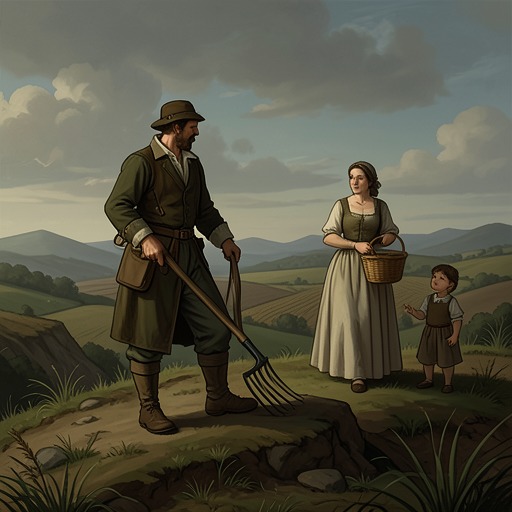
Rocho gives mutual aid a sustained human presence. Moving from cottage to cottage, he looks for practical work to do: he chops wood where a household cannot manage the stumps, carries water from the pond for Dominikowa, and helps a boy struggling to plough by taking the plough himself and showing him how to guide the mare. His assistance is not confined to one kind of task or one social circumstance. He also settles quarrels, offers advice, encourages children to obey, and uses jokes to lift the spirits of people who have grown sad or discouraged.
Care in this account includes attention to what each person needs. Rocho speaks with girls about their concerns, with women about children and domestic troubles, and with the sick through long nights spent at their bedsides. The village comes to regard him as a source of comfort and mercy, even comparing his effect on households to that of a saint. Yet the narrative does not suggest that individual kindness can abolish hardship: it asks whether he can feed the hungry, heal the sick, or replace all the missing hands. His example matters precisely because it is generous and limited at once. He can ease burdens, but the need exceeds what one person can provide.
Food-sharing and reciprocal village support
A smaller scene shows aid passing directly from household to household. Women arrive at Weronka’s home with what they can spare, acknowledging that hardship is widespread but offering their provisions sincerely. They place bundles before her—peas, barley groats, and flour—and their shared attention turns material help into an act of recognition as well as relief. Weronka’s grateful tears and the women’s own tears make visible the emotional force of receiving assistance without being treated as undeserving of it.
The same principle expands beyond a single cottage when neighboring villages help Lipce. Rocho presents their coming as a model of people helping one another in need, rather than expecting payment. The assistance is especially consequential because Lipce’s imprisoned men have left urgent work undone. Its arrival reverses the isolation of a community under pressure: essential tasks can be undertaken, and the willingness to help carries a hope that the practice might spread beyond one village. Here mutual aid is neither abstract charity nor a substitute for work; it is labor freely contributed where the loss of available workers has put households and fields at risk.
From shared grievance to collective action
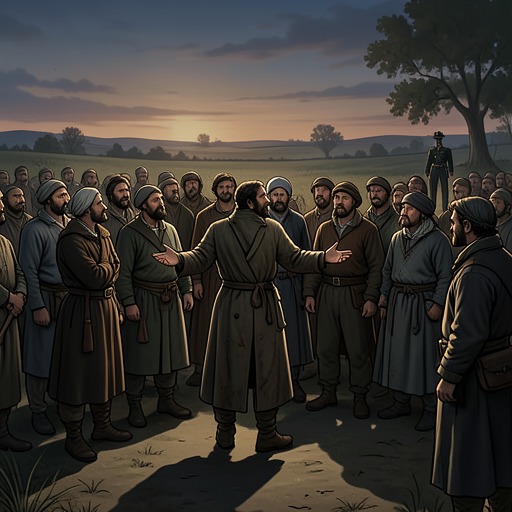
The forest dispute gives solidarity a political edge. At the crowded gathering outside the inn, villagers wait for the elders to fetch Boryna, whose standing makes him the expected leader. The image of people packed together like trees anticipates the cause that has assembled them. When the grievances are voiced, the speakers connect the felling of the forest to the refusal of employment, past confiscations, and complaints that have failed to secure redress. Farmers and hired hands are addressed together as people who have suffered an injustice. Their response turns separate injuries into a shared demand for recognition and action.
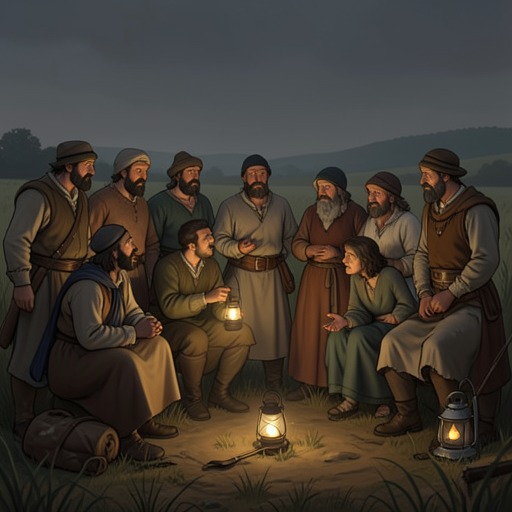
Solidarity also crosses village boundaries. Although neighboring communities had quarrelled with Lipce over borders and other disputes, peasants from Rudki, Wółka, Dębica, and even the Rzepki gentry now seek news of the prisoners and share the Lipce villagers’ concern. The injury done to Lipce is understood as a warning to peasant communities more broadly: if one village can be treated unjustly, others may suffer the same fate. Such sympathy does not erase old rivalries; rather, immediate common danger temporarily displaces them. Mutual identification emerges through attention to another community’s predicament.
Solidarity and the question of a political community
The novel places these practices beside a larger question: how formerly subordinated peasants might become part of a Polish national community. The forest address invokes honest Poles alongside farmers and hired hands, giving a shared local grievance national language. Yet the novel’s broader interpretation remains sceptical about the emergence of a unified peasant political class. Collective concern, practical generosity, and resistance to the manor demonstrate capacities for common action, but they do not by themselves resolve divisions of class, interest, or trust.
That uncertainty appears in a later dispute over the proposed school. A farmer from Przyłęk accuses Rocho of standing with the gentry and turning people against officials; others shout the accusation down. The exchange shows that a figure associated with service and community can still become the focus of political suspicion. The novel thus presents solidarity as real but contingent: it is made through specific acts of labor, food, advocacy, and shared risk, and it can be strained by conflicting allegiances. Its force lies not in an assured unity, but in the recurring possibility that suffering recognized as common may prompt people to help, defend, or act together.