Pietrek
The PeasantsPietrek, also known by the diminutive Pietruś, is a farmhand in Maciej Boryna’s household. The novel gives him no extended personal history; instead, he emerges through the work he performs, the people he serves or confronts, and a handful of episodes that resist easy moral judgment. He ploughs and tends livestock, carries a cross in a village procession, and helps sustain Boryna through illness. Yet he also makes an unwanted sexual advance on Jagna, later promises to defend her against insults, and is implicated in an intimate encounter with the priest’s Maryna. His small but recurring presence connects the ordinary labor of the farm to the village’s religious, sexual, and communal life.
Identity and Work
Pietrek’s defining social position is stated plainly: he is the Borynas’ farmhand. That role places him within a household organized around agricultural work but distinguishes him from the family whose land and authority structure its daily routines. The novel repeatedly locates him among practical tasks rather than giving him a separate home, history, or occupation. His identity is legible through service, work, and proximity to the people of the farm.
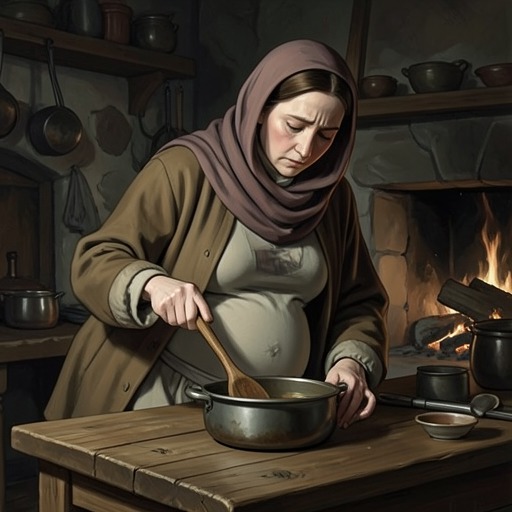
The household’s demands appear in the brisk instructions Hanka gives in the early morning. She wants the manger scrubbed and moved to the porch, barrels brought from the storeroom and rolled to the pond with stones inside so they will not float away, and the children left asleep while the work is done. In another scene, she shouts for Pietrek to go to the cattle. The command is immediate and concrete: the farm’s needs set the pace, and a farmhand is expected to answer them.
His work extends beyond livestock. Jagustynka reports that Pietrek is ploughing the potato field on the hillside while Witek the Stork-Keeper harrows the flax field in a muddy hollow with the gelding. The detail places Pietrek in the seasonal division of agricultural labor: his task is not an abstract symbol of rural life but the turning of a specific field for a staple crop. Elsewhere, when Hanka is preparing food and the cattle need attention, Pietrek is called out of the household. The farm relies on such labor at the very moment when domestic and agricultural duties compete for the same hands.
The village’s economic circumstances sharpen the significance of his position without establishing that he personally loses work. Residents speak of at least twenty hired hands desperate for employment, families whose potatoes have frozen, and poor people eating a hot meal only once a day or going to bed hungry. They had expected the manor’s felling at Wolf’s Hollow to provide work, but the squire refuses to hire men from Lipce after a complaint was lodged against him. In a public protest, the manor’s logging, its refusal of employment, and its continuing pressure on the villagers are gathered into a shared account of injustice. Pietrek is not named as one of the men affected, but his identity as a farmhand belongs to the laboring world exposed by this conflict: work is a matter of survival, and access to it is controlled by household and estate power.
Service, Care, and Communal Ritual
Pietrek’s place in the household is not limited to field labor. When a party goes out to hunt for Gypsies, the Borynas’ Pietrek is among the young men taken along with the priest’s Walek and the miller’s boy. Their departure follows an episode of loss: Balcerkowa grieves over an empty manger and calms only when told that the search party has gone. Pietrek thus appears in a practical village response to a suspected theft, acting as one of the available young men enlisted for the search.
He also takes a visible role in religious observance. During a procession through the blossom-covered village to the pond, Pietrek carries the cross because Ambrozy cannot manage it over such a distance. Other participants carry banners, holy water, and candles; the priest gives the signal, and the procession moves quietly until it reaches the water, where it is reflected. Pietrek’s task is physical and devotional at once: he bears the central object of the procession, enabling an older church servant to take part despite his limited strength. The episode places a farmhand among the community’s ritual actors, not merely on its margins.
His most sustained act of care is directed toward Maciej Boryna during the older man’s illness. Sometimes Boryna lies for whole days without water and might have died of hunger if Witek the Stork-Keeper had not secretly brought him what he could find, milking the cow a little more and giving him milk. The account names Witek as the provider, not Pietrek, and that distinction matters: the novel does not assign every act of household care to the same worker. Pietrek’s own presence around the household’s vulnerable members is shown in a separate scene, where he is greasing boots near the range and repeatedly goes in to look at Boryna or Józka of the Boryna Household as she sobs. His attention is part of the household’s close, watchful atmosphere, though the text does not present it as the same direct feeding care Witek gives Boryna.
A later scene makes Pietrek’s practical role unmistakable in a different register. He is the one leading a cart when no one else will, walking alongside it and whispering pityingly to the woman being carried away whenever he gets the chance. The action is spare but consequential: he accepts a task others refuse and accompanies the woman rather than leaving her alone on the journey. His pity does not undo his earlier conduct toward Jagna, but it adds another measure of his character—one capable of attention and tenderness in one circumstance, and violation in another.
Jagna: Coercion and Public Defense
Pietrek’s encounter with Jagna is one of the clearest tests of the limits of his respect for her. After the household has returned, Jagna is tearful and absorbed in her sorrow. Pietrek has remained close to her, helping and speaking quietly; at times he comes so near that she instinctively moves away. In the barn, as she fills a basket with chopped straw, he seizes her by the waist, pushes her against the haymow, and reaches hungrily for her lips. The sequence makes her discomfort visible before he acts: she has already been moving away from him. His advance is not presented as mutual courtship but as a physical imposition on a woman whose distress he disregards.
Later, Pietrek takes a strikingly different public position. When Grzela’s words about Jagna provoke an outburst, Pietrek pushes through with his fists raised and calls the accusation a lie. He says that Jagna’s husband cannot stand up for her and that no one else will, so he will defend her; he warns the men that if they insult her again, he will use his fists. His argument invokes a double standard: he asks how they would react if the woman were one of their wives or sisters, exposing the gap between their contempt for Jagna and the protection they would demand for women in their own families.
The defense is forceful, but it does not erase the earlier scene. Pietrek has himself disregarded Jagna’s wish to move away and attempted to kiss her by force. The contrast is central to what the evidence allows the reader to say about him: he can recognize and denounce public cruelty toward her while having violated her bodily autonomy in private. The novel does not supply a confession, apology, or explanation that reconciles these actions. His defense therefore remains morally complicated rather than serving as proof that he has become her uncomplicated protector.
Desire and the Village’s Uneven Moral Order
Pietrek is also heard in an intimate episode with the priest’s Maryna. A listener recognizes the voices of the Borynas’ Pietrek and Maryna, then turns back and stays to listen from behind thick bushes and darkness. The pair cannot be seen, but their broken, agitated words, pauses, gasping breaths, and scuffles make their closeness unmistakable. Pietrek’s own words express an attachment that has occupied his thoughts and disturbed his sleep: he tells Maryna that his mind is always on her and calls her his dearest. The scene gives his desire a private, bodily intensity, while leaving its wider consequences unstated in the evidence available here.
Set beside the attempted assault on Jagna and his later defense of her, this encounter makes Pietrek’s sexual conduct part of the village’s larger field of secrecy, reputation, and judgment. The novel does not make him a spokesman for communal morality: he participates in the intimate life that the village watches and discusses, and his treatment of Jagna shows that compassion and self-restraint are not the same thing. His place in the story is therefore less that of a fully narrated central figure than of a recurring witness to the uneven standards governing women’s bodies and men’s claims upon them.
Narrative Role and Limits of the Portrait
Pietrek’s appearances move between the farmyard, the fields, the church procession, the barn, and the concealed meeting with Maryna. Across these settings, his actions carry different weights. Ploughing the potato field and answering Hanka’s call to the cattle mark the demands of routine labor; carrying the cross makes him part of a collective religious act; leading the cart shows practical willingness and pity; the episode with Jagna reveals coercion; and his public threat against her detractors reveals an ability to challenge the group’s treatment of her. The juxtaposition prevents any one of these actions from standing as a complete account of him.
The narrative leaves important matters open. It does not provide a sustained account of Pietrek’s origins, his private life beyond the encounters described, or what he makes of the contradictions between his conduct toward Jagna and his later words in her defense. Even the final image of him walking beside the cart offers an action, not a resolution. Pietrek remains a farmhand whose significance lies in these sharply observed intersections: dependence and usefulness within the Boryna household, participation in village ritual, desire and coercion, and the possibility of pity without a simple claim to innocence.