Piotr, the Voyt
The PeasantsPiotr, the Voyt is Lipce’s village head, a local authority whose practical influence becomes inseparable from public suspicion. He can draw witnesses and supporters through persuasion, flattery, and vodka, yet a scandal in the woods turns his office into a target: villagers who already distrust his conduct begin to challenge not only his character but his right to represent them.
Position and influence
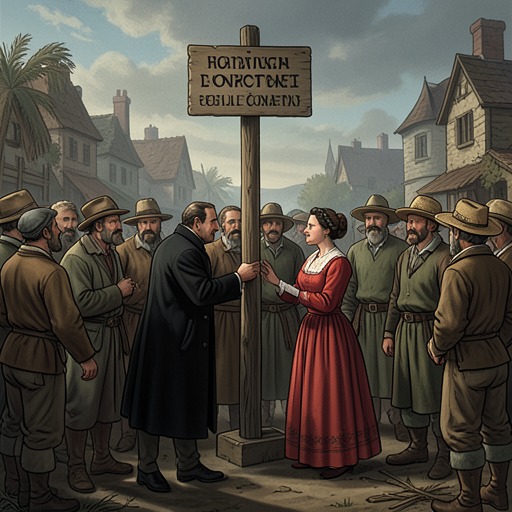
Piotr’s title gives him a strong initial advantage in a village dispute. When a brawl involving the Koziołs sets both sides searching for witnesses, the case concerns the family, but Piotr becomes deeply involved in securing support. More than half the village speaks for him, despite knowing him as a bad penny. The account describes an ambivalent calculation: people regard him as troublesome, but as Voyt he can also be useful in particular matters. He exploits that standing, winning witnesses by persuasion and flattery and by supplying vodka.
This influence is practical rather than a sign of unquestioned respect. The villagers’ willingness to support him coexists with their awareness of his faults, and the dispute exposes how local authority can be built through favors and alliances. The case may be about the Koziołs, but Piotr’s energetic intervention makes his own position part of what the village is judging.
The scandal in the woods
The crisis sharpens when a woman returning along the woodland lane recounts finding Piotr and Jagna Borynowa beneath the junipers. According to her account, the pair were lying as if asleep after drinking together; the witness says they had gone to rest in the cool and become intimate. She emphasizes the smell of vodka and Jagna Borynowa’s exposed condition, which Filipka covered with her apron. The group does not wake them at once, allowing others to arrive and see the scene for themselves.
When Grzela, the Voyt’s brother, reaches them and wakes them, Jagna Borynowa runs into the field. Piotr is so drunk that the others can barely lift him onto a cart. The report circulates through the village and is treated as a public disgrace. Its force comes not just from the alleged intimacy, but from the circumstances: Piotr, a married village official, is discovered incapacitated in a conspicuous place, with witnesses able to confirm the compromising scene. The narrative presents the incident through village testimony and rumor, making the spread and public interpretation of the story central to its consequences.
Blame and divided judgment
The scandal does not produce a single, settled judgment. Grzela declares that Piotr is no longer a brother to him, while placing the blame on Jagna Borynowa. Pietrek, a farmhand in Boryna’s household, immediately objects and defends her against that accusation. Their exchange makes visible the gendered struggle over responsibility: even as Piotr’s conduct is exposed, some villagers direct their anger toward the woman beside him, while others refuse to accept that version of events.
The account also records resistance to the gossip itself. Mateusz warns that different people are telling different stories and that the village’s additions may arise from envy; he recalls that women have been publicly condemned before, including some regarded as honest. His intervention does not erase the scene or Piotr’s part in it. Instead, it distinguishes what people claim to know from what they can establish, while showing how quickly a scandal becomes a communal judgment.
A campaign against his office
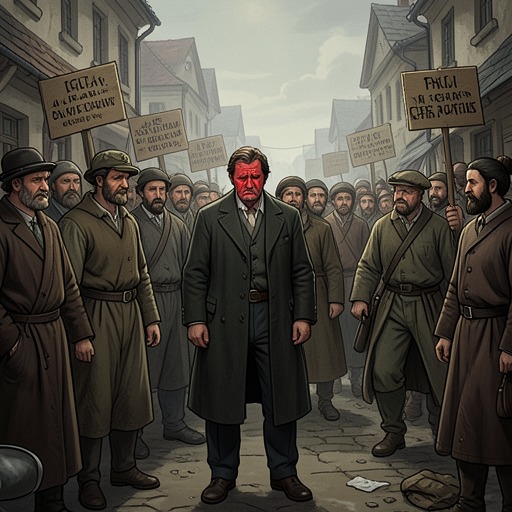
Płoszka uses the uproar to urge the villagers to remove Piotr from office. He argues that the Voyt’s behavior has shamed the village, then broadens the case against him: Piotr has allegedly sided with the Squire against the community, supported a school in Lipce, and recommended German settlers in Podlesie to the Squire. Płoszka also points to Piotr’s carousing, his new barn, his additional horses, and his regular access to meat and tea, alleging that these comforts are paid for from communal funds rather than his own.
These are accusations made in a heated political setting, not a formal finding of guilt. Sikora counters that Płoszka also wants access to the same trough, and other villagers question whether he is drunk or make clear they will not choose him as Voyt. The group nevertheless continues conferring late into the night. The campaign therefore exposes both Piotr’s weakened standing and the rivalries that complicate opposition to him: rejecting the Voyt does not automatically make his critics credible alternatives.
Religious and communal consequences
The scandal also alters a public religious observance. The priest, having heard what happened, does not allow an altar to be erected at Piotr’s house for Corpus Christi, breaking with the practice of previous years. He summons Dominikowa, who had returned only at midnight, and in his anger scolds the organist and strikes Ambrozy with his pipe stem. The withdrawn altar is a visible sign that Piotr’s household has lost a customary place in the village’s celebration.
By the time Corpus Christi arrives, the village is already in uproar. The day is still and intensely hot, but the narrative emphasizes that people scarcely notice the oppressive weather amid the commotion. Piotr’s authority has not yet been shown formally removed, but the sequence leaves him publicly compromised: his standing is contested in court-related alliances, challenged by a removal campaign, and marked by exclusion from a familiar religious custom. His episode makes village office appear at once powerful and vulnerable, dependent on community cooperation that scandal can rapidly erode.