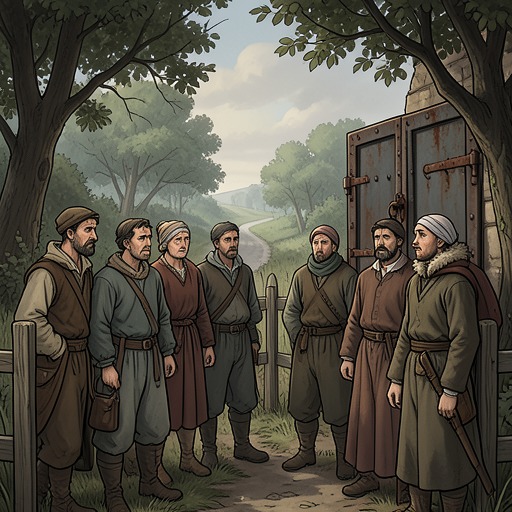
Podlesie’s German settlers leave
The PeasantsThe departure of the German settlers of Podlesie turns an ongoing village conflict into a public spectacle: a line of loaded wagons passes through Lipce under the villagers’ hostile gaze, then disappears along the poplar road. The people celebrate their exit, but the scene does not offer a clear account of who made it happen. Instead, it sets the villagers’ antagonism beside the Squire’s self-congratulation, leaving the meaning of the apparent victory contested.
Background and Stakes
The procession arrives in a community already shaped by disputes over land, work, and the Squire’s authority. In an earlier dispute over logging at Wolf’s Hollow, Lipce’s hired hands faced the prospect of losing badly needed winter work: villagers had expected the felling to employ them, but the Squire had vowed not to hire anyone from Lipce after a complaint was lodged against him with the commissioner. The dispute made decisions about land and employment feel inseparable from the villagers’ ability to endure poverty.
The forest confrontation also showed how that resentment could become collective action. A crowd gathered outside the inn, waited for Boryna, and heard the case for defending what the villagers considered theirs. The appeal joined farmers and hired hands in a common grievance against the manor’s logging and refusal to employ them; the crowd then raced home to prepare and set out together. The settlers’ passage belongs to this wider atmosphere of conflict, though the scene of their departure does not establish that the forest dispute itself caused them to leave.
The village’s anxieties were not confined to a single public confrontation. Accounts of hardship describe families without potatoes, credit, or money, fields left fallow while men were imprisoned, and poor households with no help at hand. Such details make the struggle over who may settle, work, or claim the resources around Lipce more than a matter of local pride. They frame the village’s readiness to treat the German arrival as a threat, even as the departure scene leaves the precise material terms of the conflict unstated.
The Procession Through Lipce
The settlers appear in a row of large britzkas, each covered by a white canvas bonnet. The vehicles carry household goods as well as women and children; well-fed men walk beside them, pipes between their teeth, while enormous dogs run along the road. The contrast between the loaded wagons and the villagers’ crowding around the route makes the movement of an entire household world visible. This is not a solitary traveler’s leave-taking but a community on the move.
The procession advances at walking pace, squeezing through a crush of carts and horses. The settlers do not doff their caps at the church or greet the people of Lipce. They stare back, their eyes flashing and beards trembling, while the villagers answer with insults. The account presents hostility on both sides, but the immediate imbalance is clear: the settlers are moving through the village, while Lipce’s people line the way and watch them pass.
The crowd’s anger briefly threatens to become physical. A boy throws a stone, and others reach for bricks, but they are stopped before they can follow his example. A woman raises her fist and curses the departing group. The settlers, meanwhile, do not answer the taunts; they hurry their horses onward. Their silence does not reconcile the parties. It carries the wagons out of reach, leaving the villagers’ anger to give way to the sound of wheels and barking fading into dust and shadow.
Departure and Public Interpretation
Once the carts have gone, the Lipce villagers turn from the road and gather around the Squire. Their relief is so great that they cannot settle to their prayers. The Squire chats with them, shares his snuff, and announces that they have driven the settlers out. His claim makes the moment sound like a victory achieved by the village, but it also places him at its center—as though he can present the outcome as proof of his own influence.
The blacksmith offers a different explanation, crediting the Squire for the departure. The Squire then says he prefers to sell to his own people, even at half the price, and invokes his family’s history of siding with the peasants. His assurances are self-serving claims made in the aftermath, not an independently established account of the transaction or the settlers’ motives. The scene thus keeps a productive ambiguity: the settlers have gone, but the people watching do not agree on whose action made them go, and the Squire’s friendliness does not erase the earlier record of conflict with the manor.
Significance
The departure marks a moment of communal relief, not a settled resolution. The villagers’ celebration shows the strength of their shared opposition to the settlers, while the restrained stone-throwing shows that collective anger comes close to violence without becoming an attack in this scene. The crowd’s unity is real, but it does not settle the competing claims over land, authority, or who speaks for Lipce.
The Squire’s performance sharpens that uncertainty. Earlier, the villagers had described the manor as a force that denied them work and ignored their complaints; now he presents himself as an ally who would favor local people even at a lower price. The contrast makes the settlers’ exit politically useful to him, whatever his actual role in bringing it about. The procession therefore closes one visible episode while exposing a continuing struggle over credit and power: the wagons leave Lipce, but the village’s underlying disputes remain.