Poland
The PeasantsPoland is the historical and political horizon behind The Peasants: a country divided among three empires, whose people lived under different administrations and whose national future remained unsettled. The novel’s village of Lipce is not a portrait of one actual settlement so much as a concentrated rural world. Through its land disputes and divided loyalties, the book asks whether people shaped by local claims and the aftermath of serfdom could become a Polish political community.
Partition and political disappearance
The final partition followed earlier divisions in 1772 and 1793. In 1795, Austria, Prussia, and Russia completed the process; a treaty signed in St Petersburg in 1797 declared the abolition of the Polish body politic and pledged that the name of the Kingdom of Poland would disappear from the rulers’ titles. Russia acquired the largest share, while the lands taken by Prussia doubled its area and population. The partitions involved the participation of Polish politicians who supported foreign claims, while resistance to Russian and Prussian expansion culminated in the uprising led by Tadeusz Kościuszko in 1794. Its defeat did not prevent the final division: Poland ceased to exist as a political entity until 1918.
The loss of statehood divided the former kingdom among different monarchies, each with its own language, culture, administration, and dominant religion. Władysław Reymont was born in 1867, when Poland had already been absent as a political entity for about seventy years; inhabitants of the portion held by Russia, including Reymont and his family, became Russian subjects. The division persisted in its consequences beyond the recovery of independence. The historical account notes that the geography of voting in Poland in the early twenty-first century still generally corresponds to the old partition map, a measure of how long political boundaries can shape social experience.
Emancipation and the rural order
The partitions took place while the old feudal order remained powerful. The nobility had extensive privileges, including land ownership and inheritance, judicial authority over peasants, political rights, public office, and exemption from taxes and customs duties. Peasants, by contrast, were bound to landowners and required to provide unpaid labor for a set number of days each week in a system that effectively functioned as serfdom.
Serfdom ended at different times in the partitioned territories: in Austria in 1848, in Prussia between 1811 and 1850, and last in the Russian partition in 1864. Emancipation weakened the old landowning order and brought capitalist relations into the countryside, but did not ensure security or social mobility. Landowners now had to pay for labor, estates declined or accumulated debt, and agricultural wages remained too low to sustain many laborers. Around half the rural population was illiterate, limiting access to other work and advancement. In this context, legal freedom did not automatically mean material independence or membership in a shared national project.
National identity and the peasantry
The question of how to build a national identity among former serfs became urgent before Poland regained independence. In territories under Russian rule, a symbolic language of Polish citizenship had developed across differences in ethnic identity and reached a high point in Polish Romanticism. Its ideals of rebellion, individuality, and resistance to tyranny acquired a specifically political force in a country without independence. Romantic poets, including Adam Mickiewicz, Juliusz Słowacki, and Zygmunt Krasiński, helped codify an image of the patriot willing to sacrifice himself for national freedom. The failures of the 1794 uprising and the November Uprising of 1830–31 and January Uprising of 1863–64 reinforced that political mythology.
Peasants also took part in uprisings, but their relationship to the patriotic cause was not straightforward. The gentry had initiated the rebellions, while many landowners opposed peasant emancipation; that history left some peasants reluctant or openly hostile. Political thinkers in the later nineteenth century accordingly regarded peasant national consciousness as indispensable to the possibility of a strong, free Poland. The challenge was practical as well as ideological: Polish educational and administrative institutions were in Russian hands, while a population with limited literacy and an immediate dependence on land had little reason to trust abstract national appeals over lived experience.
Poland in The Peasants
The novel’s Lipce is an actual place-name, but the village in the book does not correspond to the real village. It stands instead for a typical Polish village at the end of the nineteenth century. The narration keeps its attention on Lipce and does not follow characters into the wider world when they leave or return; for most of its inhabitants, that world remains closed, threatening, or difficult to comprehend. This narrow geographical focus gives the village the scale of a microcosm without turning it into a literal map of the country.
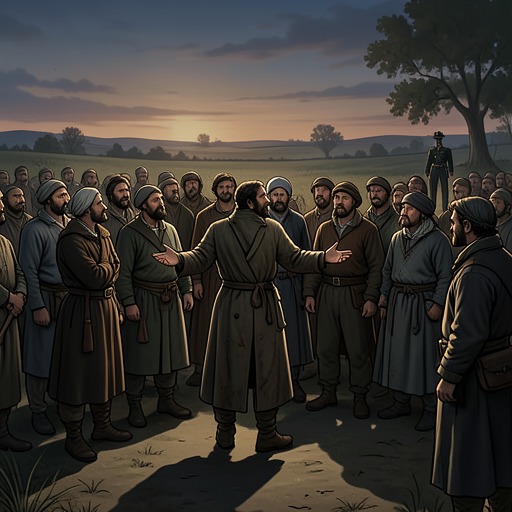
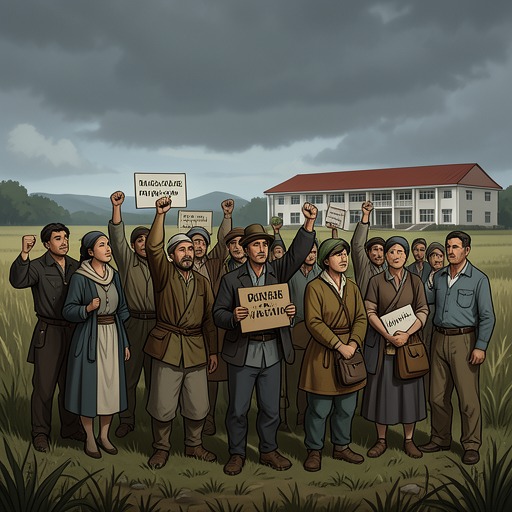
The plot’s family and land conflicts make that limitation politically significant. One central line concerns Maciej Boryna, the wealthiest farmer, and his marriage to Jagna; another follows Jagna’s affair with Boryna’s son Antek. Alongside this family conflict, the peasants confront the manor over a forest they regard themselves as co-owners of, even as its owner seeks to sell it. In a public appeal during the forest conflict, Antek addresses farmers and hired hands as people who have suffered a shared injustice, naming the manor’s felling of the forest and its refusal to employ them among their grievances. The local claim to land and work can momentarily gather people into a common cause, but it does not by itself resolve the larger question of national belonging.
A skeptical national allegory
Reymont’s political engagement and contact with National Democracy inform the novel’s interest in the nationalist potential of the village, but its account is skeptical. Rather than narrating the confident birth of a peasant political class, The Peasants presents that emergence as stillborn: village life is organized by immediate material pressures, competing claims, and inertia. The book was written from 1900 to 1908, when the 1905 Revolution had reached the Polish lands and more than 750 peasant strikes took place in that year alone, yet revolutionary action is strikingly absent from the characters’ motivations. The story, set in 1883–84, leaves political violence outside its governing pattern even as the historical moment of composition makes that absence conspicuous.
Poland therefore appears less as a unified state within the novel than as an unresolved question carried by the village. The forest dispute shows how collective action can arise from shared injury; the history of partition and emancipation explains why such solidarity does not automatically become national consciousness. By keeping the narrative inside Lipce, Reymont makes the distance between local community and national citizenship part of the subject itself.