Poverty and winter scarcity
The PeasantsPoverty and winter scarcity in Lipce turn the season into a test of both subsistence and belonging. Snow, frost, frozen or dwindling potatoes, empty purses, and the absence of paid work converge on households already living close to hunger. The anticipated felling at Wolf’s Hollow briefly promises wages, but the Squire’s refusal to hire local men deprives the poorest villagers of the work on which they had counted. For Hanka the Farmstead Keeper, the same cold becomes a daily struggle to feed her children and find firewood, while also sharpening her resolve to rely on herself rather than wait helplessly for help.
Material Conditions and Unequal Exposure
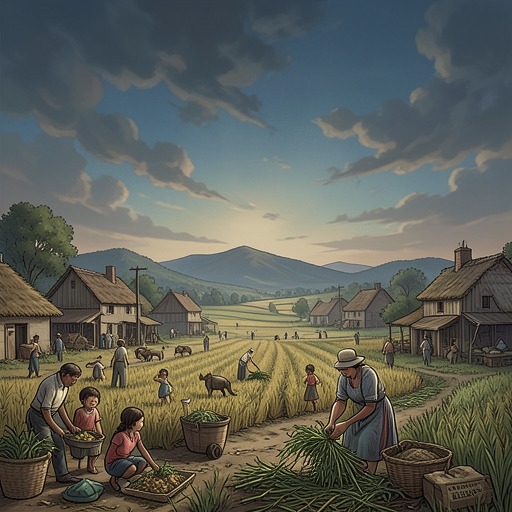
The hardship is distributed unevenly. Lipce includes wealthy farmers, lesser landholders who do not depend on extra earnings, and poor people whose circumstances are so precarious that some conceal their need to avoid losing the friendship of the wealthy. Hired hands and people who own little more than a cottage patch together work wherever they can find it: threshing for farmers, using an axe at the mill, and taking whatever other jobs become available. Even that irregular labor does not sustain everyone. About five families face a winter with no village work at all, and they look to the expected logging as a chance to survive until spring.
The prospect of wages matters because household reserves are nearly gone. Hardly anyone has even a grosz saved, many families are running out of potatoes, and some have already lost their stored crop to frost. Hunger is not a distant possibility: some people manage a hot meal only once a day and go to bed without eating. With spring still far off, the villagers anticipate a preharvest period of exceptional want, when food stocks will be low and the next season’s produce cannot yet help them. Winter scarcity therefore means both immediate deprivation and fear of what will happen before the fields can provide again.
Work Denied and the Poor’s Appeal
The expected felling at Wolf’s Hollow had seemed to offer employment to the whole village. That expectation collapses when villagers learn that the Squire has made agreements with workers from elsewhere: ten from Rudki, fifteen from Modlica, about eight from Dębica, and nearly twenty from Rzepki, while not one person from Lipce is to be hired. The woodsman confirms the decision, making the exclusion more than rumor. The poor are particularly dismayed, since the outside workforce takes the place of the only substantial winter employment they had expected.
The decision also exposes the conflict between a collective protest and individual need. The Squire is reportedly angered by a complaint lodged against him with the commissioner, and one villager insists on standing by the complaint and preventing the cutting until an agreement is reached. Another warns that an honest appeal might persuade the Squire to reconsider if he understood how many people would suffer. But the protesting villager refuses to go begging. The irony is severe: resistance intended to secure what the villagers regard as theirs may coincide with the loss of work on which the poorest depend, while the Squire’s exclusion of local labor makes their immediate need more acute.
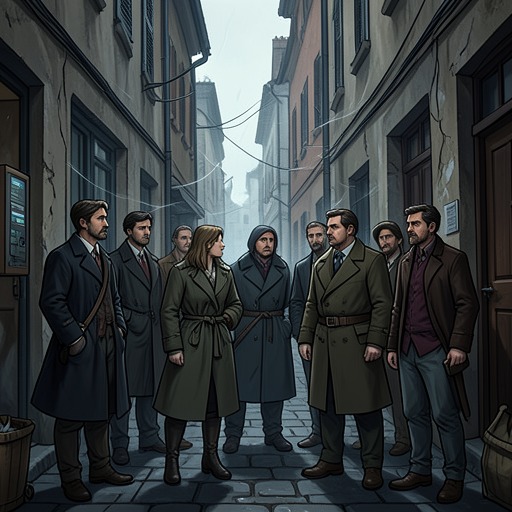
The poor gather in cottages to discuss what to do, then seek someone to lead them to the Parish Priest of Lipce for advice and intercession. Kłąb declines, citing his daughter’s betrothal, and others evade the request because they have their own interests to protect. Bartek from the Sawmill, although he has work himself, stands with the poor. He goes to the priest with Filipka, Stach, Bartek Kozioł, and Walek to ask him to intervene with the Squire. Their appeal gives the hardship a public voice: poverty is no longer only a private household trouble but a shared crisis requiring advocacy. Yet the need for mediation also shows how little direct power the poorest workers possess over the decisions determining whether they can earn a living.
Hanka the Farmstead Keeper’s Winter Ordeal
The shortage of fuel makes the broader crisis intimate and physical in Hanka the Farmstead Keeper’s home. The children shiver under their quilt, and without firewood she cannot cook; the food available is dry bread rather than a hot meal. Necessity sends her out to gather wood with hired hands and the poorest women, including Filipka, Krakalina, old Kobusowa, and Magda Kozioł. The work is not a gesture of charity or a temporary excursion. It is a task she must undertake because her household has run out of the means to keep warm and prepare food.
Her father, Bylica, follows in the storm despite his frailty. He wears Antek Boryna’s old sheepskin, has a straw rope for a belt, and keeps his head wound in an apron; the wind repeatedly stops his breath and forces him to pause. He would rather remain by the stove, but the children are cold and Hanka has gone out, so he presses on after her. Their journey through the snow makes scarcity visible in bodies: inadequate clothing, exhaustion, and the effort required simply to bring fuel home. Hanka, too, is gaunt, frostbitten, and worn down by crying and fatigue.
Even in this condition, Hanka the Farmstead Keeper refuses to make a plea for pity. She tells herself that she will gather and carry the wood, will not complain or run about seeking help, and will not allow herself or the children to be ruined. She understands her suffering through religious endurance, as a trial sent by the Lord Jesus, and hopes that patience may someday be rewarded. The narration sets this faith beside practical action: prayer does not gather the wood for her, and endurance means using her hands rather than waiting for rescue. Her determination is also shaped by injury beyond poverty. She can endure hunger and neglect more readily than Antek Boryna’s betrayal, which she cannot forget or forgive.
Assistance, Agency, and the Hope of Return
After the gathering, an older man urges Hanka the Farmstead Keeper to take care of herself and warns that she could fall ill in her exhausted state. She answers that someone must do the work and explains that they had run out of firewood and she could not cook. When he asks after the children, she reports that Pietruś, who had been ill, is improving and wants to eat much more. Her direct answer, steady gaze, and lack of her former diffidence register a change: deprivation has not removed her vulnerability, but it has hardened her into a more self-possessed speaker.
The older man offers her help and invites her to visit, despite having previously thrown her and her family out. Hanka points out that she does not know how she could dare return after that expulsion; he insists that she should come and that there is enough for her. At first she resists the thought because she fears Antek Boryna’s reaction. As she turns the encounter over in her mind, however, she separates Boryna’s responsibility for the expulsion from Antek Boryna’s actions in provoking the conflict. She recalls that Boryna had asked after the children and had spoken gently, and begins to imagine that returning might end some of the family’s misery and humiliation.
The prospect is made urgent by the expectation of another child: Hanka the Farmstead Keeper calculates that she and the children are suffering want already, and that soon there will be one more to provide for. In this moment she does not include Antek Boryna in her plans. She sees herself as responsible for deciding on behalf of herself and the children, with God or Boryna as the only possible sources of support. Her hope of returning to the farm grows into a wish to put down roots there again, to hold fast to the ground and become once more the woman in charge of the household. Winter want thus becomes a pressure that changes her sense of agency: the prospect of land and shelter is not merely a return to comfort, but a route toward security and authority.
Significance
The winter crisis links material poverty to village politics without making the interests of all villagers identical. Men with secure work or property can hesitate, protect their standing, or pursue a conflict with the Squire on terms that the unemployed cannot afford. For families with no reserves, a day’s labor is not a minor economic benefit but a defense against hunger before spring. Their distress exposes the cost of excluding Lipce workers even as the dispute over logging and the complaint against the Squire remains unresolved.
The same conditions also clarify Hanka the Farmstead Keeper’s development. Cold, hunger, and lack of firewood compel her to work alongside the poorest women, but they also show the limits of dependence on a neglectful husband and the possibility of renewed support from Boryna. The return she imagines is inseparable from the ground beneath her feet: the farm promises a material base from which she can protect the children and exercise household responsibility. Poverty and winter scarcity therefore operate both as immediate hardships and as forces that reveal who has access to work, whose appeals are heard, and what forms of self-reliance remain possible.