Prefect
The PeasantsThe Prefect is the state official whose arrival interrupts Lipce’s debate over a proposed school and its tax. He appears only briefly, but his intervention changes the gathering from a noisy village dispute into a confrontation with government power: after the villagers resist, he orders them to approve the tax. The episode makes his authority tangible while showing how a communal vote can be constrained by command, fear, and the threat of enforcement.
Identity and Appearance
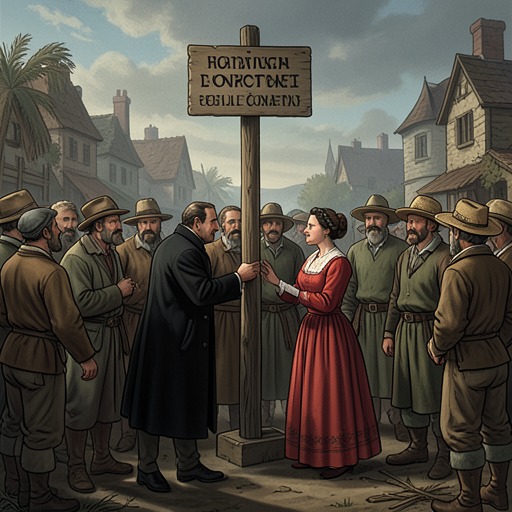
The narrative supplies no personal history or private perspective for the Prefect. He enters the story as a public officeholder, identified by his title and accompanied by the machinery of administration. His carriage arrives along the road to the chancellery; the Voyt announces him, the Notary helps him down, and the Gendarmes stand beside the doors. The villagers remove their hats as he surveys the assembled crowd. These details establish rank through ceremony and the presence of armed officials, rather than through any account of the Prefect’s life beyond the meeting.
His manner combines polished courtesy with impatience and command. At first he stands on the threshold and greets the farmers graciously. He begins speaking in his own tongue, then hiccups as he speaks; later he switches to Polish to issue his order. The account does not explain his background or specify his language, but the contrast between his official standing and the villagers’ response gives the encounter its political charge.
The School-Tax Meeting
The Prefect arrives while the villagers are still debating whether to accept the school proposal and its associated tax. The gathering has not yet settled into a vote. When the Notary calls for someone to go to the manor for fish, no one moves; a villager answers that they did not come to run errands. This refusal signals that the crowd is already pushing back against being treated as subordinate, even before the Prefect appears.
The debate is divided. Most villagers are leaning toward voting against the school, while Grzela and a group with him openly reject it and the tax. When the Prefect steps outside, the noise briefly subsides. His courteous greeting does not settle the question. Instead, he tells them in Polish, “Approve the tax, at once – I haven’t time to spare.” The abrupt instruction replaces deliberation with a demand for compliance. Some villagers are frightened; others immediately call out to one another about whether to vote and where Grzela is.
The Prefect then intervenes more forcefully as the meeting’s disorder grows. Once the villagers have drifted into argument and old disputes, he shouts, “Quiet there! Enough of this parley! Silence when I speak, and listen. You are to approve the school.” The crowd falls silent and stands rigid, its earlier willingness to oppose the proposal briefly overwhelmed by fear. The sequence shows a clear shift in the meeting: debate gives way first to alarm, then to a silence produced by the official’s command.
Language, Authority, and Resistance
The dispute over the school is not presented as a detached question of local administration. The broader account identifies the imposition of a non-Polish-language school by the Russian authorities as a source of conflict in Lipce. During the confrontation, a villager voices the grievance in a concise formula: “Every creature has its own tongue, but only we are ordered to use another’s.” The line connects the school question to the villagers’ experience of being governed through an authority and language not their own.
The Prefect’s appearance gives that pressure a face, but the scene does not make him the sole source of local power. The Voyt and the Notary serve the proceedings, and the Voyt, miller, and others move through the crowd urging obedience and stoking fears. The Prefect’s command is therefore reinforced by village officials and intermediaries. His power operates through both direct instruction and the local network that presses the villagers to comply.
Narrative Role and Limits
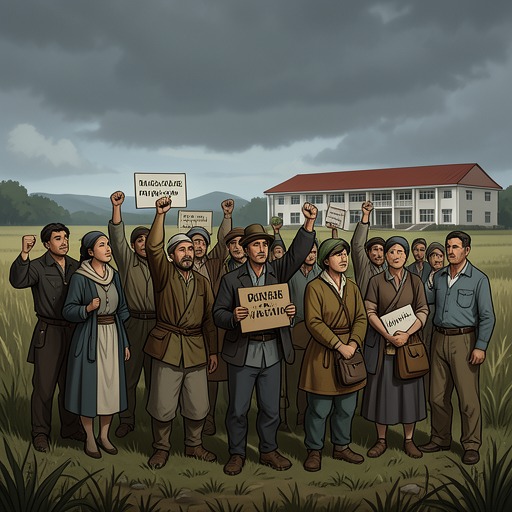
The Prefect’s brief role gains force through contrast with other scenes of collective action. When Lipce villagers mobilize against the manor’s felling of the forest, they gather in large numbers, wait for Boryna, and set out together to defend what they regard as their rights. At the school meeting, by contrast, the villagers’ opposition meets a state official backed by Gendarmes, and their resolve falters when he orders the tax approved. The contrast does not establish that the two conflicts are identical; it shows how the form of authority and the risks of resistance change from one confrontation to another.
The Prefect is thus less a fully developed individual than a concentrated presence of administrative power in a village debate. His courtesy cannot conceal the coercive force of his final order, and the scene’s sudden stillness measures that order’s immediate effect. The evidence does not say what he thinks of the villagers, what becomes of his career, or whether the vote is ultimately recorded as he commands. His significance lies in this bounded encounter: he makes visible the distance between a vote conducted in the village square and a decision the villagers are genuinely free to make.