Rocho
The PeasantsRocho is a wandering teacher and political emissary whose presence in Lipce binds practical neighborly care to the village’s emerging sense of Polish identity. He brings stories, religious instruction, and aid from house to house, but he does not turn that work into a decisive political transformation: his influence sustains the community’s possibilities while leaving its most painful conflicts unresolved.
Identity and arrival
Rocho’s identity is deliberately uncertain when he first appears. Józia Borynianka reports that an “old wanderer has turned up,” and he presents himself as a pious pilgrim who has been “to Jesus’ tomb.” The villagers do not agree on who he is or whether his account is true. One local account says he comes to Lipce every third winter and stays with Boryna, while even his name is treated as uncertain: he asks to be called Roch, but the villagers suspect that this may not be his real name. His recurring arrival makes him familiar without making him fully knowable; he belongs to the village through repeated acts of hospitality, yet remains a figure from the road. Rocho’s pilgrim appearance is only one part of his role. The narrator’s account describes him as speaking German and French, distributing pictures of saints and kings, teaching children, abstaining from meat, calming quarrels, and giving small sums to people in need. The contrast between the uncertain traveler and the capable organizer is central to his characterization: he moves through Lipce without the settled authority of a landowner or officeholder, but his knowledge, mobility, and concern allow him to connect households and generations. People receive him affectionately, and during a holiday visit to Boryna’s household they greet him as dear as a grandfather. He quietly greets each person with a word and a kiss on the head, though he refuses the food offered to him.
Teaching and Polish identity
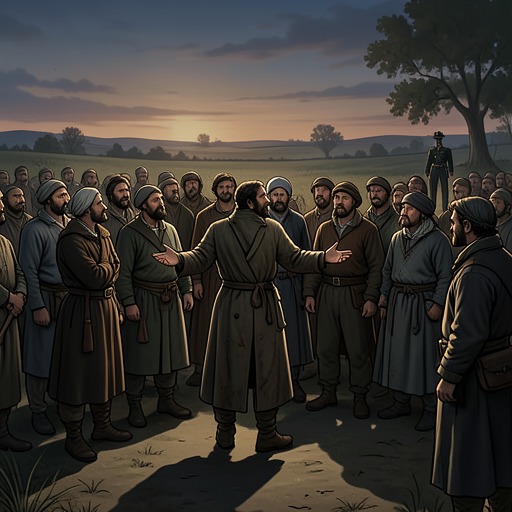
Rocho is the chief advocate of Polish identity in Lipce. His work is part of a sustained effort to bring national history and a sense of collective belonging to the peasantry. He is supported in that work by Jacek, a former insurrectionist and brother of the Squire, as well as by anonymous beggars who pass through the village telling stories of an earlier Poland. Rocho’s political teaching therefore belongs to a wider, informal network: the village hears ideas through travelers, instruction, religious imagery, and conversation rather than through recognized civic institutions. His teaching joins national tales to religious ones. At one gathering, he tells stories about the Polish people alongside holy fables and accounts of wonders in the world. The listeners are absorbed, and the narration compares their attention to dry ground drinking warm rain. As he speaks into the night, his voice seems to come from the earth and from the village’s past, as if generations of Borynas were speaking through the walls, trees, and darkness to call their descendants to reflection. The scene gives his storytelling a communal reach: he does not merely convey information but makes shared memory seem present among the people listening. That teaching also carries risk. Under directives aimed at Russifying education, teaching Polish history is forbidden, which explains the caution surrounding Rocho and Hanka the Farmstead Keeper. At another point, Rocho teaches services devoted to the Heart of Jesus that have been banned from the church. His instruction thus takes place partly beyond official religious and educational settings. The restrictions make his work more than private piety: preserving Polish historical memory and devotional practice becomes a quiet form of resistance, carried out through lessons and gatherings that require discretion.
Mutual aid in daily life
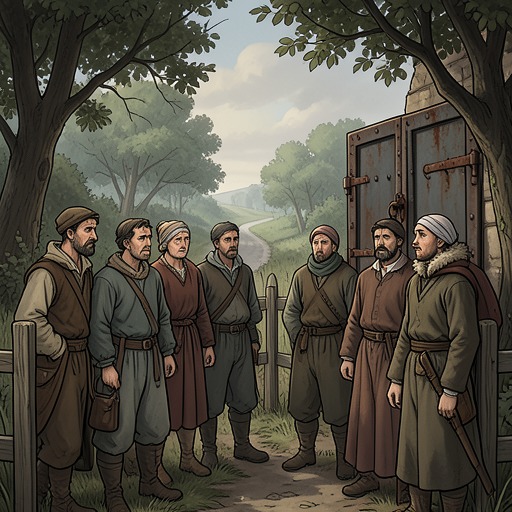
Rocho’s politics are enacted in ordinary labor. During a hard period in Lipce, he walks from cottage to cottage, looking for where he can be useful. He settles disputes, appeases feuds, gives advice, and joins difficult work rather than limiting himself to counsel. He chops wood for Kłąb’s household when Kłębowa cannot manage the gnarled stumps, brings water from the pond for Dominikowa, and tries to bring spoiled children into obedience. These particular tasks show how his influence is made: he notices needs household by household and answers them with his time, strength, and attention. The same practical responsiveness shapes his contact with people in crisis. After hearing that Magda is near death, Rocho helps rub her with snow and get her to drink; the report that she has been brought back from the brink credits his continued care alongside Ambrozy’s prayers. When Józka Borynianka is tearfully recounting a distressing event to everyone, Rocho first reassures her and then goes to see Hanka the Farmstead Keeper, who is lying down but appears strangely peaceful. In these moments he is neither simply a preacher nor a distant observer: he moves toward those who need comfort and tries to relieve distress directly. His most explicit argument for mutual aid comes when neighboring villages agree to help Lipce’s people in the fields. Rocho carries the news from house to house and urges the villagers to understand the help as an act of fellowship between Poles and Christians, not as a transaction. He insists that people must help one another because no one else will do it for them, and imagines this practice spreading across the lands until enemies disappear like snow. The image of an “immeasurable forest” turns the neighbors’ assistance into a vision of solidarity that could grow beyond a single emergency. Yet the immediate basis of the vision remains concrete: people from neighboring villages are coming to help with fieldwork when Lipce is short of labor.
Counsel, alliances, and restraint
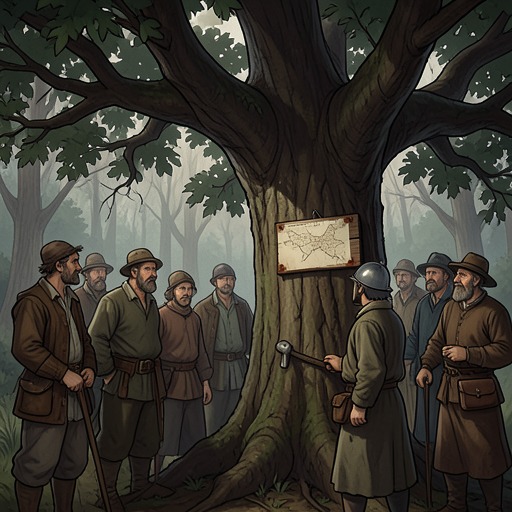
Rocho also becomes a confidant in moments when household survival and communal responsibility meet. After a long absence he returns at Whitsuntide, appearing in the village after Mass and a conversation with the Parish Priest of Lipce. People hurry into the road to greet him. Later, when Hanka the Farmstead Keeper needs money connected with Antek’s situation, Rocho advises against rushing to sell land. He warns that a person may leave land proudly and return crawling, suggests seeking a loan, and encourages her to ask among the people. When Hanka throws herself at his feet in gratitude, he promises not to tell and says he will go with her for Antek when the time comes. His counsel treats land as lasting security and mutual assistance as an alternative to a desperate sale; his promise also makes him an ally in a family’s private ordeal. His assistance is not confined to individuals. When some villagers are trying to move the community toward a decision about plots, their efforts would have failed without Rocho’s help. They approach him behind Boryna’s barn, initially uncertain whether he will oppose them, and confide in him. Elsewhere, he appears at Boryna’s home during a quiet meeting before a gathering at the chancellery, a sign of his place in the village’s discreet conversations about collective affairs. The surviving evidence presents him as a trusted intermediary: people seek him out when they need advice, help building agreement, or a safe passage from private concern into village action. But Rocho’s standing does not make him an all-powerful mediator. The narrator’s account of the political plot stresses that he does not intervene to prevent Jagna’s lynching, does not reconcile Boryna and Antek, and accepts Agata’s wandering life. His repeated movement among households can soothe quarrels and sustain cooperation, but it does not resolve every conflict or protect every vulnerable person. The distinction matters: the novel does not equate kindness with control, and Rocho’s community work cannot be mistaken for a power to overrule the village when collective violence takes hold.
Political promise and limits
Rocho’s political significance lies partly in this tension between preservation and change. He and Jacek help maintain the identity and political potential of the people of Lipce, but their work does not make the peasants fully conscious political citizens. The novel’s political movement gathers emotion and intensifies clandestine activity without culminating in a decisive uprising; its ending instead brings a curious immobilization. In this reading, Rocho functions as an instrument of political possibility and also, paradoxically, as part of the mechanism that preserves the community without revolutionizing it. His teaching keeps national and communal identities available, while the larger narrative withholds a transformation that would turn those identities into sustained political action. In the novel’s later crisis, Rocho’s own safety becomes precarious. When people fear that authorities are searching for him, Grzela worries that he will be taken. Rocho is directed to hide in a furrow among the rye until he is called for; villagers conceal and protect him rather than abandon him to the search. He answers concern for his personal danger by describing himself as one blade of grass in a flourishing field. If he is destroyed, he says, many others will remain and more will come from towns, cottages, and manors, sacrificing themselves until a hoped-for church rises from their blood and love. He later gives the cause plainly as the pursuit of truth and justice for the people. The image replaces the solitary hero with a field of potential successors: Rocho imagines his work as something that can outlast his own body. That prophecy is not a report of an accomplished political victory. It is a statement of faith in future collective endurance, spoken while he is at risk and dependent on villagers to hide him. The contrast between his expansive hope and his vulnerable, fugitive condition preserves the uncertainty at the heart of his role. Rocho can teach, comfort, organize, and imagine a wider solidarity; he cannot guarantee that the village will overcome its divisions or that his political hopes will be fulfilled. His significance rests in the work he repeatedly undertakes and in the possibility he keeps alive, even where the narrative shows that possibility being checked by passivity, danger, and communal injustice.