Rocho’s ethic of mutual aid
The PeasantsRocho’s ethic of mutual aid makes solidarity a practical duty rather than a pious sentiment: people facing hardship should help one another with their own labor, and collective work can answer needs that isolated appeals cannot. Its force lies in the contrast between that promise and the recurring injuries of village life—disputed access to pasture and forest, winter unemployment, hunger, and fields left untilled when the men are imprisoned. The ethic does not erase those conflicts; it gives the villagers a language for naming injustice and an example of how to respond together.
Moral principle and social obligation
Rocho’s teaching joins readiness, work, and prayer. He tells listeners, “After winter, spring comes to everyone who waits for it in readiness, work and prayer.” Hope, in this account, is not passive waiting: the wronged may prevail, but human happiness must be sown through labor and sacrifice. The harvest image makes the rule reciprocal and temporal. Work undertaken now matters because it creates the conditions for a future return, even when immediate circumstances offer little assurance.
The ethic also challenges a narrow understanding of religious duty as concern only for one’s own bread. Rocho warns that “he who has a care for his daily bread alone will not sit at the Lord’s table,” and that complaining about evil without doing good produces a greater evil. Together, these maxims make care for others part of Christian conduct. Prayer does not excuse indifference; it should accompany action. The principle is directed both at personal conduct and at the habits of a community in which neighbors can live close together while leaving one another’s suffering unattended.
The injustices mutual aid confronts
Material disputes give this principle its urgency. A complaint over pasture records how a cow died after being chased from grazing land that villagers believed was theirs. The aggrieved speaker points to the register, insists that the pasturage belongs to them, and considers taking the matter to court or the commissioner. The loss is counted in money—three hundred zlotys—but the grievance is also about being repeatedly driven away from a resource essential to survival. Formal claims and legal complaint coexist with the sense that the villagers are not being heard.
A similar tension surrounds the forest. Riding through it, Maciej Boryna calculates his claim in land: “There’s always my four morgen here!” He adds Jagusia’s one morgen to the reckoning and believes that the manor takes too much while the villagers say too little. His appeal to divine justice sits beside a determination that the villagers must not accept the loss. The woodland is therefore not an abstract symbol in the ethic’s setting: access to it is tied to landholding, livelihood, and the villagers’ understanding of what they are owed.
The pressure intensifies when the manor plans to fell the Wolf’s Hollow woodland but refuses to employ men from Lipce. At least twenty hired hands are desperate for work; winter frost has already ruined some potatoes, money is scarce, and some households eat a hot meal only once a day before going to bed hungry. Villagers had expected the felling to provide wages. Instead, a dispute over a complaint lodged against the squire shuts them out of the work they need. One speaker insists on standing by the complaint and refusing to let the firs be cut until the villagers receive what is theirs. The episode shows the difficult intersection of immediate need and collective resistance: accepting employment might relieve hunger, but yielding on the forest claim could leave the underlying injustice intact.
Mutual aid in a labor crisis
The need for solidarity becomes especially stark after the men are imprisoned. With spring approaching, the fields stand fallow not because the land has ceased to be fertile, but because the available labor cannot meet its demands. Women must manage livestock, gardens, planting, manure, drainage, firewood, children, and their ordinary household work; some are pregnant, while animals are calving, hatching, and farrowing. The season’s promise sharpens the crisis: earth and crops are ready for cultivation, yet the community lacks enough hands to do the work.
Rocho brings an answer from beyond Lipce. He announces that neighboring villagers will come together to work in the fields for two days. The news initially seems incredible, but the priest confirms it, and the village turns from fear toward preparation. People ready carts, cut potatoes for planting, spread manure, bake bread, and arrange food for their guests. Some supplies are obtained on credit from the inn and mill. The preparations make reciprocity visible: the recipients do not merely wait to be rescued but prepare to welcome those who will work beside them.
Rocho is elated that the visitors will work without wages, offering thanks instead. He calls this conduct what righteous Poles and Christians should do, and presents mutual assistance as a practice that can spread beyond one village: people should recognize that, in need, they must help one another. His image of that principle spreading across lands like a forest answers the threatened or contested forest with a different kind of collective growth. Here the shared resource is not timber but human effort, freely given to secure the community’s survival.
Work, faith, and collective action
The priest’s response gives the labor exchange an explicit religious meaning. He tells the helpers that giving to someone in need is as though giving to Jesus himself, thanks each man, and promises to pray for their kindness. The scene connects service to a recognizable Christian obligation while also showing it enacted through practical work rather than words alone. The priest’s thanks matter because the work has a visible beneficiary: households whose land cannot wait for the imprisoned men to return.
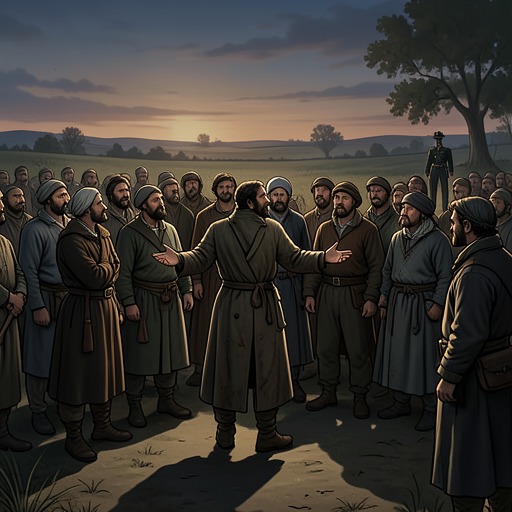
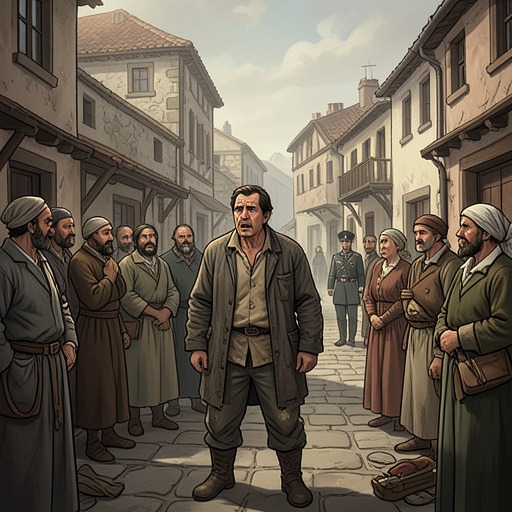
Rocho’s ethic also shapes how villagers understand public grievance. When Maciej Boryna addresses the crowd assembled against the woodcutters, he names the linked injuries: the manor is felling the forest, has refused employment to the villagers, and continues to drive them toward ruin. His appeal describes legal recourse and complaints as ineffective, and presents the cutting of the wood as the last straw. The crowd responds in anger, claiming a right that no one recognizes. Mutual responsibility here is bound to collective defense, though the confrontation also makes clear that solidarity can take a forceful, conflictual form when villagers believe ordinary remedies have failed.
The ethic should not be mistaken for evidence that need is consistently met. A report from the village describes hunger, illness, exhausted households, and families unable to obtain credit before harvest. It also condemns prosperous farmers who attend to their own food or lending returns while ignoring poor neighbors nearby, leaving the destitute to divine care. That criticism identifies the gap between communal proximity and actual obligation: living across a field boundary does not by itself create help. Rocho’s rule demands that the gap be crossed through deliberate action.
Significance and limits
Mutual aid in these episodes is neither a substitute for fair access to resources nor a claim that poverty can be solved by goodwill alone. The contested pasture, the forest dispute, and the squire’s refusal to hire Lipce men concern power and livelihood as well as neighborly conduct. The labor offered by neighboring villagers relieves an urgent shortage, but the text’s attention to repeated hunger and unequal concern keeps the scale of the problem in view. Rocho’s principle answers neglect at the level where villagers can act, without making the larger causes of deprivation disappear.
Its deepest emphasis is that dependence need not mean helplessness. The imprisoned men cannot work their fields; the women left behind are already overburdened; poor families have few resources to draw upon. Neighboring labor briefly converts a village’s isolation into shared capacity. In that movement from prayer to work, and from an individual household’s need to a collective response, Rocho’s ethic becomes both a moral rule and a practical model of community.