Russian imperial administration in Congress Poland
The PeasantsThe Russian imperial administration in Congress Poland is represented in The Peasants less through a portrait of central government than through the rules and officials that shape village life. Its presence emerges in changing territorial arrangements, restrictions on schooling and political participation, and the authority exercised in Russian by state agents. Together, these details show how imperial power entered local affairs through institutions that villagers encountered as law, language, and constraint.
Territorial administration and historical context
In the historical note to the chapter, the book places the reorganization of the Russian partition after the January Uprising. In 1866, the partitioned lands were divided into ten gubernias, or governorates, and the former voivodeships, or provinces, were abolished. This administrative change supplies a concrete outline of the territorial system behind the village setting, though the narrative does not describe the governorates’ internal operations or identify the officials who administered them.
The distinction matters to the novel’s scale. Its central action is rooted in local households, land, and communal disputes, while the state is encountered through specific regulations and interventions rather than through a sustained account of government. The administration is therefore consequential without becoming a continuously present cast of characters: its authority defines what can be taught, who may participate in meetings, and what language officials use.
Schooling, language, and Russification
Education provides the clearest account of a changing imperial policy. An edict of 30 August 1864 anticipated that village schools would teach in the language used by the majority of pupils in a commune. That arrangement was revoked in 1872, when Russian was introduced in all schools. The sequence shows a shift from a rule keyed to local linguistic circumstances toward the imposition of Russian as the language of instruction. The change is identified in the notes as part of the Russification of education in Congress Poland.
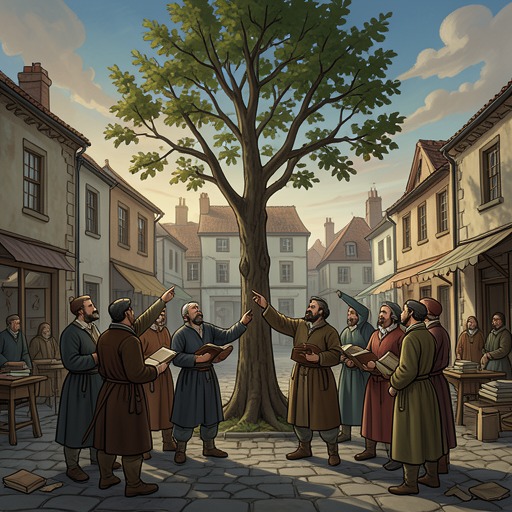
The policy’s significance is not only institutional. A note explains that strict directives forbade teaching Polish history, which is why Hanka the Farmstead Keeper and Rocho proceed cautiously when the subject arises. Their caution makes political control legible as a limit on ordinary conversation and informal teaching, not merely as a decree concerning school administration. The administration’s educational reach thus touches both the language of instruction and the transmission of historical knowledge.
The book also sets this state language against the distinctive speech of the villagers. The translator describes the novel as moving among detached narration, an intimate village-raconteur voice, stylized natural description, and extensive realistic dialogue. The peasant language is presented as a way of thinking and expressing oneself, not simply as imperfect speech. Against that locally grounded voice, Russian in official encounters marks an unequal relation: administration speaks with the authority of the state, while villagers’ own language sustains their communal life.
Commune meetings and legal participation
A tsarist decree of 2 March 1863 regulated participation in commune meetings. Peasants who owned at least three morgen were eligible and obliged to take part. The rule also named exclusions: clergy, police officers, and peasants under criminal investigation or police surveillance could not participate. The decree therefore connected civic standing to landholding while making legal or police status a bar to participation. It defined a formal channel for local assembly, but not one open on equal terms to every inhabitant.
The distinction between eligibility and exclusion is especially revealing in a book where land is central to security and standing. The decree’s threshold ties participation to property, while its exclusions show that state scrutiny could remove a landholding peasant from the meeting’s political process. The available account specifies the rule but does not establish how frequently it was applied or describe the proceedings of any particular assembly; its importance lies in the boundaries it set around commune participation.
Local public obligations also form part of the material background. Before the fair on St Kordula’s Day, village households face taxes and commune contributions alongside private debts, pre-harvest loans, and payments to servants. Even farmers with fifteen morgen calculate what they must sell, while poorer households face greater pressure. The account does not attribute every charge to the imperial administration, but it shows public dues arriving amid other demands on scarce cash, making governance part of the economic conditions against which villagers make decisions.
Officials and the sound of authority
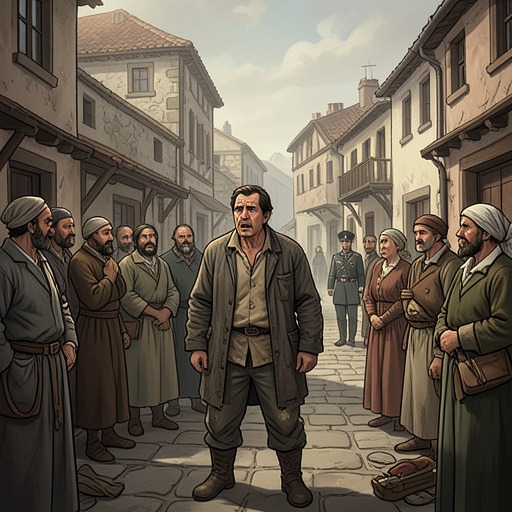
The administration becomes most immediately audible through the gendarme. A textual note identifies him as an official serving the Russian authorities and explains that his speech contains Russicisms. Russian commands are likewise glossed as the language of administration. These details make code-switching a mark of official power: Russian is not just another language in the village but the register an agent can invoke when exercising authority.
That contrast is sharpened by the novel’s attention to varied voices. Its dialogue gives the villagers a language of their own, while the gendarme’s Russian-inflected speech signals an institutional order extending beyond the village. The resulting encounter does not require an extended exposition of the state. A command in Russian, or the caution imposed by restrictions on teaching, is enough to show how imperial administration can enter daily life at particular pressure points.
The book’s presentation of the administration is consequently dispersed rather than panoramic. Territorial reorganization supplies the historical frame; school rules and meeting regulations define specific limits; taxes and commune contributions belong to the village’s material calculations; and the gendarme embodies enforcement in person. Taken together, these strands portray a state whose effects are concrete even when its machinery remains mostly outside the narrative’s immediate view.