Szymek
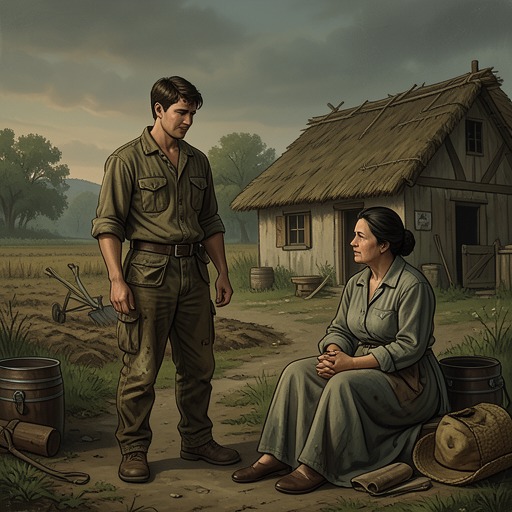
The PeasantsSzymek is Dominikowa’s elder son, a young villager whose move from a mother-governed household to a farm and marriage of his own makes independence a matter of land, labor, and belonging. His path is neither a simple escape nor a private triumph: Dominikowa resists his marriage and denies him a settlement, while neighbors eventually help the couple build a home. Szymek’s story gives concrete form to the novel’s interest in how individual households are made—and how communal support can make that possible.
Identity and Household
The text identifies Szymek as Dominikowa’s elder son. He appears first within a family economy in which children work alongside adults and household property is closely guarded. When he goes with Jagna to the cabbage field, Jędrzych stays behind to patch a leaking roof. Faced with a heavy bundle that Szymek cannot manage, Dominikowa takes it from him and carries it to the cart herself. The scene shows both the physical demands of ordinary farm work and her forceful direction of it.
The household’s modest resources also enter a court proceeding over a stolen pig belonging to Marcjanna Pacześ. Szymek testifies that the animal was white, with a black patch by its tail and a torn ear. He links the torn ear to an earlier incident when Boryna’s dog, Łapa, caught at it; the pig’s squeal had carried as far as the barn. His careful account makes household knowledge—the appearance and history of a single animal—part of the public record. The case also places Szymek beside his mother as a witness for her claim.
On another journey, Szymek rides with Dominikowa and Jagna while their cow follows the cart, tied by its horns, and geese stretch their white necks over the cart’s edge. These details locate him in a family still moving together and dependent on its animals and belongings. His later departure from that household will therefore mean more than a change of address: he must establish a new domestic unit of his own.
From Maternal Authority to Defiance
Szymek’s independence emerges through repeated friction with Dominikowa. At one point, while drunk, he answers her words not with an argument but by adjusting his belt and pounding the table. She strikes him on the chest, and Jędrzych takes him outside; in the fresh air Szymek stumbles against a fence and continues shouting and muttering. The episode registers the instability of their conflict: his resistance is real, but at this stage it is entangled with drunkenness and a loss of control.
His movement toward a separate life is not always a direct confrontation. In a gathering where others fall silent, Szymek rises and tries to leave unnoticed. When challenged, he responds sharply to the suggestion that he is forbidden to go, then puts his hat back on the chest. In another household exchange, Dominikowa tells him to go home with Jędrzych and watch the cows, expecting him to return so they can go to church together. The boys prefer to stay rather than sit in an empty cottage. These moments show a son whose choices are still subject to family instructions, but who is increasingly testing their limits.
The conflict becomes unmistakable when Szymek asks his mother for money to take the banns to the priest before Vespers. Dominikowa refuses to let him marry. Jagna tries to separate them, but the struggle continues: Dominikowa pursues Szymek around the room, striking him, and he retaliates. They crash against the walls and furniture, turning the dispute over marriage into a physical rupture within the household. The scene makes clear that Szymek’s choice of a bride is inseparable from his effort to choose a life outside his mother’s command.
Marriage, Land, and the Break with Home
Szymek’s intended marriage is to Nastusia, a girl poorer than he is. Their relationship meets opposition not only because Dominikowa refuses the match, but because marriage would redistribute family life and resources. Szymek insists that he will not ask his mother for permission even if he has to go to the inn to do so. When news spreads that the banns have been read, the announcement makes their plans public and harder to contain within the family dispute.
The struggle is also over land. Szymek declares that the land came to him from his father and that he will not surrender it. Later, gaunt and visibly drained, he speaks of his mother denying him that inheritance, driving him from the house, and refusing him a settlement. His grievance joins material need to the pain of being wronged by a parent. He threatens to hold on to what he regards as his, even if doing so means prison. The determination is desperate, but it gives his independence a specific stake: without land or a settlement, he has no secure place from which to begin married life.
Szymek ultimately obtains six morgs bought from the squire. The plot is not ready-made prosperity. It lies beside the forest and Lipce fields, but consists of wasteland marked by abandoned clay pits, rubble, stones, briars, and wet hollows. Even the squire had advised against it, yet Szymek insisted. His decision turns the land into a test of resolve rather than a reward already prepared for him. He sees a future there, but the terrain makes plain how much work that future will require.
Building a Home and Receiving Help
The new household takes shape through labor shared beyond the couple. The squire helps the cottage rise quickly; Mateusz works hard for nearly a week and urges others to contribute, while Adam of the Kłąb family carts timber from the forest. When the building is finished, a green wreath is hung around the chimney. The cottage becomes visible from Lipce, a small structure whose prominence marks the arrival of a new household in the village landscape.
Szymek and Nastusia do not remain indefinitely in the family cottage after their wedding celebration. With the guests gone and only Ambrozy still draining the bottle, they decide to move to their own place. Mateusz urges them to stay longer, but Szymek is firm. He borrows a horse from Kłąb and loads their trunk, bedding, pots, and pans onto a cart. After seating Nastusia with ceremony, he bows to their kin, crosses himself, and sets off as the others walk alongside to see them away. The ordinary inventory of their possessions gives the departure its measure: independence begins with the household goods they can carry.
Their separate home is not presented as a purely solitary achievement. The account of their emancipation emphasizes that the village supports the couple materially, and that men from neighboring villages eventually arrive to offer free labor. Their aid is described as an unusual act, given for thanks alone, and as something that becomes possible after the imprisoned men return. Szymek’s household thus connects a family break with a wider renewal of mutual assistance: setting out alone does not mean being left alone.
Character and Narrative Significance
Szymek’s arc turns on a shift from dependence to chosen responsibility. Early scenes place him under Dominikowa’s authority, alongside the family’s farm tasks and animals. Later, he openly contests her control over his marriage and inheritance, accepts a difficult plot, and insists on moving into the cottage he and Nastusia will occupy. The sequence does not erase hardship; it shows independence being made through conflict, labor, and the practical cooperation of other people.
His story also distinguishes inheritance from a secure future. Szymek claims land as his by right, yet the land he finally works is a rough tract that requires sustained effort. What he gains is not an effortless estate but the chance to establish a household through his own persistence. In parallel, the village’s support shows that self-reliance need not be opposed to solidarity. Szymek leaves his mother’s home as a separate householder, but the community’s help is part of what allows that separation to endure.