Szymek and Nastusia's cottage
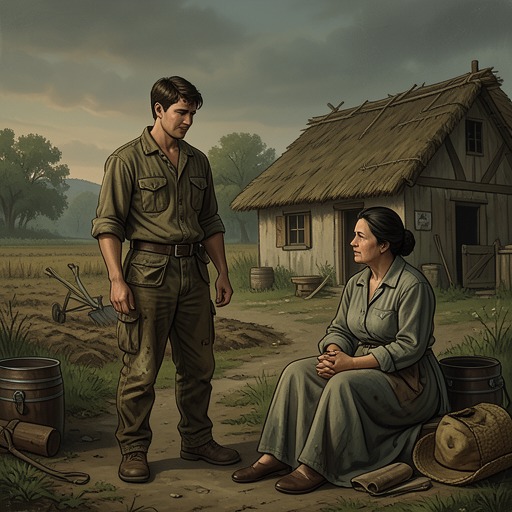
The PeasantsSzymek and Nastusia's cottage is the home Szymek builds for the two of them, and the concrete foundation of their independence after their marriage. Planned with the village opposite and the forest beside it, the house grows from Szymek’s resolve not to live as a hired hand into a shared home completed just in time for the wedding. Its making brings individual effort together with help from the community, while its possession gives Szymek a place of his own and a future household with Nastusia.
Site and intention
After walking the boundaries of his field, Szymek carefully chose where to put the cottage. He wanted the village across from it and the forest alongside: the woods would make obtaining firewood easier, and their nearness promised quiet in winter. He marked the four corners with stones, took off his sheepskin, crossed himself, spat on his palms, and began clearing and leveling the ground. The gestures make the building site both a practical workplace and the beginning of a home: Szymek marks out its limits, blesses the labor ahead, and sets his hands to the earth.
The choice answered a specific insecurity. Nastusia reported that Płoszkowa had offered them a room for the winter, but Szymek rejected the offer as entangled in the hostility between Płoszkowa and his mother. He preferred a hut of his own to dependence on someone else’s kindness. He promised Nastusia a cottage with a window, a stove, and what they needed, insisting that it would be ready in three weeks even if the work cost him his strength. Mateusz the Young Villager had promised to help, but Szymek’s plan rested first on his own willingness to labor.
Building through labor and mutual aid
Szymek worked from first light until late evening, day after day, sometimes barely speaking to anyone. Nastusia was working in kind on the Parish Priest of Lipce’s potato fields, so Tereska or someone else brought him food. At first villagers came to look from a distance. They admired his tirelessness and recognized that he would struggle to manage alone, but they hesitated to be the first to offer assistance, expecting him to ask. Szymek did not ask; the possibility did not occur to him. When Jędrzej arrived with a cart and called out that Szymek should show him where to plough, the offer came as a surprise.
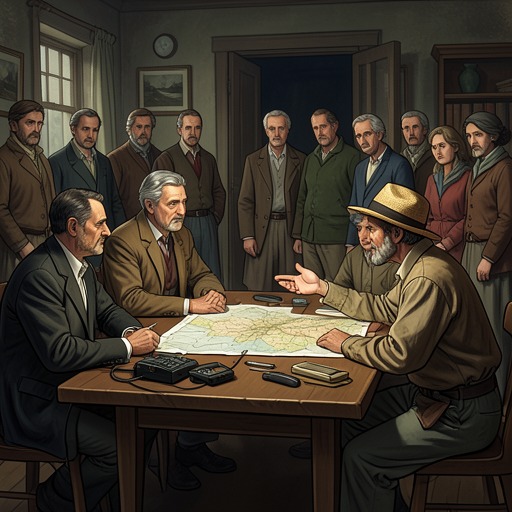
That initial help grew into a wider effort. Pan Jacek offered to work on the house, despite being old, not especially strong, and unused to peasant labor. His skill and practical ingenuity made the work proceed faster and more deftly. He and Szymek worked side by side, ate from the same double pot, and slept under one sheepskin. Szymek felt deep gratitude but remained awkward about closer friendship, regarding Pan Jacek with respect as a man of the squire class. Their cooperation therefore crosses a social boundary without erasing Szymek’s awareness of it.
The work also drew in Mateusz the Young Villager and others. Mateusz labored for almost a week and urged more people to help, while Adam of the Kłąb family carted the necessary wood from the forest. The cottage rose quickly enough to be visible from Lipce. Its construction is not presented as Szymek’s achievement alone: his refusal to ask for help initially delays the assistance others are willing to give, but neighbors and friends eventually make the project collective. Their labor turns the cottage into a visible sign of practical solidarity as well as individual persistence.
Completion and the wedding
When the work was finished on a Saturday afternoon, Mateusz the Young Villager hung a green wreath around the chimney before leaving for his own work. The wreath marks the house as completed and ready to receive a household. Yet Szymek still had tasks to finish. He whitewashed the chamber and cleared away the shavings and rubbish while Pan Jacek changed his clothes, took his fiddle under his arm, and told him that the nest was ready and he should find a hen. Szymek answered that the wedding would take place the next day after vespers, then hurried to thank him. Pan Jacek joked that he had not worked for nothing and might come to lodge with them if he were driven from the village.
Once the cottage was finished, Szymek did not simply leave it behind to prepare for the wedding. He wandered around it, stretched his weary body, touched its walls, and looked through its windows. The lime and fresh clay still smelled musty, but that smell pleased him: the new building was physically real, and it belonged to him. He repeatedly affirmed his ownership as though the fact remained difficult to believe. Only at dusk did he go back to the village to prepare for the following day. The cottage thus stands at the threshold between construction and married life: it is ready before the wedding, but its meaning is completed by the couple’s arrival.
A home claimed by its occupants
After the wedding, when most of the guests had gone, Szymek and Nastusia decided to move directly into their own place. Mateusz the Young Villager urged them to remain at the cottage where they had been staying a little longer, but Szymek was firm. He borrowed a horse from Kłąb and loaded a trunk, bedding, and pots and pans onto the cart. He seated Nastusia with ceremony, bowed and offered gestures of respect to her family, crossed himself, and set out. Their relatives and companions walked alongside them as they left.
The departure gives the cottage its decisive consequence: it is not merely a building completed for a wedding, but the household Szymek chooses to occupy at once. His insistence on moving, despite advice to wait, matches the self-reliance that drove him to build. At the same time, the house bears the marks of dependence on others in the best sense: neighbors contributed labor, Pan Jacek brought skill, and Mateusz helped carry the work through. Set beside the forest and within sight of Lipce, the cottage joins privacy to community. It gives Szymek and Nastusia a home of their own without severing them from the people who helped make it possible.