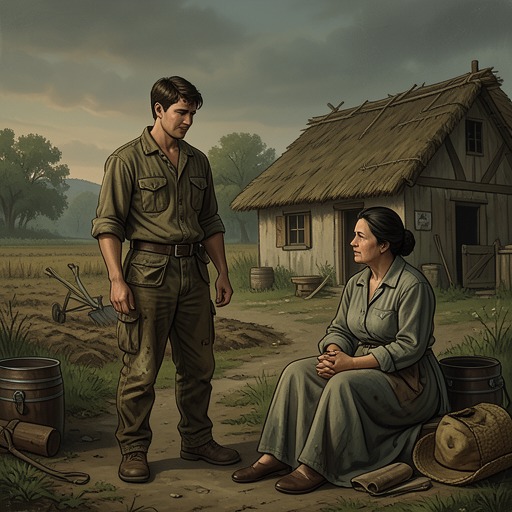
Szymek and Nastusia’s wedding
The PeasantsSzymek and Nastusia’s wedding marks the moment their obstructed courtship becomes a shared household. The ceremony is unusually subdued, but the couple’s departure to a home of their own turns the marriage into an assertion of independence; the villagers’ gifts afterward show that this new life is not theirs to manage alone.
A home prepared against opposition
Szymek’s wedding follows the rapid construction of a cottage at Podlesie. Pan Jacek had worked alongside him, sharing meals and a bed beneath one sheepskin, while Mateusz labored for nearly a week and urged others to help. Kłąb’s Adam brought wood from the forest. The cottage grew large enough to be seen from Lipce, and Mateusz marked its completion by hanging a green wreath around the chimney. Szymek was still whitewashing the room and clearing away shavings when Pan Jacek put his fiddle under his arm and announced that the nest was ready and Szymek should find a bride. Szymek replied that the wedding would take place the following day after vespers.
The marriage proceeds despite Szymek’s mother having forbidden it. On the wedding day, someone reminds him that it is his wedding; his mother answers with a mocking threat about what she will do if he gets drunk. Szymek deliberately declares that he will get drunk and runs to Mateusz’s cottage, where the party is setting out for church. His defiance is plain, but the wedding does not become a grand public challenge: the couple go forward with a small, quiet ceremony.
A subdued ceremony and a noisy celebration
The wedding party leaves for church without singing, shouting, or music. The ceremony itself is described as dismal: only two candles burn, Nastusia weeps, and Szymek sulks, glaring proudly and aggressively at the nearly empty church. The organist’s lively tune as people leave gives the occasion a brief lift, making the departure more cheerful than the service had been.
That restraint contrasts with the more elaborate wedding customs elsewhere in the story. At Boryna and Jagna’s wedding, the bride is blessed with holy water, asks forgiveness, and is embraced by the women of her family and community. Another wedding ritual brings Jagna out veiled in a sheet, seated on a kneading trough as young women try to capture her and men defend her. Szymek and Nastusia’s account instead emphasizes the small congregation and the couple’s uncertain reception. Its emotional weight lies less in a public spectacle than in the home they have made possible and the choice to begin married life together.
After the service, the wedding gathering continues at the cottage where Nastusia had been living with her mother. Mateusz plays the fiddle, Pietrek accompanies him on the pipe, and someone drums. Some guests dance in the narrow room; others dance outside among the tables where people eat, drink, and talk quietly. The celebration remains restrained: making merry in broad daylight is considered unseemly, and the guests are sober. Yet the musicians and dancing create a warmer counterpoint to the bare church and the bride’s tears.
The move to the new cottage
The party dwindles until only family and Ambrozy remain. Szymek insists that he and Nastusia should move into their own place immediately, although Mateusz urges them to stay at the cottage a little longer. Szymek borrows a horse from Kłąb and loads the trunk, bedding, pots, and pans onto the cart. He seats Nastusia with ceremony, takes leave of her mother and the assembled relatives, crosses himself, and sets off while the others walk alongside to see the couple off.
Their journey unfolds at daybreak. The sun rises over dew-bright fields, with birdsong and heavy wheat stirring in the summer air. The scene’s expansive, festive landscape contrasts with the couple’s modest belongings and uncertain start. When Nastusia’s mother notices two storks above the road, she snaps her fingers for luck and predicts that the newlyweds will have children. Nastusia blushes; Szymek, guiding the cart over the bumps, responds with a bold whistle and a roll of his eyes.
Once they are alone, however, the new home feels less like a triumph than a test. Nastusia looks around the cottage and bursts into tears. Szymek, exhausted and drunk, tells her that others have less and will envy her; then he throws himself onto straw in the corner and falls asleep. She remains outside, crying as she looks back toward Lipce, whose white walls are visible among the orchards. The wedding has secured a home, but it has not instantly made that home feel secure or welcoming to her.
Neighbors make the household possible
Nastusia’s distress recurs, though it gradually lessens as the village begins to help. Kłębowa is the first to arrive, carrying a hen and a basket of chicks. After that, a housewife visits almost every day, and no one comes empty-handed. Sikorzyna brings linen and says that a kind word will repay the gift; Płoszkowa brings pork fat and urges Nastusia to help poorer neighbors when she is established. The provisions accumulate until the couple have enough to last for a while.
The support is practical as well as emotional. A hen and chicks help establish the household; linen and pork fat meet immediate needs. The gifts also set an expectation of reciprocity: Nastusia is invited to become part of a chain of assistance, giving to poorer neighbors once she can. Even Jasiek contributes, leaving his dog Kruczek tied at the cottage before fleeing as if scalded. The villagers later tease him about having picked blueberries for Nastusia, which his mother took away. The episode adds a playful note to the aid around the new household, while showing that the couple’s life is being watched and discussed as it takes shape.
The wedding’s decisive change is therefore both personal and communal. Szymek and Nastusia leave the constrained household where their marriage was opposed and enter a cottage built through shared labor. Their first night reveals the hardship and loneliness still ahead, but neighbors answer that vulnerability with food, tools for domestic life, and small acts of care. The marriage begins quietly at church and continues, more consequentially, through the work of making a home and the community’s willingness to help sustain it.