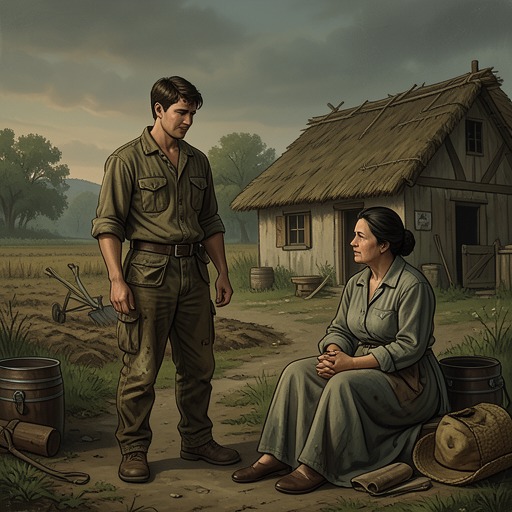
Szymek asserts his right to marry Nastusia
The PeasantsSzymek’s assertion of his right to marry Nastusia turns a village announcement into a test of who controls an adult son’s future. The banns have been read, the wedding is planned for before the harvest, and Szymek declares that he will proceed without his mother’s permission. His claim is not only romantic: he intends to establish a household and obtain his share of the family property, refusing the dependent status of a hired hand.
The banns and the village’s expectation
The news reaches Hanka as people leave High Mass. While the priest is still making announcements from the pulpit, the congregation is already streaming toward the door and the beggars are singing their supplication. In that public, everyday flow, a woman presses beside Hanka with the news that the banns have been read for Dominikowa’s son, Szymek, and Nastusia. The announcement immediately becomes a subject of speculation rather than a private matter between the couple.
The first response is to wonder what Dominikowa will say. The women expect her to pick a fight with her son, but the counterpoint is that Szymek is old enough and has a right to marry. That exchange establishes the dispute’s central tension before Szymek himself speaks: a mother may resist the match or control access to family property, but the village recognizes that her son is no longer a child whose marriage can simply be decided for him.
Questions about marriage and land
Later, Mateusz asks Jagna what her mother has said about Szymek’s banns. Jagna answers that, if Szymek wants to marry, he should do so; she does not claim to know what Dominikowa will decide about his land. When Mateusz presses the practical issue—whether Szymek will receive his morgen—Jagna says she has been told nothing and that Szymek must ask his mother himself. The conversation separates the marriage decision from the property question without resolving either one.
Szymek then joins Jagna and Nastusia, with Jędrzych arriving as well. His opening request is that Jagna not take his mother’s side when he is being wronged. Jagna replies that she is taking his side, but observes that he has changed. The exchange makes his new independence visible to the group: Szymek appears tall, clean-shaven, neatly dressed, with his hat tilted and a white capote. He describes himself as having climbed out of a child’s pen. The image gives his claim a plain measure of its own: he insists that he has outgrown the confinement of being treated as a boy.
Szymek’s declaration and plan
Jagna laughs at his boldness and asks whether freedom suits him. Szymek answers with a saying about releasing a bird from one’s grasp, then asks whether she has heard the banns. When she asks when the wedding will be, Nastusia nestles against him and holds him around the waist. Blushing, she says it is to be in three weeks, before the harvest. Her gesture and answer make clear that the marriage is not merely Szymek’s solitary challenge to his mother; Nastusia is present beside him as his intended partner.
Szymek states that he will not ask Dominikowa, even if he has to hold the wedding in the inn. The conditional is deliberately stark: if his mother’s resistance prevents a wedding at home, he still means to marry. Asked whether he has somewhere to take a wife, he says that he does. His plan is to move into the other half of his mother’s house and have her sign over his portion. He boasts that he will manage, adding that he does not intend to be anyone’s hired hand. Marriage, residence, and land therefore converge in one declaration: he claims the right to choose Nastusia, make a home, and live by his own work rather than remain dependent on his mother.
What the assertion changes
The scene does not report Dominikowa’s response or establish whether she grants the requested share. Instead, it shows Szymek shifting the burden of decision: he no longer waits for his mother to authorize his marriage, and he says he will ask directly for the property that would support his household. Jagna’s refusal to speak for Dominikowa reinforces that shift; the land question belongs between mother and son, not to rumor or mediation by others.
The announced wedding date gives the dispute a near-term horizon, while its placement before the harvest ties the couple’s plan to the village’s agricultural calendar. Yet the scene’s decisive point is not the later outcome but Szymek’s public position. Against the anticipated maternal quarrel, he presents himself as an adult entitled to marry and to claim a place of his own. His independence remains conditional on receiving a portion of the family home and land, but he no longer describes himself as willing to live as a dependent laborer.