Szymek establishes an independent farm
The PeasantsSzymek establishes an independent farm by refusing to surrender his claim to land after his mother drives him from her household. Unable to obtain a settlement from her, he takes up a practical alternative: he buys six morgs from the squire at Podlesie, pays by instalments, and begins building on a plot others consider nearly worthless. The farm’s beginnings make independence less a matter of inheritance than of labor, risk, and help freely given.
From family rupture to a plan
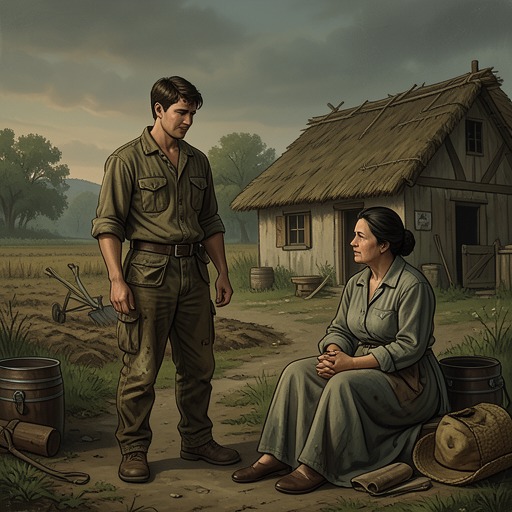
Szymek’s decision follows a bitter dispute over the property of his mother, Dominikowa. He says she is denying him the land due from his father, has chased him out of the house, and will not grant him a settlement. In despair, he threatens violence and protests that he will not give up what is his, even if the struggle sends him to prison. His anger is bound to a material predicament: without land or a settlement, he does not know where he can go or how he can make a living.
The people around him try to calm him and consider how to help, but they see no way to change Dominikowa’s decision. The opening comes from his sister, Nastka, who proposes that he buy six morgs from the squire at Podlesie and pay in instalments. Szymek returns delighted by the suggestion. Nastusia, he explains, has a thousand zlotys—enough for a down payment. The plan is not yet secure: the purchase depends on the squire accepting instalments, and the others immediately ask how Szymek will also afford a cottage, livestock, tools, and seed. His answer is not a completed budget but a declaration that these necessities can be found. The shift is decisive: instead of waiting for his mother to recognize his claim, he begins imagining a household he can establish himself.
Choosing difficult land
Szymek insists that he can make a living from work. He recalls that he alone ploughed, sowed, and brought in the harvest at his mother’s, and appeals to the village as witness that he was no idler. He asks the people around him to give him land and help him get started, promising to remain in their debt. His words mingle a plea for support with an assertion of competence: he wants assistance, but he does not present himself as incapable of doing the work.
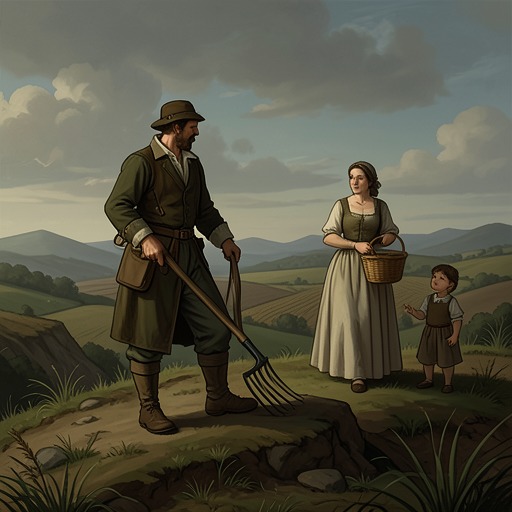
The plot he takes is beside the forest, with Lipce fields along one side. It is a rough tract rather than a ready-made farm: old clay-pit hollows interrupt it, rubble and heaps of stone cover the ground, and thorny growth, weeds, rushes, reeds, alders, junipers, and twisted pines occupy its rises and wet hollows. Even the squire advises against it, and Mateusz is appalled by the wilderness. Yet the squire sells it cheaply, at sixty roubles a morgen, and promises help with wood and other necessities. Szymek accepts the unfavorable ground precisely as something he can transform through effort. His insistence that all land becomes good when a man puts his hand to it opposes the judgment that only immediately productive property is worth taking.
When he first walks the boundaries, the holding is marked by branches stuck into the ground. He is carrying a heavy barrow, but his attention is already on the work ahead: he considers where to begin and in what order to proceed. The land’s barrenness makes the promise of ownership tangible, while the simple boundary markers show how modest and unfinished that ownership remains. Szymek’s joy rests not on an established prosperity but on the prospect of making something from a place that even the seller doubts.
Neighbors turn a purchase into a farm
Szymek does not explicitly ask the villagers for further assistance, although they recognize that he is laboring like an ox and agree that he deserves help. They wait for him to request it. Instead, Jędrzej arrives with a cart and calls out that he has come to show where to plough. He explains that he wanted to help earlier but was afraid: Jagusia had been watching him, and she had also warned him against it. Jędrzej and Szymek plough together for the day, and Jędrzej promises to return the next morning; he does so. Szymek notices bruising on his cheeks but initially leaves the matter unasked. The assistance therefore comes with a risk and a personal complication for the helper, not merely as an abstract expression of village goodwill.
Pan Jacek also offers his labor, telling Szymek that he will help build the house. Though unused to peasant work and not strong, he knows how to make the work proceed more efficiently. Szymek defers to him, astonished that a man of the squire’s class is working beside him. The two share food from a double pot and sleep beneath one sheepskin, but Szymek remains too respectful and awkward to treat Pan Jacek as an intimate friend. His gratitude coexists with an awareness of social distance: practical cooperation does not erase the distinction he perceives between them.
The house grows quickly through a wider chain of help. Mateusz works hard for almost a week and urges others onward, while Adam of the Kłąbs carts the necessary wood from the forest. By the end of the week, the shack is so conspicuous that it can be seen from Lipce. When the work is finished on Saturday afternoon, Mateusz hangs a green wreath around the chimney and goes back to his own work. The wreath marks the building as newly completed, but the farm is still being finished: Szymek is whitewashing the chamber and clearing away shavings and rubbish as the others depart.
A household begun, not inherited
The farm’s founding reverses the exclusion that set it in motion. Dominikowa’s refusal leaves Szymek without a place in her household; the purchase gives him a plot on which he can begin forming one of his own. As he walks the boundaries, he imagines the work as being for himself, Nastusia, and the future Pacześ line. Land thus carries more than immediate subsistence: it offers a basis for a future household and continuity beyond the quarrel with his mother.
The farm also emerges through a pattern of support that differs from a formal settlement. The squire makes the cheap land available and promises materials; Nastusia contributes the money for the down payment; Jędrzej ploughs; Pan Jacek helps build; and Mateusz and Adam add labor and transport. Szymek’s independence is real, but it is not solitary. He takes responsibility for the holding and repeatedly asserts his ability to work it, while its first structures depend on assistance from people around him.
When Pan Jacek says the nest is ready and Szymek should find a hen, the finished cottage is cast as the beginning of a household rather than the end of the undertaking. The building, land, and shared labor give physical form to Szymek’s answer to dispossession: he cannot recover the home or settlement withheld by Dominikowa, but he can claim a difficult plot, work it, and prepare a place for a future with Nastusia.