The Inn Dance and Boryna’s Confrontation with Antek
The PeasantsThe Inn Dance and Boryna’s Confrontation with Antek turns a village celebration into a public rupture in the Boryna household. Antek’s unrestrained dancing with Jagna, his father’s wife, makes their attraction visible to the crowd; Boryna’s intervention stops the music and brings the family conflict into the snowy lane outside. The scene’s movement from festive exhilaration to stunned silence gives the dance its force: pleasure becomes exposure, and exposure becomes a direct confrontation between father and son.
The Inn and the Public Display
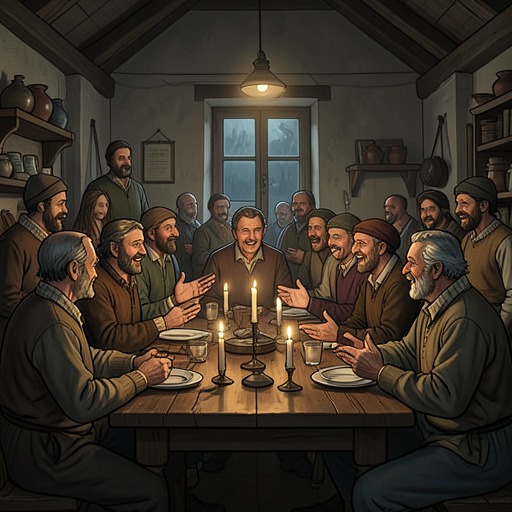
Boryna does not arrive at Jankiel’s inn willingly. He protests and curses before eventually apologizing and setting out, then enters proud and aloof, barely greeting anyone. Many of the village’s leading people are away at the Voyt’s christening, and Boryna scans the gathering for his son without finding him. His entrance establishes a sharp contrast: while he remains apart from the crowd, Antek’s attention is already fixed on Jagna.
Jagna stands by the bar as young men come to ask her to dance. She refuses them, chats, and furtively searches the room with her eyes. Her appearance commands attention even among other dressed-up young women: Nastka Gołębianka wears red, Weronka is rosy-cheeked, and Marysia Balcerkówna is known as the village’s best dancer, but the narration singles Jagna out as surpassing them all. Her clothes make that distinction visible. She wears an orange skirt striped in green and white, a low-cut blue velvet waistcoat edged with gold thread, a white blouse full at the neck and wrists, amber and pearl beads, and a blue silk scarf patterned in pink. The women gossip about her finery, but she pays them no mind. When she catches sight of Antek, she blushes with joy and turns away from Boryna, who is being led into the snug by Jankiel.
Antek has been waiting for the opportunity to approach her. He makes his way along the side of the room and greets the group; Józka Borynianka pointedly turns away. The crowd, the watching women, and the conspicuous contrast between Jagna’s attention to Antek and her marriage to Boryna make the encounter public before either man openly challenges the other.
The Dance as Escalation
When Antek takes Jagna by the waist and leads her into the dancing circle, she trembles and asks him to let her go, mindful that people surround them. He does not answer. Instead, he calls for an obertas, and the musicians launch into the dance. His friends join in, including Płoszka, Balcerek, and Grzela; Mateusz, whose ribs prevent him from dancing, keeps time with his feet and urges the dancers on.
Antek takes the lead and outdances the others. Jagna presses close to him, and he loses awareness of the people watching. They dance for a long time, stopping only to catch their breath and drink beer. Their intimacy becomes harder to dismiss with each turn: Antek holds her close, and Jagna, caught up in the movement, repeatedly urges him to continue. The narration presents their delight as bodily and immediate, carried through touch, breath, and the dizzying pace of the dance. Around them, the audience notices, whispers, frowns, and makes remarks aloud. The couple’s absorption in one another does not keep the village from watching; it makes the contrast between their private rapture and public scrutiny more pronounced.
The music and the crowd magnify the scene. Fiddles, bass viols, and flute drive the dancers into a broad circle of about fifty couples. Flagons tumble and lamps go out; firelight catches the whirling crowd as it spins from the inn through the doorway into the winter night. Antek dances more wildly than anyone else, then keeps the musicians playing by tossing them money even after others tire and the circle dwindles. The dance’s mounting energy turns his closeness with Jagna into a spectacle that Boryna can no longer miss.
Boryna Intervenes
Women upset by the spectacle go to fetch Boryna. Emerging from the snug, he sees Antek and Jagna at the head of the dance and understands what is happening. He is seized by anger, but at first says nothing; pale and wild-eyed, he fastens his capote and pushes through the crowd. When the pair sweep past, he orders them home and reaches for Jagna. Antek’s turn carries her out of Boryna’s grasp, so Boryna breaks through the circle, pulls her from his son’s arms, and leads her out without looking at Antek.
The music stops at once. The crowd falls silent, sensing that something serious is about to happen. Antek hurls himself after his father and Jagna, forcing through the people, but stumbles over a tree trunk in front of the inn and falls into the snow. He gets up quickly and catches them by the road’s turn near the pond. Boryna tells him to take his own road and stop harassing people. Jagna escapes toward the cottage with a cry, while Józka Borynianka puts a picket into Boryna’s hand and urges him to strike Antek.
Antek advances with raised fists, demanding that Boryna let Jagna go. Boryna threatens to kill him if he does not leave. The threat changes the balance of the encounter: Antek instinctively backs away, drops his hands, and begins to tremble. Boryna walks slowly home. The confrontation does not become a fight, but the threat and Antek’s retreat make the depth of their hostility unmistakable.
Aftermath and Significance
Left outside beneath the bright moon, Antek is shaken and only half-conscious. The snow glitters around him, but he cannot make sense of what has happened. Friends bring him back to the inn after word spreads that he has fought with his father. By then the celebration is over: the guests have dispersed, and only the people from Rzepki remain for the night. Pan Jacek plays mournful tunes while they sit at the tables, heads in their hands.
Antek sits alone in a corner and does not answer those who try to reach him. He is so unresponsive that Jankiel’s reminder that the inn is closing has no effect; Hanka’s voice is what finally rouses him, after people have told her he has again come to blows with his father. The scene thus ends not with reconciliation or a settled contest, but with the festive crowd gone and Antek isolated, while the consequences of the public display follow him home.
The dance makes desire legible to the village through gesture rather than declaration. Antek’s grip, Jagna’s closeness, the onlookers’ whispers, and Boryna’s forceful removal of his wife transform a crowded social occasion into a contest over intimacy and authority. Its abrupt stop marks a decisive change in the scene’s emotional charge: the joy of the dance gives way to fear, shame, and the threat of violence, leaving the father-son conflict more exposed than before.