The Lipce Forest Battle
The PeasantsThe Lipce Forest Battle is the villagers’ armed response to the manor’s felling of the forest they claim as theirs, and a turning point in the conflict between customary rights and estate power. What begins as a march to stop the work becomes a bloody confrontation; at its center, Maciej Boryna is struck down, while Antek Boryna’s hesitation to shoot his father gives way to lethal violence against the woodsman.
Causes and Mobilization
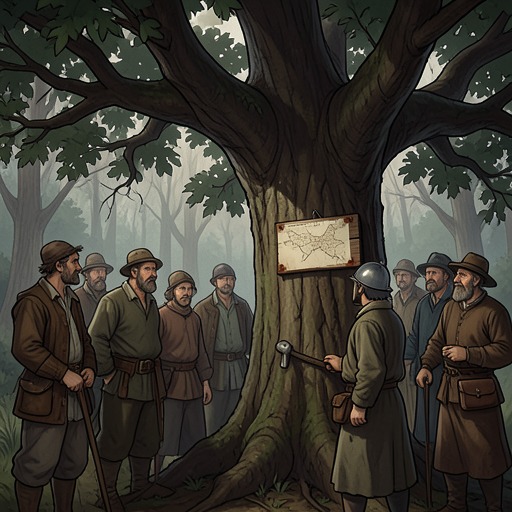
The immediate news reached Lipce on a bleak day in mid-March, as rain swept the village and thawing ice broke against the banks of the pond. At first, the villagers doubted the report that the squire had begun felling their forest: the season seemed an unlikely time to start, and people assumed that whatever work was underway must be some other woodland task. The news mattered because the villagers understood the trees as a shared right, while the manor’s decision to cut them threatened both that claim and their already accumulated grievances against its authority.
At dawn, Antek ran to the bell tower and rang the bell with the urgency of a fire alarm. Ambrozy and the organist tried to stop him, but he continued, bringing the village out of its uneasy sleep. Mateusz, Kobus, and others ran through Lipce, shouting and striking fences to summon people. The bell’s sustained, sombre toll turned scattered alarm into a common call: villagers left their cottages and gathered in the square by the inn.
The crowd waited for the elders to fetch Maciej Boryna. His position as the village’s leading farmer gave him the authority to take the front, and no farmer would begin the action without him. The people stood shoulder to shoulder, listening to the agitation moving among them. The blacksmith and miller tried to dissuade them, warning that they could all end up in prison; their intervention failed, in part because the crowd believed they served the manor’s interests. Even the Parish Priest of Lipce pleaded with the villagers to go home, but when Maciej arrived, attention shifted to him.
Maciej addressed farmers and hired hands together. He named the felling as the latest in a long sequence of injuries: the manor had refused them work, harried them, and seemed beyond the reach of courts or complaints. He argued that the villagers had no effective protector and must defend what they considered their own. The crowd answered his call to go to the forest. People raced home to change and prepare; horses were harnessed, sleighs brought out, and weapons gathered. Farmers, laborers, women, and even older children joined the procession. Some rode in sleighs, on horses, or in carts; most went on foot. Poles, pitchforks, flails, and a few scythes rose above the crowd. Before they set out, Maciej crossed himself and invoked the Christian Trinity.
Confrontation in the Forest
The cutting had been underway since dawn in Wolf’s Hollow. More than forty peasants were at work there, and the forest bore the evidence of their labor: felled trees lay across trampled snow, branches and logs covered the clearing, and golden sawdust marked the cut ground. The arriving crowd came from the village in a dense mass, with Maciej at its head. The villagers rushed the woodcutters, demanding that they stop and leave. Maciej addressed the workers from Modlica, Rzepki, and elsewhere, ordering them to take what was theirs and go, and declaring the felling forbidden.
The woodcutters initially gave way. The villagers put out fires and dismantled plank huts at the clearing’s edge; Kozłowa led the women in tearing the structures apart. Maciej then urged the farmers to go to the manor and warn the squire not to touch the timber until the law restored the peasants’ rights. Before they could decide what to do, however, horses arrived from the forest: the manor had sent help.
The steward led the farmhands into the clearing. They attacked the women with whips, while the villagers scattered under the assault. Maciej’s call to stay together brought them back to him. Taking up a wooden stake, he led the charge against the manor’s men. The villagers closed ranks and fought with the tools they had brought, while the manor’s men resisted and their horses recoiled amid the blows and noise. The steward tried to reach Maciej on horseback but was pulled down in the melee. Maciej helped move the unconscious man out of immediate danger even as the fighting continued around them.
The woodcutters and the men of Rzepki joined the manor’s side. Their leader, the woodsman, had his own grudges against Lipce and fought against the villagers. The combat spread through the clearing and into the trees, where groups grappled and pursued one another. The women, including Kozłowa, had already faced the attackers and were still among the participants despite being beaten and exhausted. Neither side quickly gained the upper hand; the villagers’ collective numbers met the manor’s force and the reinforcements from Rzepki.
Maciej and Antek
Antek arrived late and saw Maciej struggling with the woodsman. Unnoticed amid the confusion, he drew his shotgun and aimed at his father. He did not fire. As Maciej and the woodsman regained their feet, Antek remained unable to shoot, overcome by fear and shaking so badly that he lost his bearings. The moment reveals how the public forest dispute and the private father-son feud converge: Antek has the weapon and the opportunity, but cannot make himself kill Maciej.
The woodsman then struck Maciej with the butt of his gun, and the old man fell, badly wounded. Antek dropped his shotgun and rushed to his father. When he understood that Maciej was still alive, he turned on the woodsman. The woodsman fired at close range but missed; Antek caught him and killed him. He then plunged back into the battle, frightening and overpowering those who were still resisting, until others had to restrain him lest he continue the assault. His transformation is sudden but rooted in the scene’s reversal: the son who could not shoot his father becomes the man who kills the attacker who has felled him.
Outcome and Significance
The Lipce villagers emerged from the fight exhausted, wounded, and bloodied, but jubilant at having driven back their opponents. Their injuries were substantial: a young member of the Kłąb family had a broken arm, Jędrzych Pacześ could not walk, Kobus was too badly beaten to move, and Mateusz was bleeding and complained of back pain. The women tended those most seriously hurt and carried them to the sleighs. The villagers’ victory therefore did not erase the cost of their resistance; it made that cost visible in the bodies they had to bring home.
They placed Maciej in a sleigh and moved slowly, fearing he might die on the way. He was unconscious, and blood seeped through his bandages. Antek walked beside him, steadying his head over the ruts and repeatedly pleading with him. The battle thus ends not with uncomplicated triumph, but with the community’s leader gravely injured and his son at his side, shaken by the violence he has both witnessed and inflicted.
The confrontation also gives physical form to the villagers’ claim that the forest is theirs. They first try to stop the cutting by ordering the workers away, then dismantle the huts and resist the manor’s armed intervention. Maciej’s appeal to collective defense gathers farmers, hired hands, women, and young people into a single force, though the battle’s losses show the danger of that action. Later village confrontations preserve a related pattern: at the school-tax gathering, the villagers refuse to run errands for the manor, and when gendarmes are present in another crowd, people close ranks around them. These later acts are not the battle itself, but they show that collective refusal remains part of Lipce’s political life. In the forest, that refusal takes its most violent form, binding a shared grievance to Maciej’s authority, Antek’s divided loyalties, and the continuing struggle over who may use the land.