The Lipce Villagers Beat and Expel Jagna
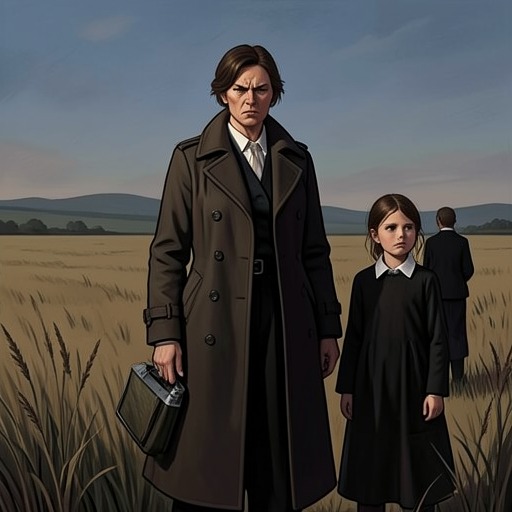
The PeasantsThe Lipce Villagers Beat and Expel Jagna is the village’s collective act of violence against a woman whose desires and choices unsettle its social order. Jagna is stoned, beaten, and driven from Lipce, yet she is not killed: left ill and incapacitated with her mother, she remains part of the community it has tried to silence. The episode brings the novel’s recurring conflict between individual desire and communal conformity to a brutal conclusion, while exposing expulsion as a means of restoring order without addressing the inequalities and injuries that order protects.
Causes and Background
The attack has a long prehistory in the novel’s portrayal of Jagna as both intensely desired and persistently judged. The opening already discloses that her affair with Antek is under way, while village women discuss her beauty, wealth, and mother, Dominikowa. In that same early scene, Jagustynka anticipates that a woman of Jagna’s kind could once have been driven out. The forecast makes the eventual expulsion feel less like an unforeseen eruption than a possibility the village has carried within its gossip from the start.
The commentary on the novel connects the expulsion to Jagna’s repeated violations of what Lipce treats as sacred. She refuses to share the community’s absolute attachment to land, and she later casts aside the settlement document that grants her six morgen. Her seduction of Jasio, the organist’s son and a future priest, is described as a final desecration. In this reading, the offense is not reducible to a single sexual transgression: Jagna repeatedly unsettles the boundaries between property and indifference, sacred and secular, accepted conduct and personal desire. The collective response follows when these disruptions appear to threaten the norms through which Lipce recognizes itself.
That conflict unfolds in a village already marked by material scarcity and resentment. During a hard winter, at least twenty hired hands urgently need work; some have lost their potatoes to frost, and the poor face hunger before the next harvest. The squire’s refusal to employ men from Lipce while felling the forest intensifies the sense of injustice. In another account of village hardship, children are hungry, sick households have no food or credit, and fields stand fallow while men are imprisoned. These circumstances do not establish a direct cause for the assault on Jagna. They do, however, show the wider community in which exclusion takes place: severe need is visible, but its burdens are borne unevenly, and the prevailing order offers no effective remedy.
The Violence and Its Meaning
The novel’s account, as interpreted in the supplied commentary, identifies the villagers’ action as a lynching and describes Jagna as being stoned. The attack culminates in her expulsion. Its force lies not only in the physical violence but in the collective authority claimed on its behalf. The crowd’s declaration, “The people are sanctioned to punish and sanctioned to reward!” presents punishment as an entitlement of the community rather than a judgment subject to law or deliberation.
Antek’s response reveals how far he has moved from his earlier rebellion. Once separated from the village by his passion for Jagna and his conflict with his father, he now declares, “I live in the village, and I stand with the village! You want to cast her out, then cast her out; and if you want to stick her on an altar, then stick her on it! It’s all the same to me!” His words do not defend Jagna or distinguish between condemning her and honoring her. Instead, they affirm his submission to the village’s decision, even as they expose his indifference to what that decision means for the woman he once loved.
The violence is therefore more than a punishment imposed by particular accusers. The critical account reads it as a systemic corrective: Jagna disrupts the social organism so extensively that the community renders her harmless. Her expulsion helps restore the village’s homeostasis, but it does so through exclusion rather than through reflection or resolution. The episode’s bitter irony is that the crowd asserts a power to punish and reward while its most persistent material grievances—poverty, competition for land, and the inability to influence those in authority—remain unsettled.
Community, Politics, and Exclusion
The expulsion follows a larger pattern in which moments of possible collective change lose their force. The conflict over the manor’s felling of the forest briefly brings the peasants together around a shared claim. At a public gathering, Antek calls the villagers farmers and hired hands and lists their injuries: the forest being felled, employment withheld, and complaints that have achieved nothing. The crowd answers with anger and demands resistance. Yet the political energy of such moments does not develop into a lasting transformation of the community. The commentary describes the novel’s political finale as immobilized rather than revolutionary.
The treatment of Jagna belongs to that failure of transformation. The village can act together decisively against an individual within its boundaries, but this unity does not make it a conscious political community capable of overcoming its social divisions. The analysis distinguishes a potential collective People from the pre-political community that reasserts itself. With the men’s return from prison and Jagna’s banishment, the disturbance is stabilized; solidarity is restored on terms that require an internal victim.
Rocho’s inaction sharpens the point. Though a political emissary, he does not intervene to prevent Jagna’s lynching. His refusal is part of a broader pattern: he also refrains from reconciling Boryna and Antek and accepts Agata’s life of begging. The narrative’s political agents preserve the community’s identity and potential without turning it into a force that protects each of its members. Jagna’s expulsion thus exposes the gap between maintaining a community and making it just.
Aftermath and Narrative Significance
Jagna survives the attack. At the end of the novel she is with her mother, battered, ill, and incapacitated, but alive. Her survival matters: the community has removed her from its shared life, not erased her from the story. The commentary cautiously suggests that, if she recovers, she may succeed Jagustynka, changing from a figure of desecration into one capable of speaking openly. This remains a possibility, not a completed transformation; the ending leaves Jagna’s future uncertain while refusing to make her death the price of restored order.
The event also gathers the novel’s seasonal and social arguments into one stark outcome. The community’s survival appears to demand a sacrificial victim, and Jagna becomes that victim even though the order her expulsion restores is still marked by unequal wealth, hunger, violence, and fear of the outside world. Her punishment does not resolve those conditions. It reveals instead how a community can defend its customary norms with extraordinary force while leaving the hardships those norms coexist with largely untouched. In that sense, the expulsion is both a culmination of the plot and a measure of Lipce’s political limits: it can unite to cast someone out more readily than it can unite to change the conditions that injure its own people.