The Lipce villagers’ forest uprising
The PeasantsThe Lipce villagers’ forest uprising transforms a longstanding grievance over access to the peasants’ forest into a mass confrontation with the manor. Its defining movement is from guarded discussion to collective action: the villagers gather, arm themselves, and go to stop the felling, asserting a shared right that they believe the manor has ignored.
Background and Mobilization
The immediate alarm comes in the evening, when Kłąb sticks his head around the door and announces that the squire is felling the peasants’ forest. The report races through Lipce with the force of an emergency. Doors slam as people carry the news from cottage to cottage; distress and anger spread, but the first response is not an uncontrolled rush to violence. A hush falls over the village. People speak in whispers, watchfully weighing their words, because they understand that the threatened forest concerns the whole community and calls for common resolve.
Farmers begin assembling and head toward the Voyt’s home, joined in the movement by people from across the village. Among those observed going are Winciorek and limping Grzela, Michał of the Cabans, Franek Bylica, Socha, Walek, Józek Wachnik, Kazimierz Sikora, and old Płoszka. Boryna is not initially seen, though word has it that he has gone too. The Voyt is away at the chancellery, so the group moves instead to Kłąb’s cottage. Those gathered shut the door against the crowd outside, while Kłąb’s son Wojtek watches the roads and the inn in case a gendarme appears. Even before anyone sets out for the forest, the meeting is marked by caution: the villagers act together, but they are alert to the possibility of official intervention.
When the assembled farmers hesitate over who should speak, Antek steps into the middle and denounces the manor. He warns that surrendering the forest will invite further encroachment on land, cottages, and property. His appeal makes the conflict larger than the timber being cut: the forest becomes a test of whether the villagers can defend their holdings and oppose the manor’s power. At dawn, Antek runs to the bell tower and rings the bell as if there were a fire. Its grave, unceasing peal draws people from their cottages; Mateusz, Kobus, and others run through the village, striking fences with sticks and summoning everyone to meet by the inn and go to the forest.
Boryna’s Call to Collective Action
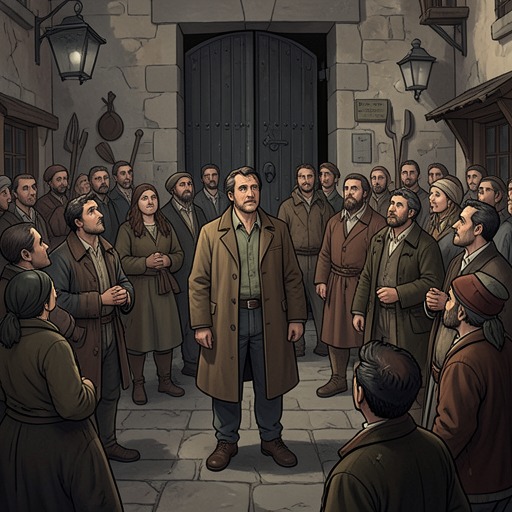
At the inn, villagers gather in silence, leaving room for those expected to join and waiting for the elders, who have gone to fetch Boryna. The priest, confronted by the crowd’s stern and combative mood, weeps and urges them to come to their senses and return home. His appeal ends when Boryna arrives and the people turn toward him. Pale, erect, and grim, with eyes that gleam like a wolf’s, he climbs onto logs beside the inn. The crowd first shouts over him; only when it quiets can he address them.
Boryna names the injury as collective and cumulative. He addresses farmers and hired hands together, recalling the manor’s refusal to employ the villagers, its repeated harassment, and the complaints and court actions that have failed to stop it. The felling is the last straw: the manor is cutting the forest the villagers regard as theirs. His speech turns a dispute over trees into a defense of the village’s homes and property, and makes the community itself the agent of resistance. Antek’s warning the previous evening—that if the villagers do not defend the forest, the manor may next reach for their land and cottages—finds its answer in Boryna’s demand that they act together.
Boryna insists that the villagers go to the forest and stop the work as a whole community, including everyone able to move. He presents their action as a defense of right and justice, and argues that the manor cannot punish an entire village. The appeal is answered in a roar of agreement. People scatter to prepare: they change clothes, harness horses, and drag out sleighs amid neighing, children’s shouts, women’s lamenting, curses, and hurried activity. Within a short time, the crowd sets off toward the poplar road, where Boryna waits with Płoszka, Kłąb, and the other leaders.
The procession makes the breadth of the mobilization visible. Farmers, farmhands, women, and older children travel in sleighs, carts, and on horses, while most walk together in a long, dense body. Stout poles, rusty pitchforks, flails, and occasional scythes rise above the crowd; the women’s red clothing streaks the mass of people. The scene resembles an ordinary journey to the fields in its mixture of vehicles and walkers, but its silence and grim expressions replace the laughter and joking of daily work. Before they proceed, Boryna stands on his sleigh, crosses himself, and begins with a prayer: “In the name of Father, Son and Holy Ghost! Amen. Let’s go!” The religious invocation and the villagers’ weapons accompany one another as the march becomes a direct attempt to enforce their claim.
The First Stand and the Manor’s Counterattack
The villagers reach the clearing in a surge of people, arriving on sleighs, carts, and horses and on foot, shouting as they descend upon the woodcutters. Maciej Boryna leaps from his sleigh and leads the charge. Some villagers brandish sticks, pitchforks, or flails; others carry a scythe or only a branch, while the women rush forward with their cries and bare hands. The crowd’s overlapping demand is simple: “Stop! Get out of the forest! It’s ours!” Boryna makes the order unmistakable, telling the woodcutters to take their tools and leave, and declaring the felling forbidden. Faced with the crowd’s numbers and weapons, the workers do not resist. They collect their axes and saws and retreat toward the forest, while the villagers press them back.
The villagers immediately try to erase the signs of the work. Some put out the fires and dismantle the stacks of cut timber; Kozłowa leads the women in tearing down the plank huts built at the edge of the clearing and scattering their boards. Boryna wants the farmers to go on together to the manor and warn the squire not to touch the woodland until the law has restored it to the peasants. But the gathering has little time to settle its next move. Dozens of horses burst from the forest: the manor has learned of the confrontation and sent help for the woodcutters.
The steward rides at the head of the manor’s farmhands. They charge into the clearing and begin lashing the women with whips. As frightened villagers scatter, Boryna calls on them to stay together; those who hear him stop and run back to him, shielding their heads from the blows with their arms. He takes up a wooden stake and attacks first, urging the villagers to strike the manor’s men and their horses. The peasants close ranks behind him, flails and pitchforks joining the assault. What had begun as an attempt to halt the felling becomes a fight over whether the manor can drive the villagers from the clearing by force.
The Battle Spreads
The struggle turns into a confused melee. The manor’s men fight back, and the horses, struck by flails, rear and refuse to move. Seeing his side falter, the steward spurs his bay horse straight into the crowd toward Boryna. A dozen blows fall on him, and many hands seize him and drag him from the saddle, hurling him into the snow. Boryna manages to shield the unconscious man and pull him to a safer place. The moment does not end the fighting: bodies continue to collide and roll through the snow, and people who break free sometimes turn and rush back into the fray.
Both sides fight at close quarters, gripping hair and collars, crushing opponents with their knees, and clawing at one another. The manor’s men have dismounted and hold their ground; reinforcements keep arriving. Men from Rzepki, whose gentry have long skirmished with their Lipce neighbours, come to the woodcutters’ aid. Their leader, the woodsman, is a powerful, notorious fighter with grievances against the villagers. He uses the butt of his shotgun to knock people down and scatter groups who try to stop him. When Stacho Płoszka attempts to restrain him, the woodsman catches him by the collar, swings him through the air, and throws him into the snow, leaving him unconscious. A Wachnik strikes the woodsman’s shoulder with a flail, but the woodsman punches him in the eyes; he falls with a cry of “Jesus!”
Mateusz the Young Villager then takes on the woodsman. Though a burly fighter and one of the few villagers said to equal Antek, he is quickly knocked down and beaten in the snow, and has to flee. The woodsman heads for Boryna, who is fighting men from Rzepki in the middle of the clearing, but the women intercept him. They shriek, claw his face and tangled hair, and pin him to the ground. Their intervention helps shift the advantage: the villagers regroup in close clusters, while the women attack from the sides, tearing at their opponents’ hair.
The combat becomes so disorderly that friend and foe are difficult to distinguish. At last, the villagers drive back the manor’s men: some lie bloodied, and others, exhausted, withdraw into the forest. The woodcutters continue fighting until they are spent; some beg for mercy, but the villagers, more enraged at them than at the manor’s men, continue to beat them. In the fury of the struggle, weapons are dropped and the fighting becomes hand to hand, with opponents choking, grappling, and rolling together in the snow. The battle is rendered not as a clean victory parade but as a collective loss of restraint, an “unutterable day of reckoning” in which the villagers’ anger carries even the wounded and beaten back into the fray.
The fighting does not end with the retreat of the manor’s men. The villagers pursue those who flee, sometimes several attacking one, while the woodsman, having shaken off the women, rallies his men. He spots Boryna and leaps at him. The two seize one another around the middle, shoulders locked, and stagger against the trees as their struggle carries them into the forest. Their grapple leaves the confrontation unresolved at this point: the leader of the villagers and the powerful champion of the opposing side are now locked together at the edge of the larger battle.
Property, Custom, and the Unresolved Claim
The uprising’s immediate target is the cutting, but the villagers understand the threatened woodland as part of a wider contest over possession and security. In an earlier dispute over pasturage, a villager insists that the land belongs to them and is recorded as theirs, while others repeatedly drive them off and claim it. The grievance is thus not simply that trees are being felled: official records, customary use, and the manor’s power to act on the ground do not reliably coincide in the villagers’ experience.
The language of measured holdings also shadows the forest dispute. Looking over the trees, Maciej Boryna calculates his four morgen alongside Jagusia’s one, treating land as a concrete measure of what is at stake. That arithmetic helps explain why the villagers’ defense joins woodland to cottages, fields, and property in their speeches: to yield one claim appears to expose the rest. Yet the scene closes not with a settled boundary or legal judgment, but with Boryna and the woodsman locked together among the trees. The collective action has driven back part of the manor’s force, but the physical struggle leaves the dispute unresolved and turns the forest itself into the ground on which competing claims are tested.