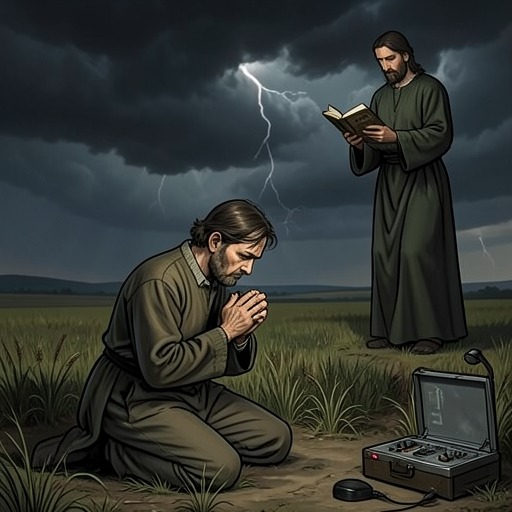
The Parish Priest of Lipce
The PeasantsThe Parish Priest of Lipce is presented through a contrast between intimate kindness and public spiritual authority. In his garden, he receives Kuba’s offering of partridges and gives him a zloty; in church, he speaks fiercely against sin until the congregation weeps and kneels. These encounters make him a vivid figure of religious authority in Lipce, while also revealing how villagers may invoke that authority to defend social distinctions the priest is not shown explicitly endorsing.
Identity and Narrative Presence
The Parish Priest of Lipce appears in a small number of sharply drawn scenes rather than through a sustained personal history. The narrative gives no account of his family, origins, or private ambitions. Instead, it defines him through his dealings with parishioners and through the different forms his authority takes: a direct act of charity toward Kuba, a forceful sermon before the congregation, and an indirect presence in Boryna’s argument about rank and obedience.
This limited presence matters. The priest is not depicted as a constant manager of village affairs; he enters the story at moments when religious practice makes visible the relations between individuals and the community. His garden is a place of personal encounter, while the church is a public space where private guilt becomes collective penitence.
Kuba’s Offering and the Priest’s Kindness
When Kuba approaches the presbytery, he finds the priest in the garden shaking fruit from pear and apple trees. The contrast between Kuba’s hesitation and the ordinary, unceremonious work of gathering fruit shapes their meeting: Kuba stops at the porch and peers inside, but does not dare enter. When the priest notices him, Kuba humbly clasps his knees and explains that he has brought partridges.
The priest welcomes the offering, invites Kuba inside, and gives him a zloty. Kuba remains on the threshold, too awed by the pictures and polished floor to enter the room fully; he crosses himself and longs to pray, yet fears that kneeling might dirty the shining surface. The priest’s kindness does not erase Kuba’s sense of distance from the household. The exchange is generous, but Kuba experiences the interior as so splendid and unfamiliar that gratitude leaves him nearly unable to speak.
The priest’s blessing recognizes Kuba not only as a giver but as a pious man who attends church every Sunday. That recognition is deeply affecting to Kuba, who clasps the priest’s legs again and leaves overwhelmed with joy. In this scene, clerical authority works through personal attention: a small payment and a few words of approval become a powerful affirmation for a poor parishioner.
The Sermon and Collective Penitence
In church, the priest’s presence changes in scale. As he mounts the pulpit in his white surplice, colored light from the windows makes him appear to the congregation like an angel. The narrative registers his transformation especially through Kuba’s eyes: the same gentleman who had spoken gently to him now seems almost an archangel as he raises his voice and rebukes the people.
The sermon names communal failures rather than addressing Kuba alone. The priest condemns sin, avarice, drunkenness, debauchery, wrongs inflicted on others, neglect of the old, and godlessness. His speech is described as prolonged and fierce, but also as pleading: he begs the congregation to come to its senses. Listeners lower their eyes, examine their consciences, and promise to mend their ways; tears spread through the church until Kuba himself trembles with guilt and breaks into sobs.
The congregation’s response turns individual remorse into a shared bodily scene. When the priest kneels in prayer, those assembled fall to the ground, raising dust as they cry for mercy. The church then grows quiet, and the High Mass begins. The scene gives the priest’s words a strong immediate effect, but does not claim that this contrition permanently reforms the villagers. It shows the force of religious ritual in the moment: moral judgment gathers the congregation into a single act of penitence before worship resumes.
Religious Teaching and Social Order
The priest’s authority also appears through Boryna’s account of what the reverend teaches. During a rebuke of Kuba, Boryna invokes respect for elders and argues that a farmhand must not push himself into the place of a farmer. He presents each person’s allotted station as part of the order established by the Lord Jesus, and says the good father would agree that this arrangement must be maintained.
The distinction between the priest’s direct words and Boryna’s reported appeal is important. The priest is not present in this exchange, and the novel does not show him delivering the specific lesson Boryna attributes to him. What the scene establishes is that religious authority can be recruited into a household dispute over rank: Boryna frames Kuba’s attempt to take a prominent place as both a breach of social boundaries and a grave sin. Kuba answers that he is not a beast and has a mind of his own, exposing the pressure beneath Boryna’s appeal to divinely sanctioned order.
Set beside the earlier sermon, this invocation leaves a pointed tension. The priest is directly shown condemning avarice, wrongdoing, and neglect of the old, while Boryna uses the priest’s presumed teaching to insist that a farmhand remain in his assigned place. The novel does not resolve that tension by making the priest arbitrate the quarrel. Instead, it shows how his moral standing circulates in Lipce: his words can call a congregation to repentance, while his name can also be used by others to reinforce hierarchy.
Narrative Significance
The Parish Priest of Lipce gives religious life both a compassionate and a disciplinary face. His encounter with Kuba is personal and consoling, grounded in an offered gift and attentive recognition; his sermon is public and morally demanding, naming wrongs that implicate the congregation as a whole. The movement between those scenes prevents his authority from being reduced either to private benevolence or to pulpit denunciation alone.
His limited role also leaves the work of interpretation with the villagers. Kuba experiences the priest’s kindness and preaching with intense reverence, while Boryna invokes clerical teaching to defend a fixed social order. The priest’s presence thus illuminates the power of popular Catholic belief in Lipce without making every claim spoken in its name his own. He stands at the meeting point of charity, ritual, moral judgment, and the village’s contested understanding of who has a rightful place.