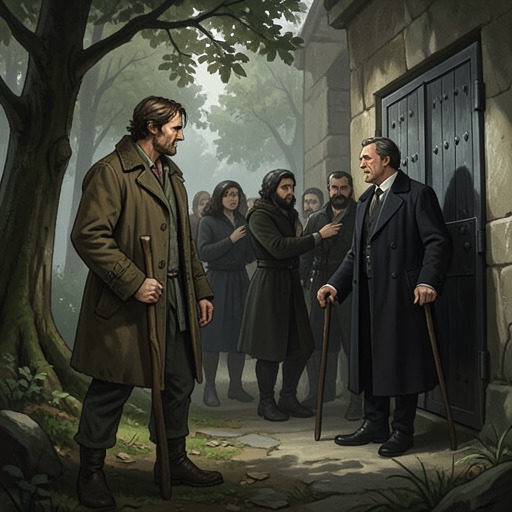
The Squire Excludes Lipce Workers from the Felling
The PeasantsThe Squire Excludes Lipce Workers from the Felling is a winter employment dispute that converts a promised source of relief into a fresh grievance against the manor. Although the felling at Wolf’s Hollow woodland offered work to people in neighboring villages, Lipce was left out. For villagers already facing hunger and a long season without wages, the exclusion was not merely a lost job opportunity: it made the manor’s control of local resources and livelihoods newly visible, and helped turn private hardship into a collective complaint.
The refusal and its discovery
The exclusion became certain through news brought back from other villages and confirmed at High Mass by the woodsman. The Squire had already made agreements and paid advances to workers elsewhere: ten were to go from Rudki, fifteen from Modlica, about eight from Dębica, and nearly twenty from Rzepki. Lipce, by contrast, had been promised no places at all. The numbers made the contrast concrete: the manor needed labor for the felling, but its hiring arrangements bypassed the village nearest to the grievance.
The decision also carried a pointed political context. Villagers understood that The Squire was angry because a complaint had been lodged against him with the commissioner. One man who had signed it said he would stand by his complaint and insisted that not a single fir should be cut until the manor reached an agreement and gave the villagers what they considered theirs. Another hoped that withholding local labor might prevent the felling altogether. The episode thus joins an immediate question of wages to the broader dispute over the forest and the villagers’ claim to a say in what happened there.
Winter need and unequal risk
The loss fell hardest on people with little or no land. Lipce contained wealthy farmers and lesser farmers who did not depend on this particular work, but it also contained hired hands and householders with no more than a cottage. They threshed for farmers, worked with axes at the mill, and took whatever jobs they could find. Around five families, however, had no winter work in the village and had been waiting for the felling as their chance to get through the season.
The broader conditions made that exclusion urgent. The winter was harsh, few people had even a small coin saved, and many households were running out of potatoes. Some had already had potatoes freeze; others ate a hot meal only once a day and went to bed hungry. With spring still distant and no other help in sight, the expectation of wages had functioned as a narrow bridge over the worst months. The refusal removed that bridge just as poverty was pressing most sharply.
The narrative also distinguishes between visible hardship and the pressure to conceal it. Some poorer villagers would not admit how badly they needed work, because they feared losing the friendship of wealthier neighbors, and so continued to side with them. Poverty therefore divided the village not only by possessions but by the social cost of acknowledging need. The exclusion exposed how easily a community could share a place without sharing the same risks—or the same willingness to name them.
The appeal to the priest
The poor gathered in their cottages to deliberate and then tried to get Kłąb to lead them to the priest for advice. Kłąb declined, giving his daughter’s betrothal as the reason; others also avoided taking responsibility, each attending to private interests. Bartek from the Sawmill, though he himself had work, was angered by this retreat. His presence among the poor’s supporters marks a contrast between secure employment and solidarity: having a job did not prevent him from recognizing the danger faced by those without one.
Bartek from the Sawmill went with four companions, including Filip from beyond the pond, Bylica’s son-in-law, Bartek Kozioł, and Walek, to ask The Parish Priest of Lipce to intercede with The Squire. Their appeal sought mediation, not simply individual placement. The group asked a religious and local authority to carry their complaint to the manor, making the priest a possible intermediary where villagers felt direct recourse had failed.
The petitioners were away for some time. After vespers, Ambrozy ran to the Kobuses’ house with word that they were in council with the priest and would soon be at the inn. The report establishes that the appeal had reached a discussion with him, but does not itself confirm that The Squire changed his decision or that work was secured. The episode’s immediate outcome is therefore suspended: the villagers have organized and made their case, while the material need that prompted it remains unresolved.
From denied work to collective grievance
The refusal recurs later as one part of a larger indictment of the manor. At a public gathering, a speaker addresses farmers and hired hands together, listing the felling of the villagers’ forest, the refusal to employ them, and the manor’s repeated harassment as injuries they can no longer ignore. The hiring decision has become more than a winter labor dispute: it stands beside legal complaints and other grievances as evidence, in the villagers’ view, that ordinary channels have not protected them.
A later account of village poverty gives the exclusion a human scale without showing that every hardship arose from it. Hanka the Farmstead Keeper describes a freezing cottage whose windows are stuffed with straw, a family with one bed, no potatoes, and a quilt sold to obtain food; she also recounts visiting a woman who has just given birth while the men are imprisoned and the fields lie fallow. These circumstances belong to the wider crisis of poverty and absent labor, not to a demonstrated consequence of the hiring decision alone. They nevertheless echo the earlier fear that the poor would be left without work, credit, or help.
The event’s force lies in the distance between the manor’s labor arrangements and the village’s expectations of livelihood and obligation. For the families waiting on winter wages, exclusion meant hunger as well as lost income; for the villagers who protested, it joined the forest dispute to a broader sense of injustice. The ensuing appeal to the priest and the later public denunciation show how a decision about who would be hired could become a shared political grievance, even though the evidence here leaves the petition’s immediate success uncertain.