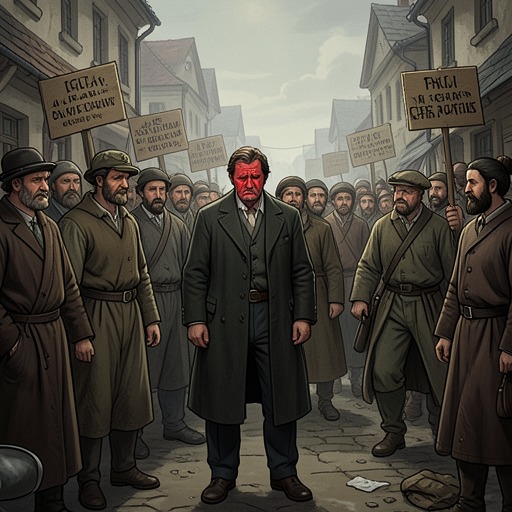
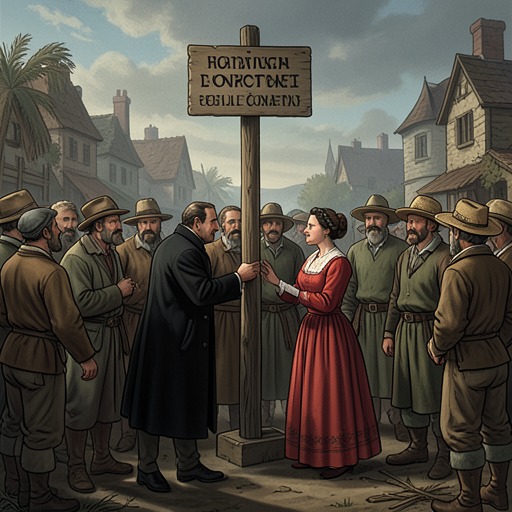
The Voyt’s arrest for embezzlement
The PeasantsThe arrest of Piotr, the Voyt, over money missing from Lipce’s community coffers turns an official crime report into a test of village solidarity. The revelation that the community itself might have to repay what his property could not cover lands among people already short of food and cash; a further accusation, that he had spent the money on Jagusia, widens the scandal into public gossip and sexual blame. The villagers do not receive a complete account of the missing funds. Instead, the event unfolds through rumor, confirmation, and accusation, as anxiety about collective liability rapidly becomes anger at the man who held village office.
The Announcement and Its Confirmation
The news arrives on a Sunday before High Mass, abruptly enough that the village initially resists believing it. Word comes that Piotr has been arrested because money is missing from the community coffers. More alarming reports follow, but the first response is dismissal: some villagers call the story idle invention. The hesitation matters. The arrest is not witnessed directly in this episode; it reaches Lipce as news that must be tested against what people can verify.
That confirmation comes in stages. Antek's Brother-in-law returns from town and confirms the reports, and Jankiel tells the people gathered at the inn that the story is true. He gives the sum as five thousand and says that Piotr’s entire farm is to be taken; if it does not cover the loss, Lipce will have to make up the remainder. The missing money is therefore not presented as a private shortfall alone. Jankiel’s account makes the village a potential payer, connecting the arrest to the livelihoods of people who had no part in managing the funds.
A Scandal Arriving in a Poor Village
The reaction is intensified by the condition of Lipce’s households. Many villagers are heavily in debt merely to get through until harvest, and the prospect of contributing to the cost of a public official’s alleged theft feels intolerable. Their anger is directed not only at the missing money but at the prospect of being made to absorb its consequences. The burdens of communal responsibility appear sharply unequal: the villagers may be required to pay, while the man associated with the loss possessed a farm that could be seized first.
This financial alarm belongs to a wider pattern of insecurity already visible in the village. During the hard winter, hired hands had been counting on work from the manor’s felling at Wolf’s Hollow; instead, they learned that the squire would employ none of them. Some villagers’ potatoes had frozen, money was scarce, and poor households faced hunger before the next harvest. Elsewhere, accounts of families without potatoes, bedding, or credit show how little reserve remained among the poorest. These circumstances do not establish a connection between the Voyt’s arrest and the earlier employment dispute, but they explain why a possible new demand on the community provokes such a fierce response.
Public Trust, Gossip, and Jagusia
After the arrest is confirmed, the village’s anger spills into curses and denunciations. The immediate fear is concrete: the community may be forced to pay for money it did not take, when many residents have little to put in the cooking pot and are already borrowing to survive. Their refusal to accept that burden gives the episode its collective force. Piotr’s position as Voyt had made him a public figure; the missing funds now expose how vulnerable the whole village may be to the costs of his conduct.
The account then acquires a second, less certain explanation. While villagers discuss the Voyt’s household and the prospect that his wife may lose her home and land, Kozłowa recalls the food and drink they enjoyed. The organist’s wife redirects the conversation by suggesting that the money was spent on Jagusia. The crowd presses her for an answer, and she names Jagusia outright, adding that the parish has been talking about the matter since spring and that people from Modlica could be asked about it. This is an allegation voiced amid village gossip, not a demonstrated finding about where the money went. The distinction is crucial: the arrest for missing funds is confirmed, while the claim about Jagusia enters as a circulating explanation that the villagers did not expect.
Consequences and Narrative Significance
The announcement changes the village’s attention from disbelief to indignation, then from the public accounts to speculation about private indulgence. Its stakes extend beyond Piotr’s arrest: if his farm cannot repay the five thousand, the residents may be asked to shoulder the shortfall. Against the background of hunger, debt, and uncertain work, that possibility makes the scandal feel like another demand imposed on people with almost nothing to spare.
The episode also shows how swiftly communal judgment forms when formal facts are incomplete. Town confirmation and Jankiel’s account establish the arrest and the reported sum; the organist’s wife supplies a name that transforms suspicion into a more intimate scandal. The sequence leaves the reader with both the force and the limits of village knowledge: public anger rests on a concrete threat to the common purse, while the alleged connection to Jagusia remains a rumor carried through the parish. In that contrast, the arrest becomes not merely a report of official action but a convergence of economic precarity, contested public trust, and the village’s appetite for explanation.