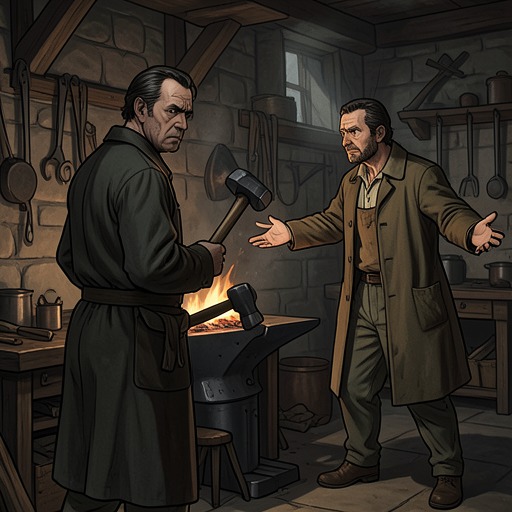
The blacksmith’s failed scheme to secure Boryna’s land for the family
The PeasantsThe blacksmith’s failed scheme to secure Boryna’s land for the family exposes the acquisitive purpose beneath a staged reconciliation. Hoping to enlist Antek in a plan to obtain more of Maciej Boryna’s land, Antek’s Brother-in-law advises him to appease his father, secure promises before witnesses, and keep legal action in reserve. Antek sees that the proposal disguises the blacksmith’s own designs; their attempted alliance collapses into accusation and flight, while the blacksmith turns back toward Boryna’s home to prevent the scheme from being exposed.
A reconciliation with an agenda
The scene begins the morning after a quarrel. At breakfast, Antek expects to find everyone against him, but is astonished to see Antek’s Brother-in-law enter. They greet one another as if nothing has happened. The appearance of ordinary friendliness makes the blacksmith’s next move possible: when Antek goes to the barn to chop chaff, his brother-in-law follows and sits on a bale thrown down from the haymow.
Speaking quietly, the blacksmith presents himself as the first to put the disagreement aside. He dismisses their quarrel as a matter of foolish words and offers to shake hands. Antek accepts the gesture, though with suspicion, and says he had not been angry with the blacksmith himself. He blames the Village Head of Lipce for provoking him and resents the official’s interference. The reconciliation is therefore real enough as a gesture between the two men, but it quickly becomes a means of steering Antek toward a much larger family dispute.
The blacksmith proposes that his wife visit that afternoon and that she and Antek speak directly with the old man. Rather than complain privately, Antek should state his claims to his father openly. The advice initially sounds like an appeal to candor; its practical purpose becomes clearer when Antek points out that Boryna has already signed a land settlement. The blacksmith answers that the document does not make the matter secure while Boryna is alive: the old man can still withdraw it. His immediate counsel is to avoid provoking Boryna and allow him to marry.
The proposed bargain
The blacksmith’s plan depends on performance as much as on law. Antek should praise Boryna, approve of his choices, and avoid opposing him to his face. If Boryna insists on the settlement already made, the blacksmith proposes that he promise the rest of the land as well, with witnesses present. That would turn a conciliatory show of agreement into something the family could later use as a claim.
Antek asks what this arrangement means for Józka and Grzela. The blacksmith dismisses the question by saying they can be paid off, adding that Grzela already receives money from his father almost every month while serving in the army. He assures Antek that following his advice will ensure the land ends up theirs. The confident promise sits uneasily beside the need for witnesses, legal leverage, and a strategy of keeping Boryna unsuspecting. The blacksmith’s brief remark, “Ram’s still kicking and furrier’s busy sewing a sheepskin …”, reinforces the urgency of acting while the old man is still alive and able to change the settlement.
He then supplies a legal argument. The four morgen at issue, he says, came to Boryna from Antek’s mother; although Boryna has sowed and reaped that land for years, he has not given it to Antek or to the blacksmith’s wife. The blacksmith presents this history as grounds for compensation, even with interest, and urges Antek to attend the wedding and speak kindly to his father. If goodwill does not work, he says, the courts remain available. He also suggests that Jagna could help persuade Boryna, since she might have more influence over the old man.
Antek recognizes the deception
For a moment, the blacksmith’s proposal appears to have won Antek’s agreement. Antek mutters that it is time for his brother-in-law to leave before he strikes him and throws him out of the gate. The blacksmith, alarmed, asks what is wrong. Antek abandons his chaff-cutter and strides toward him, pale and furious, calling him a traitor and a thief. The blacksmith jumps up and runs.
The reversal turns the supposed reconciliation inside out. The blacksmith had described the plan as a way for Antek and their family to secure their share, but Antek recognizes that the offer is not disinterested advice. In the blacksmith’s account of the land, kinship, inheritance, and legal rights are all made to serve a calculation of possession; the appeal to family solidarity cannot conceal the prospect of manipulation. Antek’s refusal also shows that he would rather break with his brother-in-law than accept a bargain he reads as deceitful.
The scheme turns back toward Boryna
Once on the road, the blacksmith interprets Antek’s anger as proof that his plan has been seen through. He is especially afraid that Antek will reveal it to Boryna. In his thoughts, he complains that he had come with what he considered good advice, then resolves not to let the land go. The episode thus makes the scheme’s self-interest explicit not through a confession to Antek, but through the blacksmith’s reaction after fleeing.
He immediately decides that he must stop Antek and, despite his fear of him, turns back to Boryna’s home. There he asks Witek whether the master is around. Witek is outside the cottage, aiming stones at geese swimming in the pond. The scene ends with the blacksmith seeking access to Boryna, leaving his next action unresolved. What has failed is his attempt to win Antek’s cooperation; his return shows that he still means to protect his interest in the land by acting before Antek can expose him.