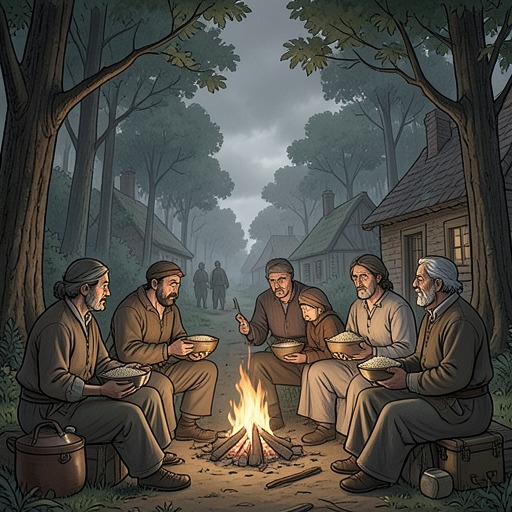
The neighboring villages’ relief work in Lipce
The PeasantsThe neighboring villages’ relief work in Lipce turns a spring labor emergency into a public demonstration of mutual aid. Carts and teams arrive from outside the village, and volunteers work without pay for two days, restoring activity to fields that local households could not cultivate alone. Yet the relief is distributed unevenly: the visiting workers are assigned chiefly to wealthier farmers, while Lipce’s own hired hands are left waiting. The episode therefore holds solidarity and exclusion together, making the revived fields an image both of collective possibility and of the village’s persistent class divisions.
The crisis behind the appeal
The need for help has been building through winter and imprisonment. Earlier, villagers feared that the squire would not hire a single Lipce man for the felling at Wolf’s Hollow, although at least twenty hired hands were desperate for work. Potatoes had frozen, money was scarce, and some families were already eating a hot meal only once a day. The expected employment had seemed one of the few ways to carry poor households toward spring; its loss threatened an even leaner preharvest season.
A later account of village misery makes the labor crisis concrete. Filipka’s eldest daughter is found desperately ill in a cottage so cold that straw has been stuffed into the windows. The household has no potatoes left, has sold its quilt, and must beg groats from the miller. In another home, Florka Pryczkowa gives birth while sick and without food, savings, or milk; her husband is imprisoned, and the fields stand fallow. Such cases reveal why spring work cannot be postponed without consequence: hunger, illness, childbirth, and the absence of able workers coincide before the harvest can provide relief.
The crisis is also political. In his appeal to the villagers, Antek describes the manor’s felling of the forest, its refusal to employ local men, and a longer history of grievances that complaints and court cases have failed to remedy. The labor shortage thus belongs to a wider conflict over who controls work and resources. The neighboring villages’ intervention does not resolve that dispute, but it answers an immediate need that neither the manor nor the village’s ordinary economic arrangements have met.
Rocho organizes the response
After a bleak day of rain, Rocho rushes from house to house with news that neighboring villagers will come on Thursday to help in the fields. At first the report seems almost unbelievable. When the Parish Priest of Lipce confirms it, despair gives way to excitement: people gather in the roads and cottages, talking over the news and, for a time, forgetting the livestock thefts that had been troubling them.
Rocho is especially moved by the prospect of men working without pay. He tells Hanka the Farmstead Keeper that they will stay for two days, enough to complete the most urgent work, and presents their service as the proper conduct of fellow Christians and Poles. He sees the gesture as more than a temporary favor: people in need, he argues, cannot depend on looking elsewhere for rescue, but must learn to help one another. His hope is expansive, extending from this village visit toward a wider fellowship in which mutual aid might overcome hostility. The scale of that hope gives the practical work an ethical meaning without making the immediate emergency disappear.
Preparation itself becomes a communal undertaking. The morning after the announcement, households tidy their cottages, bake bread, cut potatoes for planting, ready carts, and carry manure to the fields. Families prepare food and drink for their guests, slaughtering chickens or geese they had intended to take to market and obtaining additional provisions on credit from the inn and mill. The hospitality is generous but costly: those already short of resources assume further obligations in order to receive the volunteers properly.
Arrival and work in the fields
The village waits through the morning. Girls move between cottages in their best clothes, boys climb onto roof ridges to watch the roads, and the day remains cloudy, warm, and languid. Only after the bells for Mass does the sound of carts reach Lipce; the arrivals come from Wola. People hurry toward the church square, where horses and carts soon fill the space. The visitors go to Mass before the work assignments are made.
After the service, the Parish Priest of Lipce and Rocho organize the distribution outside the graveyard gates. They assign workers to cottages, taking care that wealthier households lodge with people of similar means. Within half an hour the visiting men have been apportioned. The Lipce hired hands, however, remain before the church, weeping and waiting in vain for anyone to be assigned to them. The contrast is present at the very moment the aid becomes organized: help has arrived, but the village’s poorest workers do not receive it on equal terms.
The visitors are served breakfast and offered vodka before setting out. There is little time for extended conversation; they give their names and villages, eat modestly, and leave for the fields under the women’s direction. Work transforms the landscape. Carts roll out from the yards, ploughs travel along the paths, and people move across the field boundaries. The renewed noise of horses, wheels, dogs, and greetings replaces the torpor of fallow ground. The scene registers relief not as an abstract promise but as coordinated labor spread across potato plots, barley, stubble, and weed-covered fields.
When the ploughs begin to press into the earth, the bustle subsides. The workers straighten, catch their breath, cross themselves, and turn to the work. Sowing follows in a hush described as almost liturgical: people scatter seed into fertile soil, entrusting their labor and hopes for the future to the earth. The fields seem to revive with the arrival of their cultivators, while the multitude of workers and carts stretches across the land beneath a pale spring sky. The passage links agricultural recovery to ritual and shared effort: the seed is placed in the ground by human hands, but the outcome remains dependent on the earth and the future harvest.
The boundary of solidarity
The aid lasts two days, and the Parish Priest of Lipce and Rocho go from house to house to thank the visitors. Their gratitude does not settle the question of who has benefited. Near the blacksmith’s, Kozłowa the firebrand leads the weeping hired hands to confront the priest and ask whether the workers will come to help them too. Filipka answers that the volunteers helped the farmers, the rich ones; others say that the poor have been treated as if they carried a plague. Their complaint identifies the gap between a village-wide celebration and the particular households still without the labor they need.
The priest says there were not enough workers for everyone and offers to seek other assistance, including the use of his horses for a day and appeals to the miller, the Voyt, and Boryna. These are possibilities, not a completed remedy. Kozłowa rejects the comfort of waiting: she condemns a system in which farmers have resources while the poor are left to endure hunger, and she leaves after the priest can no longer answer her accusations. Rocho stays with the hired hands, comforts them, and promises to try to obtain help, even as the visiting workers depart along roads filled with carts and farewells.
The episode’s resolution is therefore mixed. Neighboring labor prevents the spring emergency from remaining entirely in the hands of isolated households, and the sowing offers a material beginning for a future crop. At the same time, the workers’ distribution reproduces the village hierarchy: mutual aid reaches Lipce, but not all Lipce residents equally. The contrast qualifies Rocho’s expansive faith in cooperation. The fields can be revived through collective work, yet the episode leaves the poorest laborers’ immediate need unresolved and shows that solidarity must be judged not only by its generosity but also by whom it reaches.