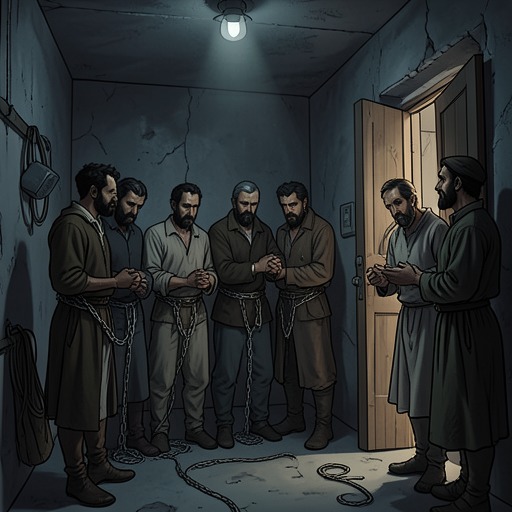
The return of the imprisoned Lipce men
The PeasantsThe return of the imprisoned Lipce men turns an official notice into a village-wide day of reunion, restoring husbands, fathers, brothers, and sons to their households while making Antek’s continued absence impossible to ignore. The news first travels through Lipce before dawn; later, families meet the returning men at the Boryna cross, where prayer, embraces, and tears mark the passage from imprisonment back into communal life. For Hanka, however, the homecoming is also a painful confirmation that her husband remains in custody.
News Spreads Through Lipce
The report that the men are returning strikes Lipce like a thunderbolt. At first, nobody knows whether the report is true, when the men will arrive, or how the news began. Its first known messenger is a commune lackey, who hurries to Piotr, the Voyt, with a letter before dawn. From there it passes quickly among the women: a neighbor carries it onward, voices relay it to nearby cottages, and in less than the time needed to say a Hail Mary the village is awake and clamorous with hope.
The morning is not bright in the ordinary sense. Dawn is only just emerging; fine rain falls over the blossoming orchards, and the day remains oddly dark and wet. Against this subdued weather, the repeated cry that the men are coming home moves from cottage to cottage like a glad bell. The speed of its spread gives the news a collective force: before anyone can establish all its details, anticipation has already seized the village.
At the Voyt’s, a man produces the official letter and points to its formal opening, addressed to the Christians of Lipce in the commune of Tymów. The letter is passed from hand to hand. Although the people looking at it cannot make out a single word, its official character convinces them that the report is true. Hanka asks whether all the men are coming back. Her question expresses the uncertainty beneath the celebration: the letter confirms a return, but the families still do not yet know exactly who will be among those arriving.
The Meeting at the Boryna Cross
The village’s expectation becomes a procession through the fields. As the people move onward, singing and prayer carry across the green land: workers pause, some remove their caps or kneel, cattle lift their heads, and a frightened colt runs from its mother. Before the procession reaches the third mound and the cross by the poplar road, someone spots men emerging from the wood. The question of whether they are the returning villagers becomes immediate.
The meeting place is the Boryna cross, close to a mound marking the edge of Lipce land and the manor woods. The returning men are already gathered beneath the large birches beside it. They have uncovered their heads as the procession approaches. Their faces are thinner and gaunter than the families remember, but their smiles are unmistakable. Recognition breaks into cries naming the returning men, including the Płoszkas, Sikoras, Mateusz, Kłąb, and old Grzela. The calls mingle with appeals to Jesus and Mary, while wives, children, and relatives strain toward the faces they have been waiting to see.
The Parish Priest restrains the crowd long enough to recite a prayer at the cross. The people kneel in a half-circle, their grateful attention fixed on Christ, and he sprinkles water over their bowed heads. Only then does the greeting become a tumult of embraces. The men cluster around the priest, kissing his hands and clasping his legs; he presses each one to his heart, kisses their heads, strokes their lean faces, and asks after them. Their return is thus received not merely as private family news but through a public religious ritual, at a boundary-marking cross in the landscape they have come back to.
Reunion and Uneven Joy
Once the priest gives the signal to continue, the procession moves along the forest road. The returned men look across the pastures, blossoming trees, and strips of winter wheat. Some cross themselves or uncover their heads; the fields appear to them as a life-giving mother and a longed-for home. The return is bodily as well as emotional: after imprisonment, they are again among the land and familiar paths of Lipce.
At the cross, greetings grow into a many-voiced reunion: laughter, kisses, weeping, children calling out, and women drawing their own men aside. The greeting lasts for two prayers and would continue longer if the priest did not urge the procession onward. By evening, families and neighbors make their way back toward the village. Men greet their thresholds with the sign of the cross, and some fall before their holy pictures, crying with happiness. At home, women seat the returned men before bowls and urge them to eat, turning welcome into the practical care of feeding people who have come back gaunt and hungry.
The same crowds that make the homecoming joyful sharpen Hanka’s loneliness. She walks among men surrounded by wives and children, while she has no one beside her to greet. Many of the imprisoned men have returned, including figures the village had regarded as rebels, but Antek is not among them. Hanka keeps her head high, joins the singing, and answers the prayers, yet she guards her distress from the people around her and does not dare ask publicly about her husband. Her outward participation in the procession contrasts with her private fear that she may never see him again.
What the Homecoming Reveals
The return resolves one uncertainty while exposing another. The villagers receive the official letter as confirmation that imprisoned men are coming back, and the procession culminates in the visible reunion of families. But the homecoming is not complete for everyone: the returning group includes many familiar men, while Antek remains imprisoned. The news that brings Lipce together therefore divides its emotional meaning. For most households, it restores an absent family member; for Hanka, the crowd’s happiness makes her own separation more acute.
The scene also links belonging to several forms of return. The men come back to their relatives, to the village thresholds, and to the cultivated land they recognize as the source of life. Prayer at the cross and before household images frames their arrival as an occasion for gratitude, while the food pressed upon them translates that gratitude into everyday care. The episode closes not with a single triumphant reunion but with a village filled again by its returned men and a household still waiting for Antek.