The social hierarchy between peasants and hired laborers
The PeasantsThe social hierarchy between peasants and hired laborers shapes who may claim the land, who receives work, and who is entitled to respect in public life. Its clearest boundary separates the independent farmer from the farmhand, even when the latter is a farmer’s son. The distinction is presented as customary and religiously sanctioned, yet the scenes around it reveal a more material system: those without land or secure work bear hunger, while the village’s established farmers occupy honored places and can speak with authority. At moments of collective conflict, however, the boundary becomes unstable, as hired hands join farmers against the manor and shared injuries briefly outweigh differences in rank.
Rank, land, and social order
The hierarchy is not simply a division between rich and poor. It distinguishes people by their position in the agricultural world: farmers possess recognized standing, while hired laborers remain dependent on others for employment and are expected to know their place. In one forceful explanation, Maciej Boryna tells Kuba that a farmhand is not a farmer and that each person has a different place allotted by God. His argument turns a social convention into a religious duty: Kuba is warned that trying to rise above his station would be a grave sin and a threat to the order of the world.
The language of allotted places masks the unequal power behind that order. Maciej Boryna insists that Kuba should not push among the foremost worshippers because everyone knows who he is. Kuba answers that he is not a beast and has a mind of his own. His protest is modest but pointed: he does not claim a farm or a farmer’s wealth, but objects to being treated as if his birth and labor have left him with less human dignity.
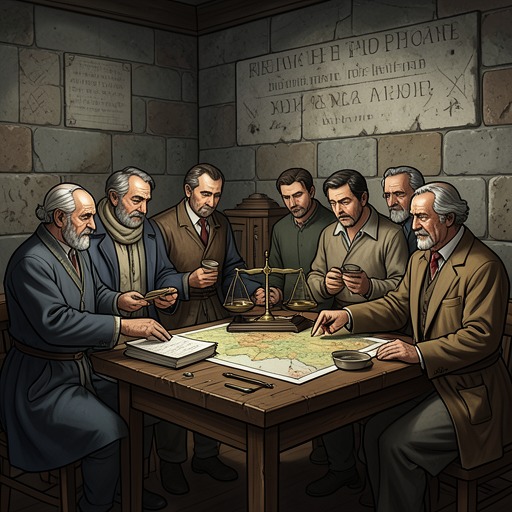
Economic power extends beyond the farmer–farmhand distinction. During a discussion among younger villagers, the blacksmith describes a world in which the squire, the priest, and the government official are each masters, while ordinary people toil hungry and bow to those above them. The conversation links personal hardship to the concentration of land: the villagers fear that soon there will not be a field for each household, while the squire is said to possess more land than two villages together. Talk of distributing new plots makes land scarcity—not merely differences in manners—a central source of the hierarchy.
Kuba at the church
Kuba’s attempt to cross the boundary becomes visible at church. After receiving a zloty from The Parish Priest, he recalls how villagers call him cripple, fool, and sponger, while the priest has treated him with respect. He enters the churchyard with his head held higher, pulls on his cap, and walks slowly and deliberately, sweeping his crooked leg along as he makes for the church. The coin does not change his station, but it accompanies a moment in which he carries himself as a person worthy of regard.
That Sunday, Kuba does not remain in the porch where a farmhand is expected to stand. He presses through the crowd and goes to the high altar, among the places occupied by farmers, Village Head of Lipce, and men with ceremonial duties. The congregation’s astonishment and disapproval make the spatial ranking explicit: the church has a front and a margin, and social status determines who is presumed to belong in each. Kuba kneels near the rail and sings, feeling absorbed in the sacred images and lights. His devotion is sincere, but his position in the church remains contested by the people who treat his presence among the farmers as an intrusion.
Maciej Boryna later uses the same incident to reassert the boundary. He reminds Kuba that The Parish Priest teaches respect for elders and that the Lord hears prayer from every corner, so there is no need to push forward. Kuba explains that he wanted to be closer to the altar; then he describes the place reserved for a farmhand as the vestibule or doorway, like the dogs, while a farmer may carry the baldachin, lead the priest, sit in the pews, and sing from the prayer book. His list shows how rank is made concrete through access, visibility, and ritual participation. The episode leaves the contradiction unresolved: Kuba is a Christian and a farmer’s son, yet his community’s hierarchy limits how fully he can enact those identities.
Work, poverty, and exclusion
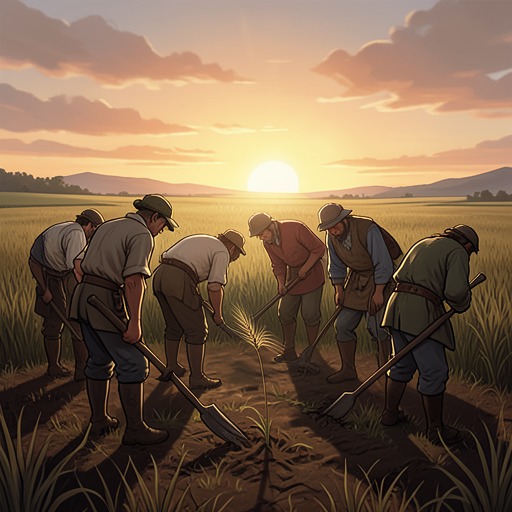
The status distinction becomes most punishing when work is scarce. At least twenty hired hands in Lipce are described as desperate for employment during a hard winter of snow and frost. Some have already lost potatoes to freezing, have no income, and face a preharvest period of severe want. Villagers had expected the squire’s felling at Wolf’s Hollow to provide work for everyone, but the squire has apparently resolved to hire no one from Lipce, angered by a complaint made against him to the commissioner. A dispute over forest rights therefore also determines whether landless workers can earn enough to eat.
The consequences of unemployment reach households already close to destitution. In a report of village misery, Filipka’s daughter is found gravely ill from hunger in a freezing cottage where the windows are stuffed with straw. The family has no potatoes and has sold its quilt; it must beg the miller for groats, while the imprisoned father cannot work. Elsewhere, Florka gives birth while ill and without savings or milk, and the fields stand fallow because the men who would work them are in prison. Such circumstances show that the laborer’s low position is not an abstract label: it leaves families exposed when wages, credit, and family labor all disappear at once.
The same account indicts the farmers’ relative security without claiming that they have no troubles. Some worry about filling their stomachs or lending money at the highest interest, while the poor live nearby across a field boundary without disturbing anyone’s sleep. The contrast between a full bowl and a hungry neighbor makes social rank a question of obligation as well as ownership. Appeals to divine order can console the poor, but they can also excuse the better placed from responding to suffering that is visible within their own village.
Solidarity and its limits
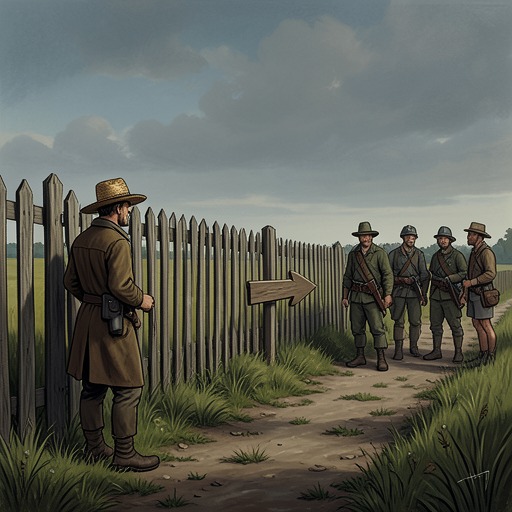
When the manor’s logging becomes the focus of collective protest, the categories of farmer and hired hand briefly converge. Antek Boryna addresses farmers and hired hands together as Christian people and honest Poles, naming the manor’s refusal to employ them alongside the felling of the forest and other injuries. The crowd answers with calls to stop the work. This appeal does not erase differences in property or status; it builds a common cause from grievances shared across them, especially the denial of work and the loss of customary claims to the wood.
During the ensuing fight, Maciej Boryna calls the fleeing villagers back to stand together. He takes a wooden stake and charges the manor’s men, while the peasants close ranks with flails and pitchforks. Their collective attack drives the manor’s men back, and the steward is pulled from his horse. In that moment, the farmer who had warned Kuba not to cross the line leads a crowd whose strength depends on people acting together. Solidarity becomes a practical force, but it appears in a violent confrontation rather than in a lasting rearrangement of social rank.
The hierarchy also governs moral judgment within the village, and its burdens fall unevenly by gender. Jagustynka condemns the double standard by which a man may leave his woman alone for years and escape blame, while a woman is condemned for what the couple did together. Her protest insists that a woman is a living human being and argues that the man should share the consequences of their conduct. The comparison broadens the entry’s social pattern: communal authority distributes dignity and punishment unequally, and those with less standing are more readily made to bear the cost.
Meaning and consequences
The contrast between Kuba’s exclusion from the foremost places at church and the hired hands’ inclusion in the forest protest captures the hierarchy’s tension. In ritual life, rank is defended as a divinely ordered boundary; in the struggle over work and land, shared vulnerability can make that boundary temporarily negotiable. Neither moment resolves the scarcity that sustains dependence. The village can recognize a common injury and still leave intact the unequal distribution of land, employment, and public respect.
The social hierarchy between peasants and hired laborers is therefore shown through both ordinary distinctions and crises. A place at the altar, the prospect of a wage, access to land, and the right to be heard all signal where a person stands. Kuba’s insistence on his own mind and humanity exposes the personal cost of that ranking; the forest uprising reveals the collective power available when those denied work and customary rights act alongside farmers. The solidarity is real, but the evidence offers no assurance that it abolishes the order that made it necessary.