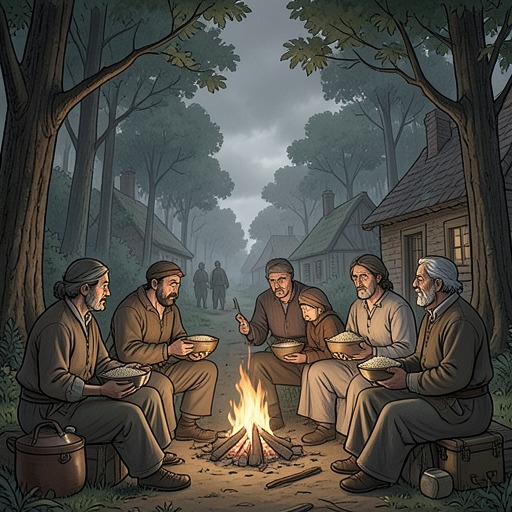
The storm destroys Wierlonka’s house
The PeasantsThe storm that destroys Weronka’s house is a village-wide calamity that becomes most acute in the collapse of her family’s cottage. After a night of battering winds and a dawn thunderstorm, Antek’s wife Hanka learns that her sister’s home has fallen. Weronka and her children survive by taking refuge in a potato pit, but their shelter, household goods, and sense of security are left in ruins. The episode makes the weather more than a backdrop: it acts upon homes, roads, livestock, and the precarious lives of the people who depend on them.
Weather and Setting
The disaster begins in a night of unsettled weather. As darkness falls, lights flicker among the trees and the wind grows stronger, pitching about the village. It rushes through houses; trees beat against walls and windows with the force of rams. The villagers lie awake fearing that the gale will tear the settlement apart. The danger is both collective and intimate: the storm threatens the village as a whole, but each household must endure it within the fragile shelter of its own walls and roof.
The wind continues for most of the night. Almost at dawn, when the exhausted inhabitants have begun to sleep, thunder rolls overhead and lightning flashes before torrential rain falls. Some villagers say that lightning has struck the forest. By the time daylight is fully established, the rain has stopped and the weather has calmed. Warmth seems to rise from the fields, birds begin to sing, and breaks appear in the low clouds. This sudden easing does not undo the damage. The contrast between the quiet, brightening morning and the wreckage it reveals gives the storm’s aftermath its force.
Weather repeatedly shapes the material conditions of village life in the novel, though its episodes are distinct. Earlier, a swollen pond overflows onto the lower road beside Boryna’s property, reaching fences and cottage walls. In another passage, winter winds strip away snow and leave the ground frozen hard. Later, heat arriving before summer damages vegetables, dries streams, and threatens crops. These episodes establish a world in which water, wind, frost, and heat can alter roads, harvests, and homes; Weronka’s ruined cottage is one especially concentrated instance of that exposure.
The Cottage’s Collapse
The morning reveals damage across the village. Fallen trees, broken roofing, and shattered fencing block the roads, making passage difficult. At the Płoszka household, the storm brings down the pigsties and crushes the geese. Other yards are also damaged, and women move among them in distress. The wreckage is not confined to Weronka’s home, but her family’s loss gives the village-wide destruction a particular human focus.
Antek’s wife Hanka has gone out to inspect the farm when Sikora arrives with news that Stach Płoszka’s cottage has been brought down and that the family may have been killed. Hanka freezes in alarm. When Sikora explains that the household is overwhelmed and asks her to come, Hanka throws her apron over her head and hurries there. Other villagers follow as news spreads. Their rapid gathering turns the discovery into an act of communal response, even as the first sight of the ruin offers little comfort.
The house is almost wholly destroyed. Only its walls remain, more crooked and sunk into the ground than before; the roof is gone, and broken rafters still swing overhead. The chimney has collapsed, leaving a stump compared to a rotten tooth. Tangled sheaves and smashed belongings cover the ground. Weronka sits beside the wall on a heap of possessions, holding her weeping children. Hanka falls upon her sister, and the people around them gather to offer comfort, but Hanka is so overcome that she can neither hear nor see what is happening around her.
Weronka’s Escape and the Family’s Loss
Weronka explains that the family had gone to bed when evening fell because there was no fuel for the lamp and no firewood. The cottage shook in the wind, but she was not initially afraid: they had endured stronger gales before. Draughts passed through the house, and she eventually dozed. Then came the boom and the crashing against the walls. She gathered the children as the building began to split and fall around them, and managed to reach the hallway just before the house collapsed behind her.
The chimney fell soon afterward. Outside, the wind was so strong that it was difficult to stand, and it scattered the thatch. With the village a considerable distance away, the night around them, and the household asleep, Weronka had no way to summon help. She pulled the children down into the potato pit, where they remained until dawn. Their survival is a narrow escape, achieved not through rescue arriving in time but through Weronka finding shelter in the one place available to her.
The family’s poverty is visible in the circumstances surrounding the collapse as well as in the wreckage. They had lacked both lamp fuel and firewood before the storm; afterward, the cottage and its contents lay scattered. When Hanka asks about the cow beside the cherry tree, Weronka identifies it as the animal on which the family depends for food. The cow’s importance sharpens the stakes of the disaster: damage to the household threatens not only a roof over their heads but the means of subsistence they still possess.
Aftermath and Significance
The episode moves from natural force to human vulnerability, then to collective care. The storm can be described through its noise and physical effects, but its consequences are measured in a collapsed home, injured or lost animals elsewhere in the village, and the terror of a mother trying to get her children out alive. Weronka’s account supplies the sequence behind the ruins that Hanka and the villagers encounter: the night’s shaking, the house’s collapse, the flight into the potato pit, and the wait until daylight.
Hanka’s arrival and the neighbors’ gathering do not restore the cottage, but they prevent Weronka’s misfortune from remaining unseen or solitary. The villagers’ presence contrasts with the family’s isolation during the night, when no one could hear them. The event therefore holds two realities together: a community capable of rushing to comfort those in distress, and households so materially exposed that a single storm can destroy their shelter and scatter their possessions. In Weronka’s case, survival is certain; recovery from the loss is not.