Tymów commune
The PeasantsTymów commune appears as an administrative framework around Lipce, most clearly when an official notice identifies the village as belonging to the commune. Its presence is concrete but limited in the available episodes: the text shows a channel for official messages and a setting for disputes over rights, not a detailed account of the commune’s governing structure. Against that framework, Lipce’s villagers pursue their interests through both formal complaints and direct collective action.
Administrative identity and reach
An official notice addressed to the Christians of Lipce, commune of Tymów, county of an unnamed district, places the village within a larger administrative order. The designation matters when news arrives that the imprisoned men are returning: a commune lackey brings a letter to the Voyt’s home before dawn, and the information spreads outward from there. The episode establishes the commune as a point of contact between village life and official communication, though it does not identify the letter’s author or show the commune itself deciding the men’s release.
The notice becomes credible locally through its passage among people rather than through their ability to read it. The Voyt presents the letter as confirmation, and the women pass it from hand to hand; although they cannot make out its words, its official character lends weight to the news. A woman taking geese to the pond first hears the report and carries it to neighbors, whose shouts relay it to nearby cottages. The commune’s administrative message thus enters a village information network that quickly makes it communal knowledge.
Records, claims, and local rights
The novel also places formal records and remedies beside villagers’ own understandings of land. In a dispute over pasture, a speaker insists that the grazing land is theirs and that the claim is clearly entered in the register, while complaining that others repeatedly drive them away and assert ownership. The suggested recourse is to take the matter to court or the commissioner. These details show villagers invoking documentary recognition and formal authorities when access to pasture is contested; they do not establish how the commune adjudicates such disputes.
Maciej Boryna’s thoughts about the forest reveal a different, personal reckoning with land. As he travels through the woods, he counts four morgen as his and adds a morgen associated with Jagusia, while anticipating that the manor may deny the villagers’ claims. The passage connects a specific measure of landholding to the broader conflict over the forest, but it does not identify those holdings as rights granted or administered by Tymów commune. The distinction is important: the commune names Lipce’s administrative affiliation, while the claims voiced in the forest conflict arise from the villagers’ own accounts of what belongs to them.
Collective action beyond official channels
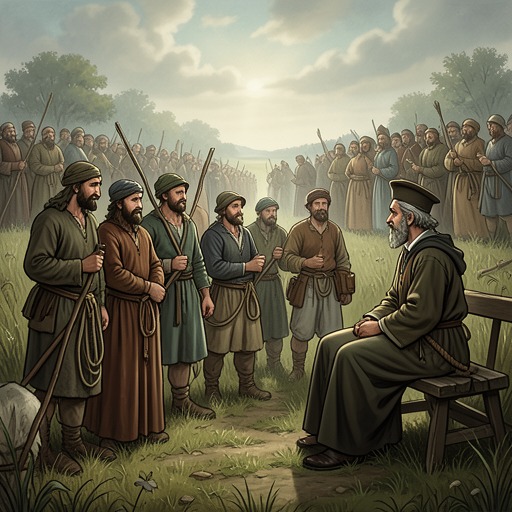
When the manor’s felling of the forest becomes the focus of a village gathering, the villagers wait for Maciej Boryna, whom they regard as the person who should lead them. His speech gathers several grievances—loss of employment, repeated injuries and confiscations, and the failure of court complaints—into a call for the whole village to defend what it claims as its right. The crowd answers together, then disperses to prepare; peasants, hired hands, women, and older children assemble with carts, horses, poles, pitchforks, flails, and scythes.
At the forest, the villagers confront the woodcutters directly, insisting that the woodland is theirs and demanding that the workers leave. This mobilization is village-led rather than presented as an act of Tymów commune. The contrast between appeals to courts and a mass intervention on the ground shows the limits the villagers perceive in formal remedies, without suggesting that the commune itself organized, authorized, or resolved the confrontation.
Administrative frame and village voice
Tymów commune’s significance is therefore chiefly relational: it marks Lipce’s place in official administration, while the episodes give the villagers their own routes for circulating news, asserting claims, and coordinating action. The official letter reaches the village through an intermediary, but its meaning is made public by neighbors; forest grievances are raised in a crowded meeting and carried into collective resistance. Administrative belonging and village self-organization are shown side by side, not as interchangeable forms of authority.