Weronka
The PeasantsWeronka, the sister of Hanka the Farmstead Keeper, is shown through the pressures of a crowded, cash-poor household: she works constantly, yet her elderly father says she sometimes forgets to feed him, and her home is marked by quarrels that Hanka experiences as daily misery. When a storm destroys the family cottage, Weronka’s distress becomes public, and the relief offered by neighbors and the priest gives her family temporary shelter and supplies. Her story places domestic hardship alongside both the injury of estrangement and the fragile support available within the village.
Identity and household
Weronka is Hanka the Farmstead Keeper’s older sister. Their relationship has been damaged since their mother’s death: Hanka recalls that Weronka took what remained in the household and would share nothing, after which the sisters saw little of one another. That history makes the later scenes of Hanka caring for Weronka’s family more than an uncomplicated display of sisterly affection. Their connection carries an old grievance into circumstances that neither can easily manage alone.
Weronka’s household includes her husband, Stach Płoszka, their children, and her elderly father. The old man’s account of a missed breakfast makes his dependence concrete: Weronka has forgotten to give him food, but he hesitates to remind her. He does not present this as deliberate cruelty. Instead, he defends her by describing a home where many mouths must be fed and where even potatoes do not always suffice. His account places the omission within scarcity, without erasing the old man’s hunger or his reluctance to ask for care.
Work, scarcity, and domestic conflict
The evidence presents Weronka as a woman with a heavy workload rather than an idle or indifferent housekeeper. Her father says she spins and weaves woollen skirts for other people, and works as hard as an ox. The household has two cows, whose milk provides butter and cheese to sell in town for a little money, but these small earnings do not make the family secure. Stach, meanwhile, threshes barley for the organist, eats where he works, and earns forty groszy a day in addition. The family’s resources are therefore assembled through separate kinds of labor, yet they remain insufficient to prevent daily want.
Hanka’s account of the household is harsher. During three weeks living there, she says, not a day passed without shouting, brawling, or squabbling. She accuses Weronka of slapping the children and nagging Stach, who, in Hanka’s view, works hard while enduring a miserable home life. The contrast with their father’s gentler defense matters: one speaker emphasizes Weronka’s exhaustion and the family’s lack of food; the other describes the harm she believes Weronka’s temper inflicts on those around her. The scenes establish neither a simple portrait of a cruel woman nor a claim that poverty excuses every action. They show a household where strain is heard in quarrels, children’s cries, and the old man’s careful excuses.
Stach’s work also creates a small opening for Antek Boryna. When the organist needs another person to thresh dry barley, Stach asks Antek to come and earn a few groszy. The offer places Weronka’s family within the village’s informal circulation of labor: a day’s work can bring in a little cash, but it cannot by itself lift a household out of precariousness. Later, when Stach is no longer present in the household, Hanka remarks that his absence has made the value of a man’s work and help newly apparent. The evidence does not specify why he is gone, but it records the practical burden his absence leaves behind.
The storm and the loss of the cottage
A spring storm leaves Weronka and her family without their home. The cottage stands only as warped, sunken walls, broken rafters, and a collapsed chimney; household belongings and sheaves lie scattered around it. Weronka sits beside the ruin with her arms around her weeping children, crying out over where they will sleep and where they can go. The damage is not merely to a building: it removes the family’s shelter at a moment when they have little capacity to replace it.
Hanka rushes to her sister and embraces her, while others gather to comfort her. The scene does not suggest that their earlier estrangement has vanished, but the immediate disaster changes what their relationship asks of them. Weronka is overwhelmed by the loss, and Hanka’s response is direct physical care. Their father moves through the rubble gathering hens and feeding the cow tethered to a cherry tree; people think he has lost his mind. These small acts of tending animals and children continue amid the wreckage, as if the family’s ordinary responsibilities have survived even though their ordinary home has not.
Shelter, aid, and later family dealings
The first wave of sympathy is brief: the women who have come to comfort Weronka soon remember their own breakfasts and urgent work and disperse. The family is left to consider how to salvage anything from the ruins. Then Sikora’s wife returns with a practical offer: the family can use a room on the other side of the house, install an iron stove despite the lack of a chimney, and pay rent if they can. If they cannot pay, they can help with work or stay on a blessing. The offer answers the immediate question of shelter without pretending the family can meet ordinary rent reliably.
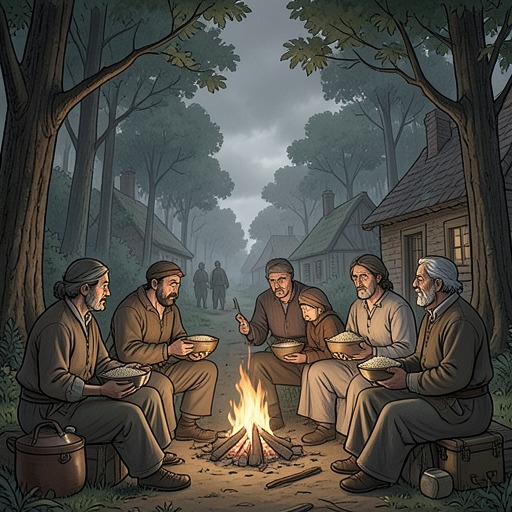
Aid also comes through the priest and the women of the village. After consulting together, they bring what each can spare—peas, barley groats, or flour—and the priest sends money for Weronka’s needs. Hanka watches the recipients cling to the women and weep, and feels the force of the response herself. The assistance is modest in material terms, but its form is significant: food and a room are offered in ways that recognize the family may not have cash. Work can stand in place of rent, and what neighbors possess is pooled rather than treated as a surplus beyond their concern.
The cottage remains a practical concern after the first emergency. Pan Jacek seeks Mateusz the Young Villager’s help to cut and plane wood for Stach Płoszka’s cottage. Mateusz is willing to cut the timber but hesitant about building, and says he may leave the village. His reluctance shows that rebuilding depends on labor that cannot simply be assumed; even with a room found for the family, restoring a home remains unfinished business.
In a later exchange, Weronka visits Hanka and hears what has happened. She passes over the matter of Jagusia and instead comments on Grzela’s death, observing that his share will come to Hanka in the division of property. The remark is practical and focused on inheritance, consistent with a world in which family security depends on portions of land or property as well as daily wages. Weronka’s brief intervention does not undo the sisters’ history, but it shows them sharing information about the material consequences of a death. Across these episodes, she is neither reduced to Hanka’s accusations nor separated from the deprivation they describe: her labor, her family’s need, and the support they receive make visible the narrow margin between household survival and disaster.