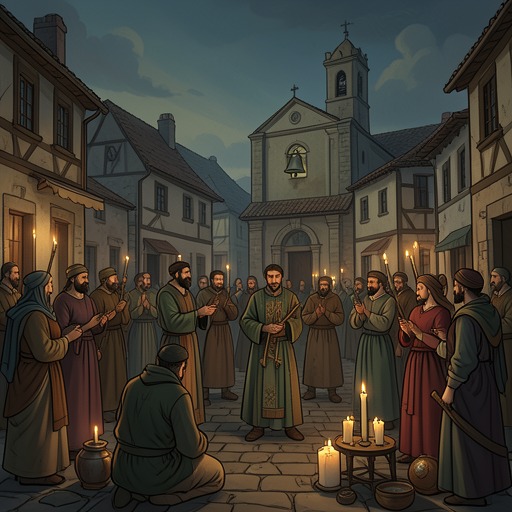
Wigilia (Polish Christmas Eve traditions)
The PeasantsWigilia (Polish Christmas Eve traditions) transforms a severe winter night into a shared sacred occasion, binding Catholic belief to household work, food, family, and care for animals. In Lipce, the vigil is not only a supper: its preparations reorder the home, the first star marks the hour of Christ’s birth, and the breaking of the wafer extends fellowship across the table and into the byre. The customs make religious time visible in ordinary acts, while revealing the labor and social relations that sustain village life.
Preparation and the household
The observance begins long before the meal. On Christmas Eve, Lipce is active from daybreak, despite a frost that has returned after several days of damp mist. The sun shines on rime-covered trees and snowy fields, but brings little warmth; the mill stops for the holiday, and the surrounding countryside appears cold, quiet, and nearly lifeless. Against that stillness, village households clean and air their rooms, scatter fresh pine needles through chambers and hallways, and sometimes whitewash their stoves. They bake bread and special sweet rolls, prepare herring, and grind poppy seeds for dumplings. The bustle gives the feast a material foundation: sacred celebration depends on the work of preparing rooms and food.
Preparation extends across households of different means. On the vigil evening, rich households, hired hands, and the poorest families alike set out a sheaf of corn in the eastern corner of the room, cover benches or tables with bleached linen, and spread hay beneath the cloth. They wait for the first star. This shared arrangement makes a common ritual out of domestic spaces that remain economically unequal. The Christmas observance brings the village into a recognizable pattern without erasing the differences between those who own farms and those who work for them.
The first star and the supper
The first star is the vigil’s decisive threshold. Józka and Witek stand on the porch in the cold to watch for it; when Witek sees it in the eastern sky, the household gathers to look. Rocho kneels in the snow, and the others kneel after him. They identify the light with the star of Bethlehem and receive it as a visible sign of divine mercy. The narrated star seems to grow and advance, its light scattering across the snow as darkness gives way to a crowded, brilliant sky. The scene makes the transition from waiting to celebration an act of shared belief: the family does not simply notice a star but answers it together through prayer and gesture.
Rocho announces that supper can begin because the Word has become flesh. Inside, Boryna sits first at the long bench; Dominikowa and her sons join him, with Rocho, Pietrek, Witek, and Józka arranged around the table. Jagna sits only briefly because she must serve. This seating and division of work preserve the household’s order even within the common feast. Boryna crosses himself and divides the wafer among everyone, who eat it reverently, as if receiving the Eucharist. Rocho blesses the food as holy bread, and the family eats slowly and with dignity, although they have had only dry bread during the day.
The supper follows the vigil’s food customs. It begins with sour beetroot soup cooked with mushrooms and whole potatoes, then herring fried in hemp oil, poppy-seed dumplings, and cabbage with mushrooms. Jagna serves buckwheat pancakes mixed with honey and fried in poppy-seed oil. Bread accompanies the meal. Cake and strudel are absent because they contain milk and butter, ingredients considered unsuitable for the day. The rules shape not just what is eaten but how the meal marks the occasion: abundance and care are expressed within the discipline of a particular fast-day table.
Blessing the animals
The household’s sacred fellowship continues beyond the table. On Christmas night, Boryna’s family observes the belief that cattle can understand human speech and speak in human voices, because the Lord was born among them. Witek carries a lantern to the byre, where the cows rise at the light and the sound of voices. Dominikowa instructs Jagna, as the woman of the house, to distribute the wafer, saying that the cattle will thrive and avoid illness; she also warns that they must not be milked until evening the next day or they will lose their milk.
Jagna breaks the wafer into five pieces, makes the sign of the cross between each cow’s horns, and places a piece in each animal’s mouth. When Józka asks whether the horses will receive some too, she is told they were not present at the Nativity. The exchange sets a limit within the custom even as the ritual expands beyond the human household. The cows are treated as participants in Christmas fellowship, while the specific rule about milking carries the blessing into the practical management of the farm.
Religious time and village life
Wigilia joins the Nativity story to repeated actions in the present: waiting for the star, kneeling, sharing the wafer, keeping the food rules, and blessing the cattle. These actions make the holy occasion tangible within a winter household. The ritual’s reach is also social. Families across the village prepare in parallel, and the shared meal at Boryna’s brings relatives and other guests together; yet Jagna’s serving work and Boryna’s place at the head of the table show that communal celebration retains the household’s internal roles.
The wider narrative depicts other village rites and gatherings, including a wedding farewell in which a mother blesses her daughter, prayers and reunion at a cross, and a church procession under a baldachin. Those occasions are distinct from Wigilia, but they likewise show how ceremony gathers people into visible patterns of belonging. The Christmas vigil gives that pattern a particular form: a home is cleaned and prepared, the family waits for a sign in the sky, and a shared blessing passes from person to person and, finally, to the animals on which farm life depends.