Witek
The PeasantsWitek, a foundling raised in Maciej Boryna’s household, is both a working cowherd and one of the novel’s most attentive observers of village life. He tends livestock, rescues strays, and forms close attachments to animals and to Kuba; yet he has no known parents or land of his own. His small acts of care and his aspiration to become a farmhand with horses expose the boundary between the farmers who possess land and the landless dependents who labor for them.
Identity and Place in the Household
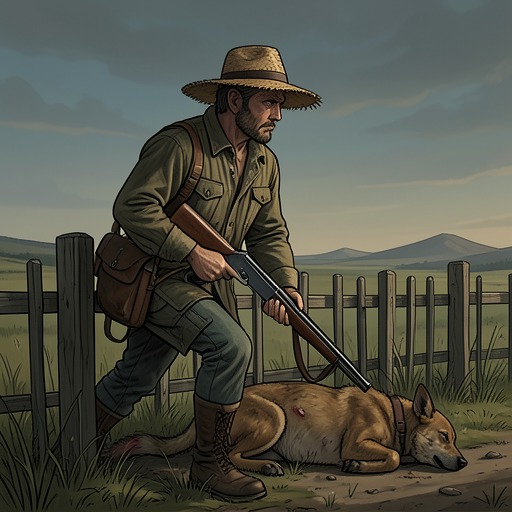
Witek’s place in the household is defined by work rather than kinship. He is called a foundling, and the narrative shows him doing the practical jobs on which a farm depends: watching cattle, helping with fieldwork, carrying potatoes, and responding to the needs of animals. He moves among the household’s people, but his status remains precarious. When Maciej Boryna lashes him after a cow is injured, Witek explains that the woodsman chased him and that he brought the cow home after it began groaning and trying to lie down. The episode reveals how little protection a boy in his position has when the farm’s property is at stake.
That vulnerability is part of a broader rural division. The novel distinguishes farmers, who have land, from hired hands and tenants who lodge with others or go out to earn their living. Witek’s experience gives that distinction a personal shape: he contributes labor to the farm but does not possess the property that would make him a farmer in his own right. His aspiration is not grand or abstract. He imagines becoming big enough to work as a farmhand, going to Warsaw, and finding a place with horses; he also associates town life with the simple dignity of owning boots.
Work, Skill, and Animal Companions
The rhythm of Witek’s working life is visible in the ordinary bustle of the farm. While Antek and Kuba cart potatoes, Hanka and Józka of the Boryna Household manage geese, pigs, and cows. Witek brings the rest of the herd in from pasture and puts hay behind the cattle’s racks so that they will stand quietly for milking. These are not incidental chores: his attentiveness helps keep the household’s daily labor moving, even though he has little authority within it.
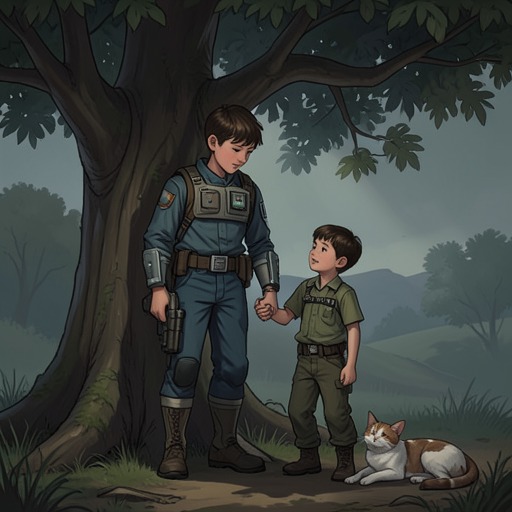
Witek’s care extends beyond useful livestock. He gathers stray dogs from around the village and nurses them back to health, a kindness Józia Borynianka invokes when she defends him. He rescues a sick stork in autumn, shelters and feeds it, and teaches it tricks until it follows him around the farm. The stork, Łapa the dog, and Witek form a small, familiar company, going together to hunt rats in the stable. His bond with animals is practical as well as affectionate: he sets snares for partridges, watches over the farm’s creatures, and notices when a filly is getting into a neighbor’s clover.
That attachment can bring him into conflict with authority. Witek tries to take a bird kept outside the priest’s house, creeping up at night after the household has gone to sleep. The dogs recognize him but still attack, tearing his trouser leg as he runs away. He remains determined to retrieve the bird, and later announces that he has taken his stork back from the priest. When the bird is again in his care, he hides it in a potato pit and sets Łapa to guard it against children. His persistence makes the stork more than a pet: it is a creature whose safety and companionship Witek tries to claim in a world where few things belong to him.
His animal knowledge is accompanied by a curious responsiveness to the natural and supernatural life of the farm. When he hears that cows can talk on Christmas night, he quietly summons Józka of the Boryna Household and slips away with her to the byre. Later, unexplained disturbances around the stables—spilled fodder, whinnying horses, and Łapa’s behavior—lead him to believe that Kuba’s soul comes there. Witek’s attention to animals makes him especially alert to signs that other people might overlook, while his interpretation of them reflects the village’s folk beliefs about the dead.
Kuba, Memory, and Care
Kuba is a formative companion and teacher to Witek. In the fields, while keeping watch over Maciej Boryna’s livestock beneath the hayrick, Kuba teaches the boy his prayers, correcting him when he stumbles. The relationship is affectionate but not sentimental: Kuba scolds and prods him with his crop, while Witek learns through that mixture of instruction, discipline, and shared work. The older man’s death leaves a lasting mark on the boy.
When someone comes looking for Kuba’s grave, Witek is moved and offers to lead the way. He knows how to find it even beneath the snow because Ambrozy has raised a cross there and Rocho has written a small board for it. Witek’s knowledge preserves a modest act of remembrance: the grave is not simply a place in the woods but a marked location he can guide another person to. His later belief that Kuba’s spirit returns to the stables extends that remembrance into everyday life, where the dead remain present through familiar places and signs.
Witek’s care also reaches Maciej Boryna when the patriarch is incapacitated. The sick man can lie for whole days without water and might have died of hunger without Witek, who secretly brings him whatever food he can obtain and sometimes milks extra for him. Witek’s concern is described as a strange, sorrowful tenderness. The boy who has little standing in the household quietly supplies the care its master needs. When Maciej’s body is found, Witek calls for the mistress and leads her to it; afterward he keeps returning to look in on Maciej and on the grieving Józka of the Boryna Household while greasing boots beside the stove. His attentiveness persists through illness and death, not only when it can earn him approval.
Orphanhood and Village Ritual
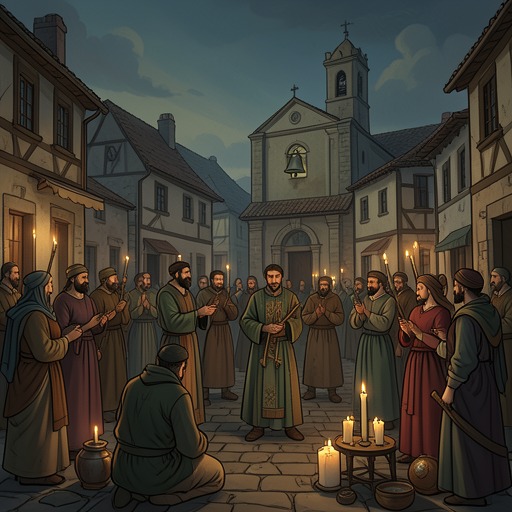
Witek’s lack of family becomes most painful in a public religious setting. At the All Souls’ observance, villagers come forward to name their dead: fathers, grandfathers, great-grandfathers, and whole families. Witek has brought money for an offering, but when his turn comes he cannot name a mother or father. Surrounded by people whose family histories are spoken aloud, he is overcome and initially cannot speak. He then decides to offer names of his own, confidently giving Józef, Marianna, and Antoni—the first names that come to mind. The gesture does not supply him with a real ancestry, but it asserts his right to participate in a communal rite from which his orphanhood seems to exclude him.
He finds another kind of belonging among village boys. On Great Saturday, when there are no farmhands or older lads to lead the customary ceremonial burial of rye soup and herring, the boys assemble under Contrary Jasiek. In a later Easter-season procession, Witek leads a group of younger children to the priest’s garden. They carry sticks and bags; Witek brings Pietrek’s fiddle, while another boy winds up a toy cockerel. Witek signals when to begin, directs the high and low notes with his bow, and keeps watch over the proceedings. He also holds the gifts entrusted to the group. The villagers are surprised that boys barely out of childhood can carry on as farmhands do. For a while, Witek occupies a position of responsibility that the household’s hierarchy rarely grants him.
The contrast between ritual inclusion and social exclusion remains sharp. At the offering table, he must invent the names that other villagers inherit. In the boys’ procession, he can lead through competence, attention, and trust. These scenes show him finding ways to take part in collective life without erasing the poverty and orphanhood that mark his place within it.
Growing Responsibility and Narrative Significance
As the farm’s circumstances change, Witek takes on work that would otherwise fall to absent or overburdened adults. He works a gelding harrowing flax ground in a muddy hollow and helps carry potatoes out to the fields. When Hanka directs the women to join the work, she leaves the potato-carrying to Witek and Józka of the Boryna Household. His tasks remain those of a dependent laborer, but the story repeatedly shows that household survival rests on his reliability.
His role is not limited to farm labor. When Hanka is reluctant to visit Nastusia, she orders Witek to tie a piglet to a string and take it to her. On another occasion, he stays beside a woman left in the cottage, keeps flies away with a branch, and hands her water while she sleeps. He also brings a brood of young partridges. When a hare is held and caressed like an orphaned child, it escapes into the hallway; Łapa gives chase, and Witek follows, setting off a commotion that brings Hanka from the farmyard and makes Józka laugh. Such scenes place his affinity for living creatures alongside the household’s work and distress, without making either a mere ornament to the other.
Witek’s greeting to Antek on his return is another brief sign of enduring attachment: he spots him and runs over to kiss his hand. The gesture contrasts with the divisions and estrangements that shape the adults’ relations. Across the novel, Witek is neither a landholder nor a decision-maker, and the evidence does not give him a settled future. What it does give him is a persistent capacity to care, to learn, to remember, and to take responsibility when others need him. Through a foundling who longs for work with horses yet has no land to inherit, the novel makes the village’s class structure tangible: Witek belongs to the farm through labor and affection, but not through property or family lineage.