the manor
The PeasantsThe manor is a powerful landholding presence whose authority in the story is felt through disputed pasture, forest rights, and access to wages rather than through a detailed portrait of its buildings. Its decisions affect both the villagers’ claims to the land and their ability to survive, making the estate a recurring focus of conflict in Lipce. As the woodcutting dispute escalates, the manor’s control over employment and timber becomes inseparable from the question of who is entitled to use the surrounding resources.
Land, pasture, and competing claims
A dispute over pasture gives the conflict a practical, costly beginning. One account blames the manor’s people for chasing a cow until the animal developed an inflammation and died; others were driven off as well, and Walek’s boy was badly beaten. The speaker insists that the pasture belongs to the manor and that this is clearly recorded in the register, while also complaining that villagers repeatedly drive them away and claim the land as their own. Taking the matter to court or to the commissioner is proposed, with the loss valued at three hundred zlotys. The passage establishes a clash between a documented claim and a competing local assertion, while showing that enforcement itself can bring injury and material loss.
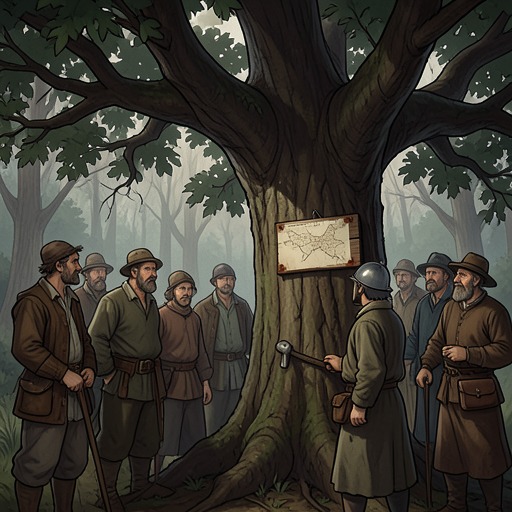
The forest dispute makes the same conflict larger and more difficult to settle. In the woods, Boryna measures the trees against his own claim: he counts four morgen as his and adds the one morgen he associates with Jagna. He believes the manor is claiming too much and that the villagers have said too little, and he resolves that they will not simply accept being wronged. The forest is not an abstract boundary in this scene. Its dense pines, old oaks, birches, and tangled undergrowth are both a living landscape and a potential source of timber, land, and livelihood. Boryna’s attention moves between the ancient trees and the acreage he believes belongs to him, showing how personal attachment and material claims overlap.
Timber, work, and winter need
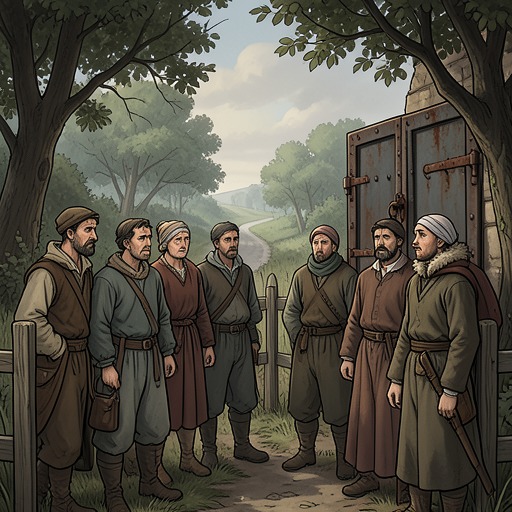
The manor’s decision about whom to hire turns the forest question into an immediate crisis for poor households. Villagers learn that the squire has made agreements and paid advances to workers from Rudki, Modlica, Dębica, and Rzepki, but has hired no one from Lipce. A woodsman at High Mass confirms the report. The poor are dismayed, particularly those who had expected the felling at Wolf’s Hollow to provide work. At least twenty hired hands in Lipce are described as desperate for employment; several families face a winter without local work, and five or so have no winter employment at all.
The stakes are sharpened by the approach of a severe winter. Potatoes have frozen for some households, money is not coming in, and the coming preharvest period is expected to be lean. Some people eat a hot meal only once a day and go to bed hungry. The exclusion is therefore more than a grievance over the distribution of jobs: for the laborers waiting on the felling, employment had seemed like a chance to bridge the season before spring. Their need is also unevenly shared. Lipce has wealthy farmers and people who can manage without the earnings, alongside cottage-owning laborers and families who rely on whatever work they can find. The manor’s hiring decision exposes that division even as it gives the excluded workers a common cause.
The estate also figures in arrangements that benefit a small group of village leaders. Voyt tells Boryna that he, the miller, and the blacksmith have agreed with the manor to transport wood to the sawmill and planks to town. Other villagers, Voyt acknowledges, have complained that the three will not let anyone else earn money. This partnership contrasts with the lack of felling work offered to Lipce laborers: the manor is not simply outside village economic life but enters it through selective agreements that concentrate opportunity among a few.
From complaint to collective resistance
The manor’s refusal to employ Lipce workers is tied to the wider struggle over the forest. Boryna is angered that a council was held without him, and he suspects the miller, Voyt, the blacksmith, and the squire of acting against the villagers. When the poor appeal for work, he refuses to beg the squire to change his mind. He says he signed the complaint against the manor and will stand by it, insisting that not a single fir should be cut until the squire reaches an agreement with the villagers and gives them what they consider theirs. His position joins resistance to logging with opposition to the manor’s exclusion of local workers, though the immediate cost of that resistance falls heavily on people who need wages.
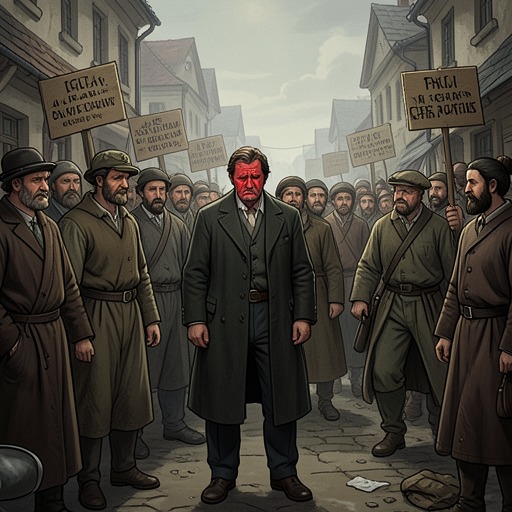
At the gathering before the confrontation, Antek addresses farmers and hired hands together. He lists the manor’s felling of the forest, its refusal to employ the villagers, and the injuries and complaints that, in his view, have gone unanswered by courts and officials. The crowd responds with demands to drive off the cutters and stop the work. The speech turns separate grievances into a shared accusation: villagers have sought formal remedies, but believe those remedies have failed to protect them. The estate’s power is thus challenged not only as a landholder’s claim, but as a force that can disregard both local protest and the community’s expectation of access to work.
When the crowd reaches the clearing, Boryna arrives at its head by sleigh, followed by women, men, and young people on horseback, in carts, and on foot. Some carry sticks, pitchforks, flails, scythes, or branches; the women rush forward with cries and fingernails. Together they shout for the woodcutters to stop and leave the forest, claiming it as theirs. Boryna calls on the workers from Modlica and Rzepki, among others, to listen. The scene makes the confrontation tangible: the manor’s timber operation has brought outside workers into a forest the villagers regard as their own, and a dispute over access has become a collective physical challenge to the felling.
The manor as a structure of power
Across these episodes, the manor’s authority operates through several linked means: a recorded claim to pasture, control of timber operations, the power to choose workers, and agreements with selected village figures. These forms of control meet different kinds of resistance. Villagers consider courts and the commissioner, lodge a complaint, organize councils, and finally move together against the woodcutters. Their response ranges from formal petition to direct obstruction, reflecting their belief that established channels have not secured either their rights or their livelihood.
The estate’s significance lies in the way it turns a place and its resources into a question of social survival. For Boryna, the forest’s trees are counted in morgen and tied to claims he refuses to surrender; for poor laborers, the planned felling represents urgently needed winter wages; for the manor, timber and employment are managed through its own agreements. The resulting conflict does not make the villagers’ interests identical, as the contrast between excluded workers and Voyt’s transport partnership shows. It does, however, reveal how the manor’s decisions can connect land, work, poverty, and collective action in Lipce.