Changeling
The People Upstairs“Changeling” names the terrifying possibility that a child has been exchanged for something other than what a family or community expects. In the story, the word becomes especially charged because Terence Greene is not literally a folkloric substitute but an alien child born to disguised Milotans on Earth. Mrs. Danko’s suspected accusation therefore misses the scientific truth while touching its emotional shape: Terence is a child who belongs to his parents yet appears radically foreign to the society around him.
The Word and Its First Suspicion
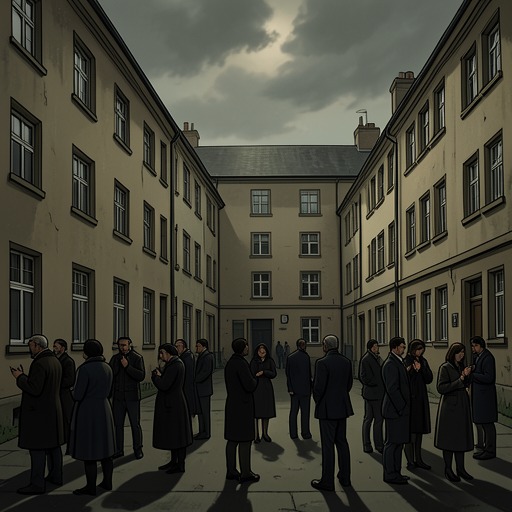
May Greene first connects the expression with the neighbors’ private talk about her family. She knows that the residents speak behind everyone’s back, but she senses that the Greenes are discussed differently. She wonders whether Mrs. Danko muttered “Changeling” after the births of other babies and whether only May, whose hearing is slightly keener than a human’s, caught it in connection with Terence.
The possibility unsettles May in her role as a mother even though it does not seriously threaten her work as a secret agent. Mrs. Danko is regarded throughout the building as not quite sane, so her suspicions can be dismissed as the ravings of an old woman. That dismissal protects the Greenes’ cover, but it does not erase the word’s intimate force. “Changeling” expresses the neighbors’ sense that something is wrong with the child and converts an unrecognized biological difference into a tale of substitution.
A Folkloric Explanation for Alien Difference
The term arises in a setting where the Greenes’ difference is perceptible but difficult to identify. Dan Greene has dull light-green skin and restrained red pupils, while his family relies on a plastomask, contact lenses, and other bodily adaptations to pass as human. Their apartment is conventionally furnished, yet it carries an indefinable suggestion of alienness. The family’s strangeness is therefore present before anyone can explain it, and “Changeling” supplies a culturally available explanation for an unease that has no ordinary vocabulary.
The word also echoes the story’s opening suggestion that extra-terrestrials may live among human beings. The narrative presents the alien presence from the alien’s position, emphasizing the Greenes’ necessity of adjusting to a strange and distasteful culture. Mrs. Danko’s superstition reverses that perspective: instead of recognizing that the outsiders are genuinely nonhuman, she interprets their difference through an old human myth. The result is both comic and revealing. A fanciful explanation comes closer to the truth than the rational explanations later offered by the school, yet it remains safely contained within human assumptions.
Motherhood, Guilt, and the Child Who Does Not Fit
May’s response to the label is complicated by her conflicted experience of motherhood. She and Dan had not expected a child; May’s pregnancy was regarded as impossible, and the couple initially faced the prospect of returning to Milotis in disgrace. Their adaptations had been intended as lifetime changes, making them difficult to reverse, while the Bureau would blame them for failing to take proper precautions. May refused Dr. Robinson’s offer to end the pregnancy because she had always wanted a child.
After Terence’s birth, however, the practical and emotional burdens of caring for him erode the idealized pleasure May had anticipated. Milotan babies have the same undignified physical needs as terrestrial babies, but the robots that would have cared for an infant on Milotis are unavailable in the technologically inferior Earth environment. May remains at home while Dan continues working, and the loss of her income deepens the family’s financial strain. Their allowances and Earth salaries barely cover the expense of living on an alien planet; imported tobacco, familiar food, luxuries, and eventually necessities must be abandoned.
May consequently spoils Terence out of guilt. She sometimes feels no pleasure in him and wonders whether he was worth the sacrifices she and Dan made or whether refusing Dr. Robinson had been sentimental and foolish. Remorse then overwhelms that doubt, and she gives Terence things that are not good for him simply because he wants them. The emotional logic behind “Changeling” is thus not only communal suspicion. It also touches May’s private fear that the child she fought to preserve has not become the child she imagined, and that her own failure to feel uncomplicated maternal joy makes her somehow an inadequate mother.
From Suspected Superstition to Public Misdiagnosis
Terence’s development intensifies the community’s uncertainty. He does not walk until he is two or speak until he is three, leading the neighbors to assume that he is backward. May resents this judgment but is gradually conditioned by ten years in human culture and begins, in a limited way, to think of him as retarded herself. The label “Changeling” belongs to the same interpretive world: it identifies an abnormal child without understanding the actual cause.
When Terence enters human school, his difference is still concealed behind the alterations Dr. Robinson made to his body. His parents tell him only that they come from a far-off place, withholding the truth because he is too young to be trusted with their secret. They must teach him that he is different and instruct him to conceal the masks and contact lenses, but they do not yet tell him why. The child is therefore surrounded by explanations that are all partial: backwardness, foreignness, mutation, and superstition.
The school principal later supplies another version of the same mechanism. After Terence’s body is exposed during swimming, she assumes that he is a “freak” produced by radiation from bombs and believes that the authorities have concealed the danger. Her explanation is modern rather than folkloric, but it performs the same work as “Changeling.” Faced with an unassimilable body, the community reaches for a familiar story—witchcraft, mutation, enemy nationality, or radiation—instead of confronting a reality beyond its conceptual habits.
The Word’s Retrospective Truth
“Changeling” is never confirmed as a literal description, and the evidence does not establish that Mrs. Danko deliberately directed it at Terence. Its power lies precisely in that uncertainty. The old woman may have been making a directed accusation, or she may simply have been suspicious of the entire human race as she mistakenly understood it. Yet the word remains an accidental approximation of Terence’s condition: he is born to Milotan parents, altered to survive in human society, and treated by his neighbors as a child who does not properly belong.
The term also anticipates Terence’s eventual movement toward knowledge. After the school incident, he clings tightly to May’s hand on the way to the car, and she feels closer to him than she has since his infancy. Then he asks, in halting Milotan, to hear about Milotis and whether such a place truly exists, where everyone is like them. The suspected changeling is no longer merely an object of adult concealment or neighborhood speculation. He begins to speak from the hidden identity that the word has unknowingly circled all along.
As an expression, “Changeling” therefore compresses the story’s larger irony. Human society calls Terence an exchanged or unnatural child because it cannot imagine alien life among itself, while the actual danger comes less from the child’s body than from the rigid explanations imposed upon it. The word reveals how communities turn difference into myth—and how myth, by accident, can preserve a fragment of truth that official rationality refuses to see.