Compulsory School Attendance Law
The People UpstairsThe Compulsory School Attendance Law is the legal pressure that turns Terence Greene’s upbringing from a private family arrangement into a public institutional risk. Although the Greenes can keep him at home while he is young, the law eventually requires him to attend school, exposing the limits of masks, lenses, selective disclosure, and parental control. Its significance lies in how an ordinary civic obligation becomes the mechanism through which an Earth-born Milotan is drawn into human society and brought dangerously close to discovery.
Legal Pressure on the Greenes
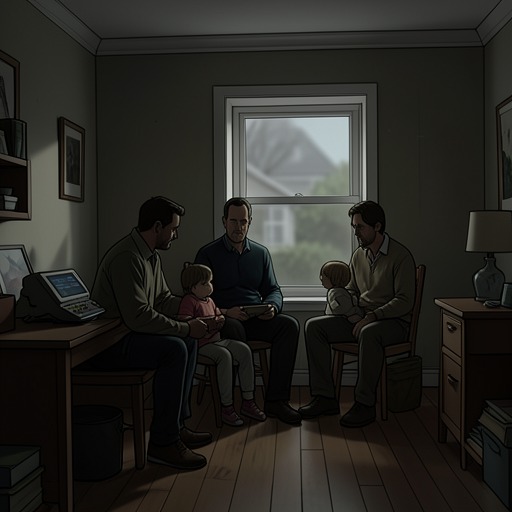
Dan Greene invokes the law when May Greene proposes keeping Terence at home after his birth. A child could remain concealed for a while, he explains, but by about six years of age Terence would have to attend school because the law required it. School attendance would also bring medical examinations and related procedures. Even if Dr. Robinson produced disguises good enough to pass a superficial examination, the family would live under constant fear that a more searching inspection would reveal the deception.
The law therefore limits the Greenes’ possible strategies before Terence is old enough to understand them. A tutor might appear to avoid the school requirement, but Dan rejects the idea because a private tutor would be conspicuous in Washington Heights and might require them to reveal their secret to another person. Their work depends on appearing to be inconspicuous, average, middle-class individuals; compulsory schooling is one of the institutions that makes such concealment difficult to sustain.
Terence’s Required Entry into School
When Terence Greene reaches six, the Greenes can no longer postpone enrollment. On Milotis he would be developmentally comparable to a terrestrial four-year-old, but Milotan children learn quickly enough for Dan and May to expect him to perform adequately. They choose a private day school, seeking the best limited educational advantages available on Earth while avoiding the greater exposure of a boarding school.
May attempts to manage the legal and institutional consequences by telling the principal that the Greenes are Christian Scientists and therefore do not want Terence subjected to medical examinations. The school’s high fees make the principal accommodating. This arrangement does not abolish the law’s pressure; it merely converts a general requirement into a negotiated form of access, dependent on the school accepting the family’s explanation and respecting its claimed religious exemption.
Terence’s entry into school also tests the family’s effort to control his identity. At home, May Greene and Dan Greene speak both Milotan and English with him, warn him not to use Milotan in public, and keep him away from other children as much as possible. Yet the attendance requirement places him among human children for sustained periods, where ordinary differences in speech, development, knowledge, and bodily appearance cannot be managed entirely by the household.
Institutional Exposure and Failure of Concealment
The first school day passes without an immediate crisis, but the legal requirement has already created the conditions for one. Terence’s developmental history has made him appear backward to the neighbors: he does not walk until two and does not speak until three. The social judgment of retardation burdens May, even though Terence’s slower development is normal for a Milotan child. School consequently receives not a neutral pupil but a child whose body and growth have already been interpreted through terrestrial expectations.
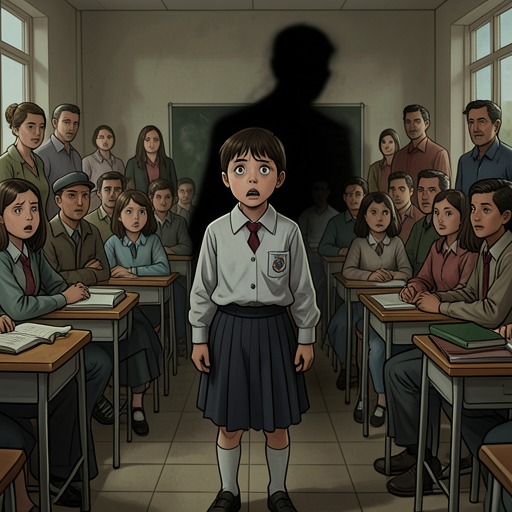
The decisive danger comes when the school introduces swimming lessons. Because attendance has placed Terence in a curriculum involving bodily exposure, the disguises that protect him in ordinary clothing can no longer preserve the secret. His mother is horrified when he returns shaken, and Terence tells her that he is different as an accusation. The school’s apparently genteel environment has proved unable to shield him from the physical scrutiny built into ordinary education.
The principal’s reaction shows the gap between formal inclusion and practical belonging. After the incident, she tells May that Terence cannot remain at the school. May responds by claiming that the family is considering a move to the suburbs and will transfer him somewhere where nobody knows him. The principal urges her to tell the authorities what is wrong with him in advance, presenting them as friends who want to help. For the Greenes, however, that proposed assistance would be another route to exposure. The law has required Terence to enter the institution; the institution now threatens to pass his difference to the authorities.
Citizenship, Schooling, and Identity
Terence’s legal position is paradoxical. He is born on Earth, in the United States of America, and possesses a genuine birth certificate, making him formally a citizen rather than a person dependent on forged papers. Yet the Compulsory School Attendance Law gives that nominal civic belonging a coercive consequence: citizenship and residence bring him under terrestrial educational requirements, while his body remains dependent on Milotan masks, hand coverings, and contact lenses.
The law also helps produce the identity crisis that the Greenes fear. Dan wants Terence told the truth early enough to prevent him from identifying with human society, whereas May postpones the full explanation, believing that he will discover soon enough that he is an alien. Their compromise is to tell him only that his parents come from a far-off place. At school, Terence tries to interpret that fragment through the knowledge supplied by his teacher, Miss Chase, first guessing Russia and then China. His confusion shows how compulsory social education gives him human categories before his parents can give him a secure Milotan one.
After the swimming-lesson exposure, Terence finally asks in halting Milotan whether Milotis really exists and whether there is a place where everyone is like him. The required movement into school has therefore produced the very disclosure the family tried to defer. It has not simply educated him; it has forced a confrontation between his official Earth identity, his concealed Milotan body, and the human social world that has been teaching him how to understand difference.