Dr. Robinson
The People UpstairsDr. Robinson is the New Jersey physician who becomes the Greenes’ essential medical ally after May Greene’s unexpected pregnancy exposes the danger of their long-term mission on Earth. He does not belong to the Milotan operation, yet his professional skill and discretion allow the family to preserve its disguise, keep Terence Greene on Earth, and postpone the moment when the child’s body will collide with human institutions. His role is therefore small in personal appearance but decisive in the plot: he turns an impossible biological accident into a precarious domestic arrangement.
Identity and Introduction
Dr. Robinson first enters the story through May Greene’s visit to New York. She has removed her silk-thin plastomask and Milotan contact lenses before telling Dan Greene that she has seen him, so the consultation takes place within the couple’s most guarded secret: the Greenes are humanoid Milotans living under Earth identities. Dan initially interprets May’s condition as an illness and fears that an Earth virus has overcome their presumed immunity. The physician’s diagnosis overturns that assumption. May is not sick in the ordinary sense; she is pregnant.
The pregnancy is medically significant because the Bureau had sent the Greenes to Earth on the expectation that May was sterile or past childbearing. Their assignment was intended to last for life, and the adaptations made to their bodies had included amputations that left them poorly suited both to Earth and to a return to Milotis. Dr. Robinson is consequently not merely a doctor consulted about a private condition. He is the first Earth professional forced to confront the biological fact that the Greenes’ covert existence has produced a child.
Medical Discretion and the Pregnancy
Dr. Robinson responds to May’s situation with unusual discretion. He tells her that he could help her get rid of the pregnancy and would do so without reporting the matter back to Milotis. His offer is presented as considerate rather than coercive, and May recognizes that he is being kind. Yet his medical solution conflicts with the central desire she has carried throughout her life: she has always wanted a child. Because she had believed herself barren, she had accepted the Earth posting; the unexpected pregnancy makes that previous compromise unbearable.
His discretion gives the Greenes a choice that the Milotan Bureau would almost certainly deny them. If he reported the pregnancy, the couple could expect blame for failing to take proper precautions and disgrace for violating the assumptions under which they had been posted. If he concealed it, the child might remain outside the Bureau’s immediate knowledge. Dr. Robinson thus becomes a confidential intermediary between the Greenes’ private wishes and the bureaucratic system governing Milotan agents. His silence is not a grand political rebellion, but it changes the family’s available future.
Dan Greene understands the practical dangers more quickly than May can accept them. The child would need disguises, medical protection, and eventually an explanation for compulsory schooling and examinations. Dr. Robinson is the person they imagine could make the technical part of that plan possible. May hopes he might produce small masks in progressively larger sizes as the child grows. She and Dan know that this would be expensive, but they initially treat cost as a problem that could be met by surrendering luxuries. Robinson’s earlier willingness to keep the pregnancy unreported makes him the natural custodian of the secret, even though the broader social consequences remain beyond his control.
Terence Greene’s Birth and the Laboratory Work
Eight months later, the pregnancy ends in Terence Greene’s birth on Earth. Because he is born in the United States of America, he possesses a genuine birth certificate and is technically a citizen of that country. He is the first Milotan on Earth not to require forged papers, and, in the strict legal sense established by the narrative, he is not even technically a Milotan. This paradox depends on the medical and domestic arrangements Dr. Robinson helps create: Terence’s body is alien, but his legal existence begins as an entirely valid Earth birth.
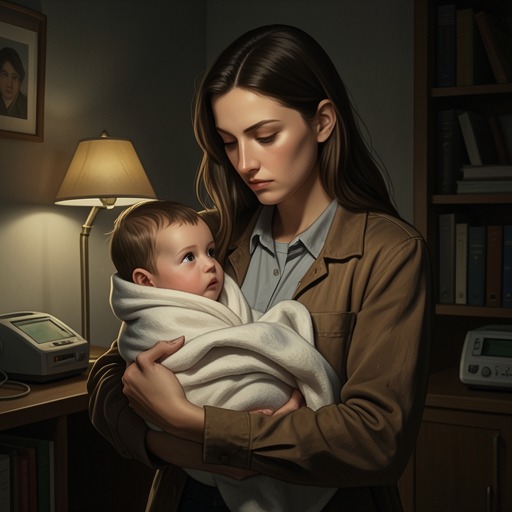
Robinson fits the baby with small masks and lenses in a laboratory described as remarkably complete for a New Jersey general practitioner. The equipment gives him the reputation of a thwarted Pasteur, suggesting both scientific ambition and the mismatch between his capabilities and the ordinary setting in which he works. His laboratory becomes an improvised site of biological adaptation. Rather than curing Terence, Robinson must make the child appear human by technological means, translating an alien body into a form that can pass through Earth life.
The disguises are not a one-time intervention. Milotan babies grow more slowly than terrestrial children because Milotans have a life span roughly one-third longer than that of terrestrials, and their maturity comes correspondingly later. That slower growth buys the Greenes some time, but it does not remove the practical burden. New masks and lenses are needed as Terence develops, and even the first set is costly. Robinson’s work therefore creates both protection and dependency: every successful disguise keeps the family safe, while every replacement increases the financial pressure produced by their covert life.
Limits of Medical Protection
Dr. Robinson can address the visible body, but he cannot solve the social systems that threaten to expose it. Dan Greene recognizes that masks might work while Terence is very young and can remain at home, but at about six the child would have to attend school because the law requires it. Medical examinations would create another danger. Even a very good disguise might pass a superficial examination, yet the family would remain permanently anxious about closer scrutiny. A tutor would not provide a durable answer either, because an inconspicuous middle-class family in Washington Heights could not easily employ one without attracting attention or admitting another person into the secret.
The Greenes therefore depend on Robinson while knowing that his expertise cannot make their situation secure. His devices can conceal Terence’s face and eyes, but they cannot make school attendance optional, erase the difference between Milotan and terrestrial biology, or guarantee that an institution will respect the family’s chosen explanation. The couple eventually enroll Terence in a private day school by claiming that they are Christian Scientists and that he must not undergo medical examinations. That strategy extends the logic of Robinson’s work from the laboratory into public life: the child’s body is protected not only by masks and lenses, but also by a carefully maintained social narrative.
The arrangement also has an economic cost. May stays home to care for Terence, while Dan continues working, because Milotan infants require the same exhausting daily care as terrestrial babies and the Greenes must conform to Earth customs rather than rely on the robots that would have cared for a child on Milotis. Losing May’s income is a serious blow in an alien environment where living expenses are high. Robinson’s disguises consume resources at the same time that parenthood removes one salary, forcing the family to abandon imported tobacco, familiar table delicacies, luxuries generally, and eventually even necessities.
Narrative Function and Significance
Robinson represents a form of Earth competence that is neither wholly hostile nor fully capable of rescue. He is kind about May’s pregnancy, willing to conceal it, and technically skilled enough to construct the masks and lenses on which Terence’s childhood depends. Yet the story refuses to make medicine a complete answer. Robinson can modify appearance and manage immediate biological risk; he cannot alter the law, school customs, neighborhood suspicion, or the emotional consequences of raising a child whose body must be concealed from everyone around him.
His work also sharpens the contrast between legal identity and embodied identity. Terence has an authentic Earth birth certificate, but his ability to inhabit that citizenship depends on an artificial exterior produced in Robinson’s laboratory. The child is legally native to Earth while physically dependent on an alien disguise. Robinson’s medical technology makes that contradiction livable for a time, but it also makes the contradiction material: Terence’s apparent humanity must be repeatedly manufactured, resized, paid for, and guarded.
The limits of this protection become unmistakable when Terence reaches the age of swimming lessons. The school’s ordinary curriculum creates a crisis that masks and contact lenses cannot prevent, because swimming requires the child’s body to be seen. Terence tells May that he is different as an accusation, and the school ultimately expels him after the resulting scene. May performs distress before the principal and proposes moving from Washington Heights to the suburbs, while the principal urges her to tell the authorities what is wrong with him. Dr. Robinson is not present in this confrontation, but its structure confirms the boundary of his role: his inventions can prepare a child for public life, not guarantee acceptance once the disguise fails.
After the school crisis, Terence clings to May Greene’s hand on the way to the car and asks her, in halting Milotan, to tell him about Milotis, the place where everyone is like them. The question marks the point at which Robinson’s practical concealment gives way to a larger identity problem. The doctor has helped the Greenes preserve Terence’s safety, but he cannot decide whether the boy should understand himself as an Earth citizen, a Milotan, or both. That unresolved inheritance is the lasting consequence of Robinson’s intervention: he makes the family’s chosen life possible, while the very success of that life postpones rather than eliminates the truth it must eventually confront.