Evil eye
The People UpstairsThe Evil eye functions in the story as both superstition and social diagnosis. It is first attached to the barely perceptible difference of the Greenes, then invoked around Terence’s unusual body, and finally placed beside explanations involving radiation, Russia, and mutation. Its recurring presence shows how the people around the family respond to what they cannot understand: they do not recognize the alien truth, but they repeatedly reach for inherited forms of menace and blame.
Superstition and Perceived Difference
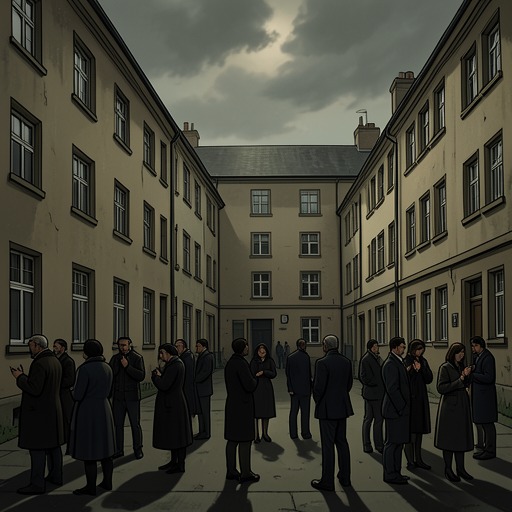
Old Mrs. Danko senses that the Greenes are subtly different and mutters about the Evil eye. Her suspicion is not based on a demonstrable fact; it is an instinctive response to an uncategorized difference. The phrase therefore establishes a gap between appearance and interpretation. The Greenes are living among ordinary tenants, yet a small disturbance in the social surface is enough to make them seem touched by an old, irrational danger.
The expression also belongs to a wider pattern of explanation. The story presents the possibility of extraterrestrials living among human beings, but the human observers never move directly toward that possibility. Instead, they interpret strangeness through superstition, rumor, and familiar public anxieties. The Evil eye is the most intimate and archaic version of that process: a name placed over uncertainty before uncertainty can become knowledge.
The Gesture Around Terence
The Evil eye becomes more pointed when Terence is treated as unlike other children. He develops slowly, and the neighbors regard him as backward. May also hears the possibility that Mrs. Danko has muttered “Changeling” after the babies in the building, while only her unusually keen ears have caught it. When Mrs. Danko later snarls, “Too good for public school!” and “Commissars!”, she makes a sign to ward off the Evil eye.
This moment joins several incompatible explanations without resolving any of them. Terence’s difference is treated as evidence of privilege, foreign politics, supernatural substitution, or contamination. Mrs. Danko’s gesture gives physical form to that confusion. It is a defensive act aimed at a threat she cannot define, and it turns Terence’s body into the supposed source of danger. The irony is that her superstition is closer to the truth than the public explanations, but still misses the truth completely: Terence is not bewitched or exchanged for another child, but he is not human.
From Folk Belief to Cold War Suspicion
The expression stands in contrast with the more modern explanations that surround Terence’s exposure. When the school principal sees his body, she assumes that the family has concealed a condition connected with bomb radiation. She reasons that the reports of fallout from the bombs must be true and imagines that authorities have concealed the danger in order to continue the arms race. The Evil eye and radiation thus occupy opposite ends of the explanatory spectrum, yet they perform a similar social function.
Both explanations make the unfamiliar manageable by assigning it to an existing story. Mrs. Danko turns difference into an old curse; the principal turns it into a consequence of contemporary political catastrophe. Neither woman considers a reality beyond the available categories. The Greenes’ alien identity remains protected not by the perfect success of their disguise, but by the human tendency to prefer a recognizable falsehood—witchcraft, Russian influence, mutation, or fallout—to a fact outside ordinary awareness.
Irony and Narrative Significance
The Evil eye is therefore a compact emblem of the story’s central irony. The Greenes fear that discovery will reveal their status as Milotans, yet the surrounding humans repeatedly reinterpret visible anomalies through their own cultural habits. Even Mrs. Danko’s suspicion, which appears irrational to the household, becomes harmless because the other tenants regard her as not quite right in the head. Her warning is neutralized socially before it can become an investigation.
At the same time, the expression reveals the emotional cost of such interpretation. May can smile at the thought that the actual truth would be more terrible to the neighbors than their superstition, but she remains troubled as a mother. The Evil eye is not merely a joke about credulous people. It represents the gaze that makes Terence an object of fear, and it anticipates the later explanations that similarly transform his bodily difference into evidence of danger. The story’s alien premise consequently reverses the usual direction of supernatural fear: the supposedly monstrous family is adapting to human society, while human society protects itself from knowledge by inventing monsters it already knows how to name.